
10 KiB
Name
双均线突破策略Double-Moving-Average-Crossover-Strategy
Author
ChaoZhang
Strategy Description
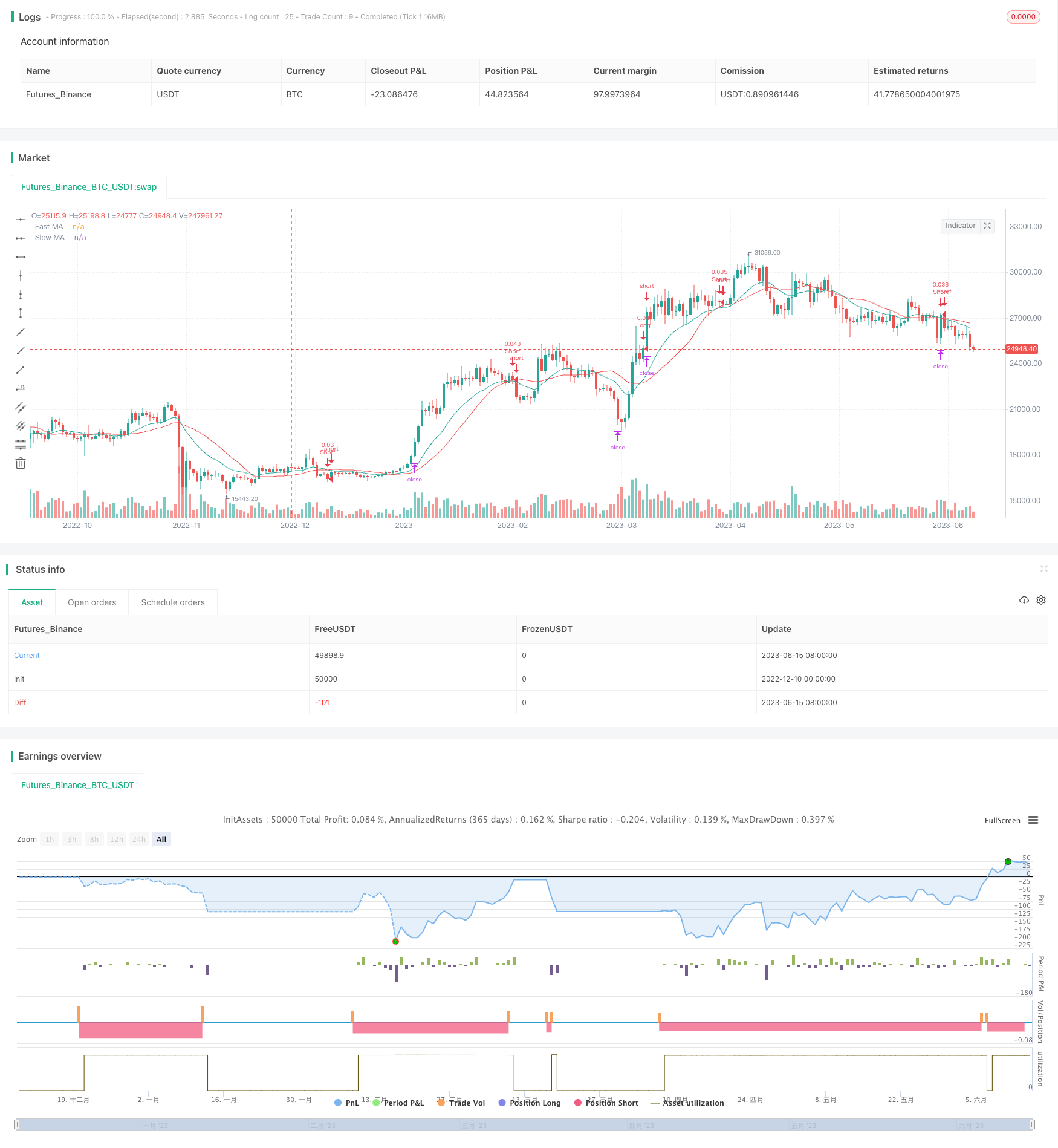 [trans]
概述
双均线突破策略是一种基于两条不同周期的移动平均线交叉作为买卖信号的趋势跟踪策略。该策略采用快速平均线和慢速平均线交叉点作为交易入场点,交叉后判断趋势方向并建立相应多头或空头头寸。它既可以抓住中间级别的趋势,也可以减少不必要的抖动所带来的交易频率过高的问题。
策略原理
该策略使用两条移动平均线:一条快速MA和一条慢速MA。快速MA周期一般设置为较短周期(如15期),用来捕捉短期价格变动;慢速MA周期一般设置为较长周期(如21期),用来判断主要趋势方向。策略的交易信号来自两个MA的交叉:当快速MA上穿慢速MA时为买入信号;当快速MA下穿慢速MA时为卖出信号。
通过设置不同的MA周期组合,可以调整策略捕捉趋势的时间长度。较短的MA组合可以捕捉短期小周期的价格变动机会;较长的MA组合可以过滤震荡,只捕捉较长线级别的趋势。
该策略还包括了风险管理模块:止盈、止损、移动止损。这可以限制单笔交易的最大盈亏,有助于保护整体收益。
策略优势
双均线策略具有如下优势:
- 概念简单,容易理解和实现;
- 可以通过调整MA周期,适应不同的市场环境,捕捉不同时间长度的趋势;
- 较为稳定,避免过于频繁交易;
- 结合止损止盈,可以有效控制风险;
- 易于优化,可以调整MA周期、风险管理参数等,进一步提高效果。
风险分析
双均线策略也存在一定的风险,主要集中在以下几个方面:
- 在震荡盘整阶段,MA交叉信号可能过于频繁,带来交易频率过高的问题;
- 双均线间存在滞后,可能错过价格反转点,无法及时止损;
- 不能有效过滤假突破,可能带来不必要的亏损;
- MA本身对价格反应迟钝,无法完全跟踪价格变动。
这些风险可以通过调整MA参数、加入过滤条件、优化止损逻辑等方式得到改善和优化。
优化方向
双均线策略可以从以下几个方面进行优化:
- 加入成交量或波动指标等过滤器,避免在震荡和假突破中频繁建仓;
- MA周期和组合可以多样化调整,适应不同周期和品种的特征;
- 可以测试不同类型的MA,如EMA、LWMA等,选取对价格反应最灵敏的MA形式;
- 增加机器学习算法,可以自动寻优MA参数、止损幅度等超参数;
- 可以测试不同的止损方式,如跳空止损、追踪止损、平均止损等。
通过这些优化和改进,可以大幅提高策略的胜率、收益率、风险回报率。
总结
双均线突破策略整体而言是一种易于实施和优化的趋势跟踪策略。它拥有操作简单、灵活可调、风险可控等优点,非常适合作为量化交易的入门策略。通过不断测试和优化,这种策略可以持续改进,并具有成为优质量化策略的潜力。
||
Overview
The double moving average crossover strategy is a trend-following strategy that uses the crossover of two moving averages of different periods as trading signals. It enters long or short positions when the fast MA crosses above or below the slow MA and determines trend direction after the crossover. It can capture intermediate-term trends while reducing unnecessary trading frequency from excessive fluctuations.
Strategy Logic
The strategy employs two moving averages: a fast MA with a shorter period (e.g. 15 periods) to capture short-term price moves, and a slow MA with a longer period (e.g. 21 periods) to identify major trend direction. Trading signals are generated from the crossover between the two MAs: the fast MA crossing above the slow MA gives buy signals, while the fast MA crossing below gives sell signals.
By tuning the MA period combinations, the strategy can adjust the timeframe of trends to capture. Shorter MA combos target short-term oscillations while longer MA combos filter out noise and focus on longer-term trends only.
The strategy also incorporates risk management modules including take profit, stop loss and trailing stop loss. These help limit the max profit/loss of individual trades and contain overall risk.
Advantages
The double MA strategy has the following edges:
- Simple logic and easy to understand/implement;
- Flexibility to adapt to market conditions by tuning MA periods;
- Stability from fewer trade signals;
- Effective risk control via stop losses;
- Ease of optimization on MA, risk parameters etc.
Risks
There are also some risks to consider:
- Excessive crossovers and trading frequency during range-bound markets;
- Lagging MAs may miss price reversal points and fail to stop loss in time;
- Vulnerability to false breakouts resulting in unnecessary losses;
- General price tracking inaccuracy due to lag of MAs.
These weaknesses can be alleviated via optimizations like filtering signals, trailing stop loss etc.
Enhancement Opportunities
The strategy can be enhanced in aspects like:
- Adding filters on volume or volatility to avoid whipsaws;
- Testing more MA types and fine-tuning periods/formulas to fit different products and timeframes;
- Examining MA types like EMA, LWMA for fastest price tracking;
- Automating MA tuning and stop loss sizing with machine learning;
- Alternate stop loss techniques e.g. gap, average price, chandelier.
Significant lift in win rate, risk-adjusted returns is expected from these augmentations.
Conclusion
Overall, the dual moving average crossover strategy offers simplicity, flexibility and controllable risks. Its ease of implementation and optimization makes it an ideal initial quant strategy. With recurrent testing and tuning, it has the credentials to evolve into a robust system over time.
[/trans]
Strategy Arguments
| Argument | Default | Description |
|---|---|---|
| v_input_1_ohlc4 | 0 | Fast MA Source: ohlc4 |
| v_input_2 | 15 | Fast MA Period |
| v_input_3_ohlc4 | 0 | Slow MA Source: ohlc4 |
| v_input_4 | 21 | Slow MA Period |
| v_input_5 | false | Invert Trade Direction? |
| v_input_6 | 100 | Take Profit percentage(0.1%) |
| v_input_7 | 100 | Stop Loss |
| v_input_8 | false | Trailing Stop Loss |
| v_input_9 | false | Trailing Stop Loss Offset |
| v_input_10 | true | Use Start Time Limiter? |
| v_input_11 | 2018 | Start From Year |
| v_input_12 | 5 | Start From Month |
| v_input_13 | true | Start From Day |
| v_input_14 | false | Start From Hour |
| v_input_15 | false | Start From Minute |
Source (PineScript)
/*backtest
start: 2022-12-10 00:00:00
end: 2023-06-16 00:00:00
period: 1d
basePeriod: 1h
exchanges: [{"eid":"Futures_Binance","currency":"BTC_USDT"}]
*/

//@version=3
strategy(title = "Silent Trader Strategy", shorttitle = "Silent Trader", overlay = true, pyramiding = 0, default_qty_type = strategy.cash, default_qty_value = 1000, commission_value = 0.0675, initial_capital = 1000, currency = currency.USD, calc_on_order_fills = true, calc_on_every_tick = true)

maFastSource   = input(defval = ohlc4, title = "Fast MA Source")
maFastLength   = input(defval = 15, title = "Fast MA Period", minval = 1)
maSlowSource   = input(defval = ohlc4, title = "Slow MA Source")
maSlowLength   = input(defval = 21, title = "Slow MA Period", minval = 1)

tradeInvert     = input(defval = false, title = "Invert Trade Direction?")
inpTakeProfit   = input(defval = 100, title = "Take Profit percentage(0.1%)", minval = 0)
inpStopLoss     = input(defval = 100, title = "Stop Loss", minval = 0)
inpTrailStop    = input(defval = 0, title = "Trailing Stop Loss", minval = 0)
inpTrailOffset  = input(defval = 0, title = "Trailing Stop Loss Offset", minval = 0)

useTakeProfit   = inpTakeProfit  >= 1 ? inpTakeProfit  : na
useStopLoss     = inpStopLoss    >= 1 ? inpStopLoss    : na
useTrailStop    = inpTrailStop   >= 1 ? inpTrailStop   : na
useTrailOffset  = inpTrailOffset >= 1 ? inpTrailOffset : na

useTimeLimit    = input(defval = true, title = "Use Start Time Limiter?")
startYear       = input(defval = 2018, title = "Start From Year",  minval = 0, step = 1)
startMonth      = input(defval = 05, title = "Start From Month",  minval = 0,step = 1)
startDay        = input(defval = 01, title = "Start From Day",  minval = 0,step = 1)
startHour       = input(defval = 00, title = "Start From Hour",  minval = 0,step = 1)
startMinute     = input(defval = 00, title = "Start From Minute",  minval = 0,step = 1)

startTimeOk() =>
    inputTime = timestamp(syminfo.timezone, startYear, startMonth, startDay, startHour, startMinute)
    timeOk = time > inputTime ? true : false
    r = (useTimeLimit and timeOk) or not useTimeLimit

maFast = ema(maFastSource, maFastLength)
maSlow = sma(maSlowSource, maSlowLength)

fast = plot(maFast, title = "Fast MA", color = #26A69A, linewidth = 1, style = line, transp = 50)
slow = plot(maSlow, title = "Slow MA", color = #EF5350, linewidth = 1, style = line, transp = 50)

aboveBelow = maFast >= maSlow ? true : false
tradeDirection = tradeInvert ? aboveBelow ? false : true : aboveBelow ? true : false

if( startTimeOk() )
    enterLong = not tradeDirection[1] and tradeDirection
    exitLong = tradeDirection[1] and not tradeDirection
    strategy.entry( id = "Long", long = true, when = enterLong )
    //strategy.close( id = "Long", when = exitLong )

    enterShort = tradeDirection[1] and not tradeDirection
    exitShort = not tradeDirection[1] and tradeDirection
    strategy.entry( id = "Short", long = false, when = enterShort )
    //strategy.close( id = "Short", when = exitShort )

    strategy.exit("Exit Long", from_entry = "Long",  profit = close * useTakeProfit / 1000 / syminfo.mintick, loss = close * useStopLoss / 1000 / syminfo.mintick, trail_points = close * useTrailStop / 1000 / syminfo.mintick, trail_offset = close * useTrailOffset / 1000 / syminfo.mintick)
    strategy.exit("Exit Short", from_entry = "Short", profit = close * useTakeProfit / 1000 / syminfo.mintick, loss = close * useStopLoss / 1000 / syminfo.mintick, trail_points = close * useTrailStop / 1000 / syminfo.mintick, trail_offset = close * useTrailOffset / 1000 / syminfo.mintick)
Detail
https://www.fmz.com/strategy/434991
Last Modified
2023-12-11 15:21:58