
7.2 KiB
Name
TRAMA双均线交叉智能量化交易策略-TRAMA-Dual-Moving-Average-Crossover-Intelligent-Quantitative-Trading-Strategy
Author
ChaoZhang
Strategy Description
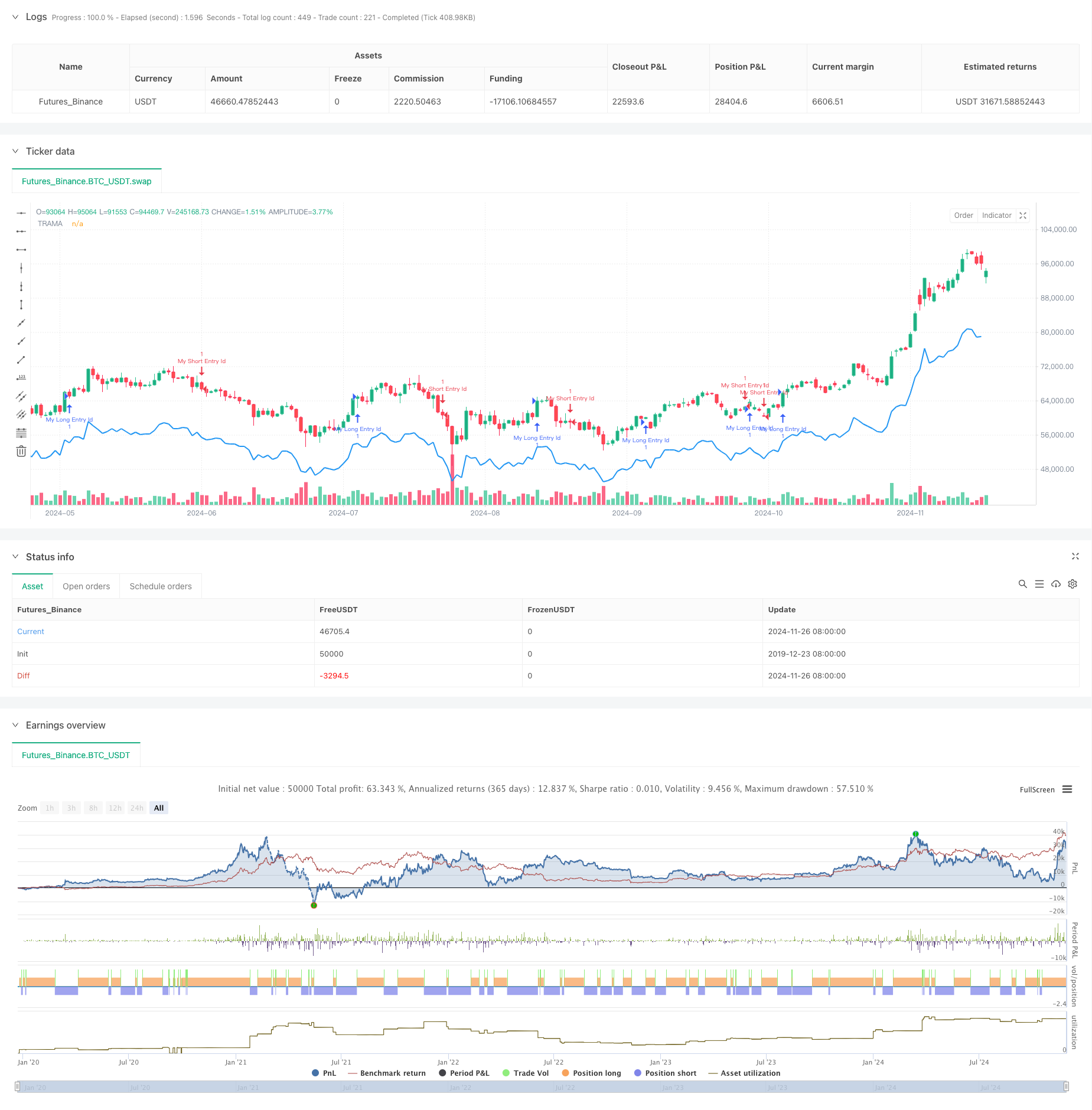
[trans]
概述
这是一个基于TRAMA(Triangular Moving Average)和简单移动平均线(SMA)的智能量化交易策略。策略结合了两种均线系统进行交易信号的生成,并设置了止盈止损机制来控制风险。该策略采用4周期和28周期的SMA交叉以及TRAMA指标来确认交易信号,通过多重信号确认提高交易的准确性。
策略原理
策略使用两个核心组件来生成交易信号。首先是基于4周期和28周期SMA的交叉系统,当短期均线向上穿越长期均线时产生做多信号,向下穿越时产生做空信号。其次,策略引入了TRAMA指标作为辅助确认系统。TRAMA是一种改良的移动平均线,具有更快的响应速度和更低的滞后性。当价格突破TRAMA时,会产生额外的交易信号。策略同时设置了基于百分比的止盈止损机制,分别为2%的止盈和1%的止损。
策略优势
- 双重信号确认机制显著提高了交易的可靠性
- TRAMA指标能够更快速地捕捉市场趋势的变化
- 具有明确的风险控制机制,通过止盈止损来保护资金
- 策略逻辑清晰,易于理解和维护
- 可以同时进行多空双向交易,增加了盈利机会
策略风险
- 在震荡市场中可能产生过多的交易信号
- 固定的止盈止损比例可能不适合所有市场环境
- 短期均线可能对价格噪音较为敏感
- 在剧烈波动的市场中可能面临滑点风险
- 需要考虑交易成本对策略表现的影响
策略优化方向
- 引入波动率自适应的止盈止损机制
- 增加市场环境过滤器,在不同市场条件下调整策略参数
- 优化TRAMA参数的选择方法,可考虑使用自适应周期
- 添加交易量确认指标,提高信号的可靠性
- 考虑增加趋势强度过滤器,避免在弱趋势中交易
总结
这是一个结合了传统技术分析和现代量化交易理念的策略。通过多重信号确认和严格的风险控制,策略展现出较好的实用性。虽然存在一些需要优化的地方,但整体框架设计合理,具有良好的应用前景。建议交易者在实盘使用前,进行充分的历史数据回测和参数优化。 ||
Overview
This is an intelligent quantitative trading strategy based on TRAMA (Triangular Moving Average) and Simple Moving Average (SMA). The strategy combines two moving average systems for generating trading signals and implements a stop-loss/take-profit mechanism for risk control. It uses 4-period and 28-period SMA crossovers along with the TRAMA indicator to confirm trading signals, improving accuracy through multiple signal confirmation.
Strategy Principles
The strategy employs two core components for generating trading signals. First is the crossover system based on 4-period and 28-period SMAs, generating long signals when the short-term MA crosses above the long-term MA, and short signals when it crosses below. Second, the strategy incorporates the TRAMA indicator as an auxiliary confirmation system. TRAMA is an improved moving average with faster response time and less lag. Additional trading signals are generated when price breaks through the TRAMA. The strategy also includes percentage-based take-profit and stop-loss mechanisms set at 2% and 1% respectively.
Strategy Advantages
- Dual signal confirmation mechanism significantly improves trading reliability
- TRAMA indicator enables faster capture of market trend changes
- Clear risk control mechanism through stop-loss and take-profit levels
- Clear and easy-to-maintain strategy logic
- Enables both long and short trading, increasing profit opportunities
Strategy Risks
- May generate excessive trading signals in ranging markets
- Fixed stop-loss and take-profit percentages may not suit all market conditions
- Short-term moving average may be sensitive to price noise
- Potential slippage risks in volatile markets
- Need to consider the impact of trading costs on strategy performance
Strategy Optimization Directions
- Introduce volatility-adaptive stop-loss and take-profit mechanisms
- Add market environment filters to adjust strategy parameters under different conditions
- Optimize TRAMA parameter selection method, consider using adaptive periods
- Add volume confirmation indicators to improve signal reliability
- Consider adding trend strength filters to avoid trading in weak trends
Summary
This is a strategy that combines traditional technical analysis with modern quantitative trading concepts. Through multiple signal confirmation and strict risk control, the strategy demonstrates good practicality. While there are areas for optimization, the overall framework design is reasonable with good application prospects. Traders are advised to conduct thorough historical data backtesting and parameter optimization before live trading.[/trans]
Source (PineScript)
/*backtest
start: 2019-12-23 08:00:00
end: 2024-11-27 08:00:00
period: 1d
basePeriod: 1d
exchanges: [{"eid":"Futures_Binance","currency":"BTC_USDT"}]
*/

// This Pine Script™ code is subject to the terms of the Mozilla Public License 2.0 at https://mozilla.org/MPL/2.0/
// © ivanvallejoc

//@version=5
strategy("MANCOS2.0", overlay=true, margin_long=80, margin_short=80)

longCondition = ta.crossover(ta.sma(close, 4), ta.sma(close, 28))
if (longCondition)
    strategy.entry("My Long Entry Id", strategy.long)

shortCondition = ta.crossunder(ta.sma(close, 4), ta.sma(close, 28))
if (shortCondition)
    strategy.entry("My Short Entry Id", strategy.short)

// Parámetros de la TRAMA
length = input(1.5, title="TRAMA Length")
src = close
filt = 2 / (length + 1)
trama = 0.0
var tramaPrev = na(trama[1]) ? close : trama[1]
trama := (src - tramaPrev) * filt + tramaPrev

// Plot de la TRAMA
plot(trama, color=color.blue, linewidth=2, title="TRAMA")

// Señales de compra y venta basadas en TRAMA
buySignal = ta.crossover(close, trama)
sellSignal = ta.crossunder(close, trama)

// Configuración de Take Profit y Stop Loss
takeProfitPerc = input(2, title="Take Profit (%)") / 100
stopLossPerc = input(1, title="Stop Loss (%)") / 100

// Precios de TP y SL
takeProfitPrice = strategy.position_avg_price * (1 + takeProfitPerc)
stopLossPrice = strategy.position_avg_price * (1 - stopLossPerc)

// Condiciones de entrada en largo
if (buySignal)
    strategy.entry("Long", strategy.long)

// Condiciones de salida para posición larga (TP/SL)
if (strategy.position_size > 0)
    strategy.exit("TP/SL", "Long", limit=takeProfitPrice, stop=stopLossPrice)

// Entrada en corto basada en TRAMA
if (sellSignal)
    strategy.entry("Short", strategy.short)

// Precios de TP y SL para posiciones cortas
takeProfitPriceShort = strategy.position_avg_price * (1 - takeProfitPerc)
stopLossPriceShort = strategy.position_avg_price * (1 + stopLossPerc)

if (strategy.position_size < 0)
    strategy.exit("TP/SL", "Short", limit=takeProfitPriceShort, stop=stopLossPriceShort)
Detail
https://www.fmz.com/strategy/473362
Last Modified
2024-11-29 15:25:13