
13 KiB
Name
HMA优化多周期量化交易策略与动态止损结合-Optimized-Multi-Timeframe-HMA-Quantitative-Trading-Strategy-with-Dynamic-Stop-Loss
Author
ChaoZhang
Strategy Description
[trans]
概述
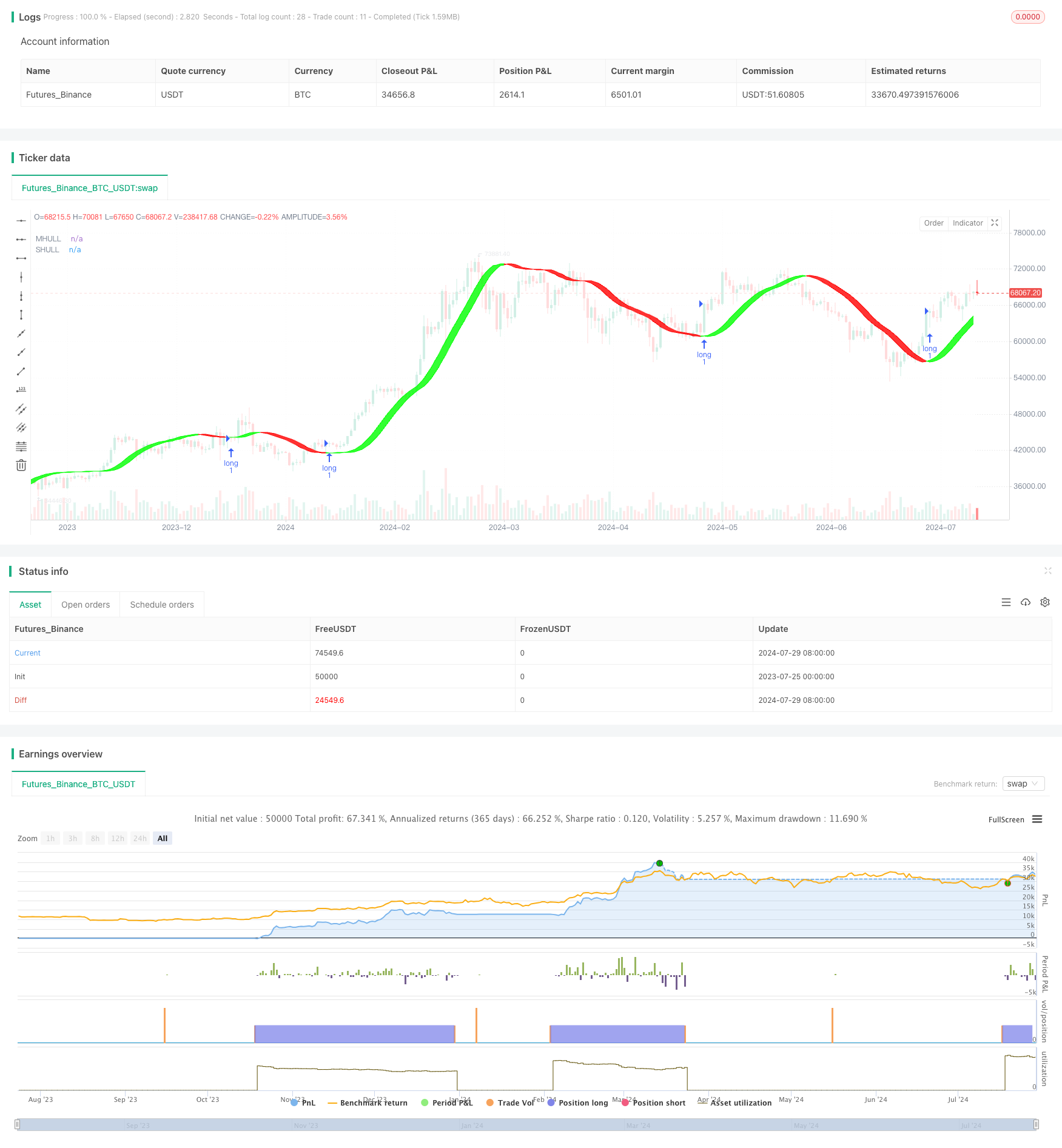
本文介绍了一种基于Hull移动平均线(HMA)的优化量化交易策略,该策略结合了多周期分析和动态止损机制。这个策略是在著名的Hull Suite基础上进行了改进,增加了PineScript v5的"strategy.exit()"命令来实现trailing stop或延迟trailing stop。策略主要利用HMA的快速反应特性来捕捉市场趋势,同时通过多个时间周期的分析来提高信号的可靠性。动态止损机制则有助于保护利润并控制风险。该策略适用于各种金融市场,特别适合波动较大的市场环境。
策略原理
-
Hull移动平均线(HMA):策略的核心是使用HMA及其变体(EHMA和THMA)来识别市场趋势。HMA相比传统移动平均线具有更快的反应速度和更少的滞后。
-
多周期分析:策略通过比较不同时间周期的HMA来生成交易信号。这种方法可以减少假信号,提高交易的准确性。
-
动态止损:策略使用trailing stop机制,在盈利达到一定点数后激活,可以有效地锁定利润并控制风险。
-
交易时段控制:策略允许用户定义特定的交易时段,这有助于避免在波动性较低或流动性不足的时间进行交易。
-
方向控制:策略提供了选择交易方向(做多、做空或双向)的选项,使其能够适应不同的市场环境和交易风格。
策略优势
-
灵活性强:策略允许用户选择不同的Hull移动平均线变体(HMA、EHMA、THMA),以适应不同的市场条件。
-
风险管理出色:通过使用动态止损机制,策略能够在保护利润的同时限制潜在损失。
-
适应性强:多周期分析方法使策略能够适应不同的市场环境,减少假信号的影响。
-
可视化效果好:策略提供了多种可视化选项,如颜色编码的HMA带状图,有助于交易者更直观地理解市场趋势。
-
自动化程度高:策略可以完全自动化执行,减少了人为情绪影响和操作错误的可能性。
策略风险
-
过度交易:由于策略基于快速反应的HMA,在横盘市场可能产生过多的假信号,导致过度交易。
-
滑点风险:策略采用scalping技术,可能面临较高的滑点风险,特别是在流动性较低的市场。
-
参数敏感性:策略的性能高度依赖于参数设置,不当的参数可能导致策略表现不佳。
-
市场条件变化:在剧烈的市场条件变化下,策略可能需要重新优化参数以保持有效性。
-
技术依赖:策略的执行依赖于稳定的网络连接和交易平台,技术故障可能导致重大损失。
策略优化方向
-
增加市场情绪指标:结合如VIX、期权隐含波动率等市场情绪指标,可以帮助策略更好地适应不同的市场环境。
-
引入机器学习算法:使用机器学习技术来动态调整HMA参数和止损水平,可以提高策略的适应性。
-
增加交易量分析:结合交易量数据可以提高趋势判断的准确性,减少假突破带来的损失。
-
优化时间框架选择:通过回测不同的时间框架组合,找到最优的多周期分析设置。
-
引入风险平价方法:在多品种交易中使用风险平价方法分配资金,可以更好地控制整体投资组合风险。
总结
HMA优化多周期量化交易策略与动态止损结合是一个灵活、高效的交易系统。它通过结合Hull移动平均线的快速反应特性、多周期分析的稳定性和动态止损的风险控制,为交易者提供了一个全面的量化交易解决方案。虽然该策略在快速变化的市场中表现出色,但仍需要交易者密切关注市场条件的变化,并及时调整参数以保持其有效性。通过持续优化和引入新的技术元素,这个策略有潜力在各种市场环境中保持竞争力。然而,使用者应当充分认识到量化交易的潜在风险,并在实盘交易中谨慎使用。
||
Overview
This article introduces an optimized quantitative trading strategy based on the Hull Moving Average (HMA), which combines multi-timeframe analysis with a dynamic stop-loss mechanism. The strategy is an improvement on the famous Hull Suite, incorporating the "strategy.exit()" command from PineScript v5 to implement a trailing stop or delayed trailing stop. The strategy primarily leverages the fast-response characteristics of HMA to capture market trends, while enhancing signal reliability through analysis across multiple timeframes. The dynamic stop-loss mechanism helps protect profits and control risks. This strategy is applicable to various financial markets, particularly suited for highly volatile market environments.
Strategy Principles
-
Hull Moving Average (HMA): The core of the strategy uses HMA and its variants (EHMA and THMA) to identify market trends. HMA offers faster response and less lag compared to traditional moving averages.
-
Multi-timeframe Analysis: The strategy generates trading signals by comparing HMA across different timeframes. This method reduces false signals and improves trading accuracy.
-
Dynamic Stop-Loss: The strategy employs a trailing stop mechanism that activates after reaching a certain profit point, effectively locking in profits and controlling risks.
-
Trading Session Control: The strategy allows users to define specific trading sessions, helping to avoid trades during periods of low volatility or liquidity.
-
Direction Control: The strategy offers options to choose trading direction (long, short, or both), making it adaptable to different market environments and trading styles.
Strategy Advantages
-
High Flexibility: The strategy allows users to choose between different Hull Moving Average variants (HMA, EHMA, THMA) to adapt to various market conditions.
-
Excellent Risk Management: Through the use of a dynamic stop-loss mechanism, the strategy can protect profits while limiting potential losses.
-
Strong Adaptability: The multi-timeframe analysis method enables the strategy to adapt to different market environments, reducing the impact of false signals.
-
Good Visualization: The strategy provides multiple visualization options, such as color-coded HMA bands, helping traders understand market trends more intuitively.
-
High Degree of Automation: The strategy can be fully automated, reducing the possibility of emotional influence and operational errors.
Strategy Risks
-
Overtrading: Due to the strategy's reliance on the fast-reacting HMA, it may generate excessive false signals in ranging markets, leading to overtrading.
-
Slippage Risk: The strategy employs scalping techniques, which may face high slippage risk, especially in markets with lower liquidity.
-
Parameter Sensitivity: The strategy's performance is highly dependent on parameter settings; inappropriate parameters may lead to poor strategy performance.
-
Market Condition Changes: In the face of drastic market condition changes, the strategy may require parameter re-optimization to maintain effectiveness.
-
Technology Dependence: The strategy's execution relies on stable network connections and trading platforms; technical failures could lead to significant losses.
Strategy Optimization Directions
-
Incorporate Market Sentiment Indicators: Integrating market sentiment indicators such as VIX or implied volatility from options can help the strategy better adapt to different market environments.
-
Introduce Machine Learning Algorithms: Using machine learning techniques to dynamically adjust HMA parameters and stop-loss levels can improve the strategy's adaptability.
-
Add Volume Analysis: Incorporating volume data can increase the accuracy of trend judgments and reduce losses from false breakouts.
-
Optimize Timeframe Selection: Through backtesting different timeframe combinations, find the optimal multi-timeframe analysis settings.
-
Introduce Risk Parity Methods: Using risk parity methods for capital allocation in multi-asset trading can better control overall portfolio risk.
Conclusion
The Optimized Multi-Timeframe HMA Quantitative Trading Strategy with Dynamic Stop-Loss is a flexible and efficient trading system. By combining the fast-response characteristics of the Hull Moving Average, the stability of multi-timeframe analysis, and the risk control of dynamic stop-loss, it provides traders with a comprehensive quantitative trading solution. While this strategy performs excellently in rapidly changing markets, traders still need to closely monitor changes in market conditions and adjust parameters timely to maintain its effectiveness. Through continuous optimization and the introduction of new technical elements, this strategy has the potential to remain competitive in various market environments. However, users should fully understand the potential risks of quantitative trading and use it cautiously in live trading.
[/trans]
Source (PineScript)
/*backtest
start: 2023-07-25 00:00:00
end: 2024-07-30 00:00:00
period: 1d
basePeriod: 1h
exchanges: [{"eid":"Futures_Binance","currency":"BTC_USDT"}]
*/

// This Pine Script™ code is subject to the terms of the Mozilla Public License 2.0 at https://mozilla.org/MPL/2.0/
// © anotherDAPTrader

//Based upon Hull Suite by InSilico and others//
//with SCALP exit//

//@version=5
strategy('DAP Hull Sweet Scalp v1 Strategy', overlay=true)

// Session //

session = input(title='Session (Goes flat at end of session!)', defval='1800-1700')

//Check if it's in session//

is_session(session) =>
    not na(time(timeframe.period, session))

//Call the function
Session = is_session(session)

//Start and end of the session
start = Session and not Session[1]
end = not Session and Session[1]

//Plot the background color to see the session
bgcolor(Session ? color.new(color.white, 0) : na)

// trade directions //

strat_dir_input = input.string(title='Strategy Direction', defval='long', options=['long', 'short', 'all'])
strat_dir_value = strat_dir_input == 'long' ? strategy.direction.long : strat_dir_input == 'short' ? strategy.direction.short : strategy.direction.all
strategy.risk.allow_entry_in(strat_dir_value)

src = close

modeSwitch = input.string('Hma', title='Hull Variation', options=['Hma', 'Thma', 'Ehma'])

length = input(55, title='Length(180-200 for floating S/R , 55 for swing entry)')

switchColor = input(true, 'Color Hull according to trend?')

candleCol = input(false, title='Color candles based on Hull\'s Trend?')

visualSwitch = input(true, title='Show as a Band?')

thicknesSwitch = input(1, title='Line Thickness')

transpSwitch = input.int(40, title='Band Transparency', step=5)

//FUNCTIONS
//HMA
HMA(_src, _length) =>
    ta.wma(2 * ta.wma(_src, _length / 2) - ta.wma(_src, _length), math.round(math.sqrt(_length)))
//EHMA
EHMA(_src, _length) =>
    ta.ema(2 * ta.ema(_src, _length / 2) - ta.ema(_src, _length), math.round(math.sqrt(_length)))
//THMA
THMA(_src, _length) =>
    ta.wma(ta.wma(_src, _length / 3) * 3 - ta.wma(_src, _length / 2) - ta.wma(_src, _length), _length)

//SWITCH
Mode(modeSwitch, src, len) =>
    modeSwitch == 'Hma' ? HMA(src, len) : modeSwitch == 'Ehma' ? EHMA(src, len) : modeSwitch == 'Thma' ? THMA(src, len / 2) : na

//OUT
HULL = Mode(modeSwitch, src, length)
MHULL = HULL[0]
SHULL = HULL[2]

//COLOR
hullColor = switchColor ? HULL > HULL[2] ? #00ff00 : #ff0000 : #ff9800

//PLOT
///< Frame
Fi1 = plot(MHULL, title='MHULL', color=hullColor, linewidth=thicknesSwitch, transp=50)
Fi2 = plot(visualSwitch ? SHULL : na, title='SHULL', color=hullColor, linewidth=thicknesSwitch, transp=50)
///< Ending Filler
fill(Fi1, Fi2, title='Band Filler', color=hullColor, transp=transpSwitch)
///BARCOLOR
barcolor(color=candleCol ? switchColor ? hullColor : na : na)


// Scalp //

slPoints = input.int(title='Profit Points Before Stop', minval=0, maxval=1000, step=1, defval=1, confirm=false)

slOffset = input.int(title='Then Trailing Stop Loss of ', minval=1, maxval=1000, step=1, defval=1, confirm=false)

//trades//

// Long Entry Function//

if Session and ta.crossover(HULL[0] , HULL[2])
    strategy.entry('long', strategy.long)
    strategy.exit('trailing stop', from_entry='long', trail_points=slPoints, trail_offset=slOffset)

// Short Entry Function//

if Session and ta.crossunder(HULL[0] , HULL[2])
    strategy.entry('short', strategy.short)
    strategy.exit('trailing stop', from_entry='short', trail_points=slPoints, trail_offset=slOffset)

if end
    strategy.close_all("End of Session - Go FLat")
Detail
https://www.fmz.com/strategy/458242
Last Modified
2024-07-31 11:28:09