
20 KiB
Name
动态Keltner通道动量反转策略-Dynamic-Keltner-Channel-Momentum-Reversal-Strategy
Author
ChaoZhang
Strategy Description
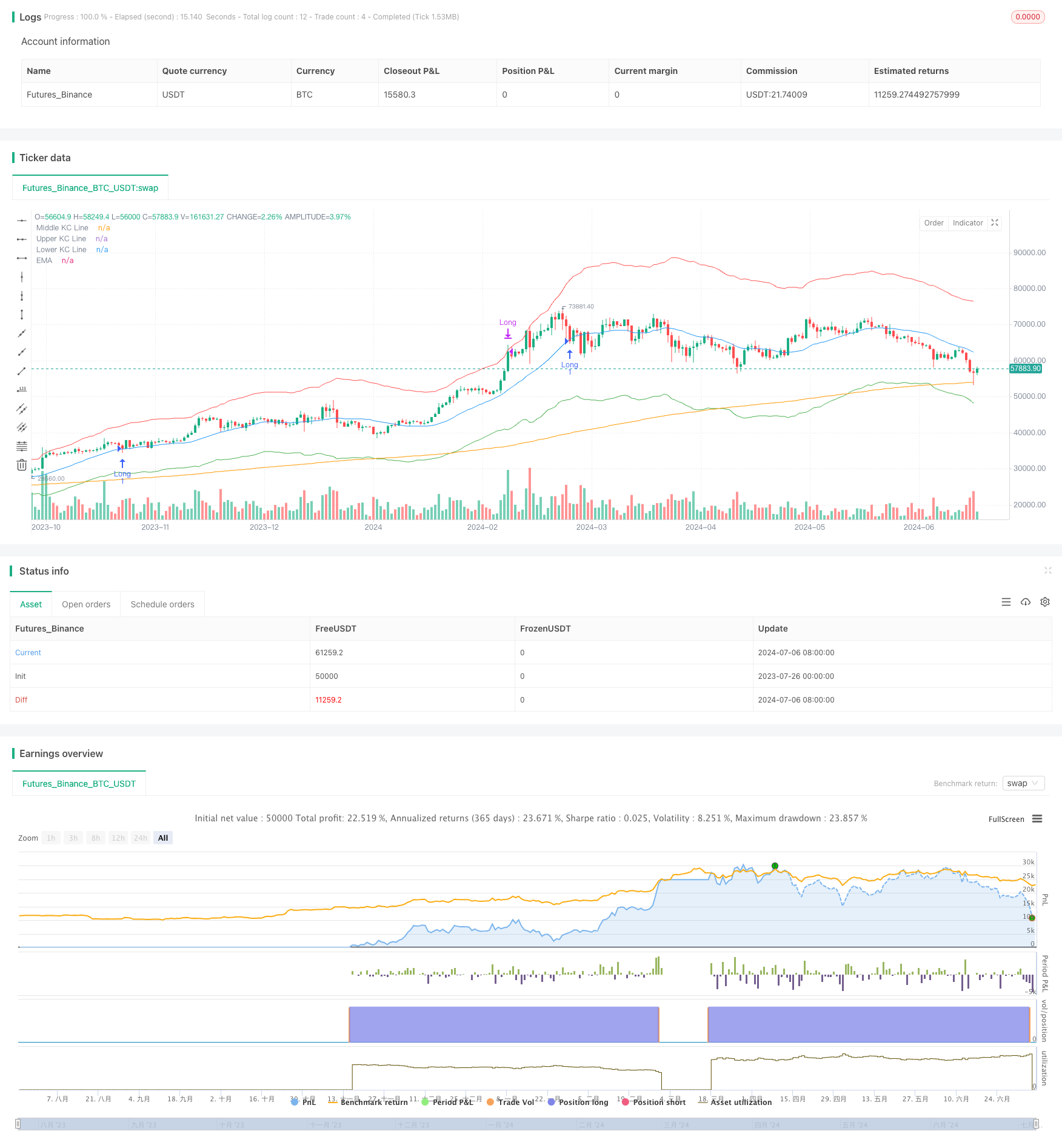
[trans]
概述
动态Keltner通道动量反转策略是一种结合了多个技术指标的复杂交易系统。该策略主要利用Keltner通道、指数移动平均线(EMA)和平均真实波幅(ATR)来识别市场中的潜在入场和出场点。其核心思想是在市场出现回调后捕捉动量行情,同时融合了趋势跟踪的元素。
该策略的主要组成部分包括:
- Keltner通道:用于识别市场的超买和超卖状态。
- 指数移动平均线(EMA):作为趋势过滤器。
- 平均真实波幅(ATR):用于动态止损设置。
策略的入场条件精心设计,要求价格触及Keltner通道的外轨,随后回落至中轨,并且收盘价位于EMA的上方或下方。这种设计旨在捕捉市场在大幅波动后的潜在反转或趋势延续。
出场条件同样基于Keltner通道,当价格达到或超过相应的通道边界时,策略会自动平仓。此外,策略还采用了基于ATR的动态止损机制,为风险管理提供了灵活性和适应性。
策略原理
动态Keltner通道动量反转策略的核心原理可以分为以下几个关键部分:
-
Keltner通道设置: 策略使用20周期的简单移动平均线(SMA)作为Keltner通道的基准线,通道宽度设置为6倍ATR。这种设置使得通道能够动态适应市场波动性的变化。
-
趋势过滤: 采用280周期的EMA作为长期趋势指标。这有助于确保交易方向与整体市场趋势保持一致。
-
入场条件:
- 多头入场:要求在过去120个周期内上轨被触及,当前蜡烛线的影线触及中轨,且收盘价在EMA之上。
- 空头入场:要求在过去120个周期内下轨被触及,当前蜡烛线的影线触及中轨,且收盘价在EMA之下。
-
出场条件:
- 多头出场:当高点达到或超过上轨时。
- 空头出场:当低点达到或跌破下轨时。
-
风险管理: 使用35周期的ATR计算动态止损,止损距离设为5.5倍ATR。这种方法可以根据市场波动性自动调整止损水平。
策略的设计理念是在市场出现显著波动后(触及Keltner通道外轨)寻找潜在的反转或趋势延续机会。中轨触及要求有助于确认价格回调,而EMA则用于确保交易方向与整体趋势一致。
策略优势
-
多指标协同:结合Keltner通道、EMA和ATR,提供了全面的市场分析视角,有助于减少假信号。
-
动态适应性:通过使用ATR来设置Keltner通道宽度和止损距离,策略能够自动适应不同市场条件下的波动性变化。
-
趋势确认:利用EMA作为额外的趋势过滤器,有助于提高交易的成功率,避免逆势交易。
-
灵活的入场机制:通过要求价格在触及外轨后回落至中轨,策略能够捕捉到潜在的反转或趋势延续机会,既不会过早入场,也不会错过重要的交易机会。
-
清晰的出场策略:基于Keltner通道的出场条件为交易提供了明确的获利目标,有助于锁定利润。
-
风险管理:采用基于ATR的动态止损机制,能够根据市场波动性自动调整止损水平,提供了更好的风险控制。
-
参数可调:策略提供了多个可调参数,如ATR长度、Keltner通道乘数、EMA长度等,使得交易者可以根据不同的市场和时间框架进行优化。
-
代码实现简洁:尽管策略逻辑相对复杂,但代码实现简洁明了,便于理解和维护。
策略风险
-
参数敏感性:策略的性能可能对参数设置非常敏感。不同的市场条件可能需要不同的参数设置,这增加了策略优化和维护的难度。
-
滞后性:使用移动平均线和ATR等指标可能导致信号产生滞后,在快速变化的市场中可能错过重要的入场或出场机会。
-
假突破风险:在横盘市场中,价格可能频繁触及Keltner通道的边界,导致过多的假信号。
-
趋势依赖:策略在强趋势市场中表现可能更好,但在震荡市场中可能面临频繁的止损出场。
-
过度优化风险:由于策略提供了多个可调参数,交易者可能陷入过度优化的陷阱,导致策略在实盘交易中的表现不如回测结果。
-
市场条件变化:策略可能在特定的市场条件下表现良好,但当市场特征发生变化时,性能可能会显著下降。
-
执行风险:在实际交易中,由于滑点和流动性问题,可能无法准确地在指定价格执行交易,这可能影响策略的整体表现。
为了缓解这些风险,建议采取以下措施:
- 在不同的市场和时间框架上进行充分的回测和前向测试。
- 使用稳健的参数优化方法,避免过度拟合。
- 考虑增加额外的过滤条件,如成交量指标,以减少假信号。
- 实施严格的资金管理规则,限制每笔交易的风险敞口。
- 定期监控和评估策略性能,及时调整参数或暂停交易。
策略优化方向
-
动态参数调整: 考虑引入自适应机制,根据市场波动性或趋势强度动态调整Keltner通道乘数和EMA长度。这可以提高策略对不同市场条件的适应性。
-
多时间框架分析: 整合更高时间框架的趋势信息,例如在日线策略中考虑周线趋势。这有助于提高交易方向的准确性。
-
成交量确认: 引入成交量指标作为额外的确认信号。例如,要求入场时成交量高于平均水平,以增加交易的可信度。
-
市场状态分类: 开发一个市场状态分类系统,区分趋势市场和震荡市场。在不同的市场状态下使用不同的参数设置或交易规则。
-
止盈优化: 考虑实施更复杂的止盈策略,如移动止盈或部分止盈,以更好地平衡风险和回报。
-
入场优化: 细化入场条件,例如要求价格在触及中轨后有一定的反弹确认,或者增加动量指标的确认。
-
机器学习集成: 探索使用机器学习算法来优化参数选择或预测最佳入场时机。
-
相关性分析: 如果在多个市场上使用该策略,考虑加入相关性分析,以避免过度集中风险。
-
事件驱动因素: 整合基本面或事件驱动的过滤器,例如避免在重要经济数据发布前后交易。
-
回撤控制: 加入总体回撤控制机制,在策略达到预设最大回撤时自动停止交易。
这些优化方向旨在提高策略的稳健性、适应性和整体性能。然而,在实施任何优化之前,务必进行彻底的测试和验证,以确保这些改进确实能够带来实质性的性能提升。
总结
动态Keltner通道动量反转策略是一个精心设计的交易系统,它巧妙地结合了多个技术指标来捕捉市场中的潜在反转和趋势延续机会。通过利用Keltner通道、EMA和ATR,该策略不仅能够识别潜在的入场点,还提供了动态的风险管理机制。
策略的核心优势在于其动态适应性和多层面的市场分析方法。通过要求价格触及外轨后回落至中轨,并结合EMA趋势确认,策略能够在保持较高成功率的同时,捕捉重要的市场动向。此外,基于ATR的动态止损机制为风险控制提供了灵活性。
然而,该策略也面临一些潜在的风险,如参数敏感性和市场条件变化带来的挑战。为了应对这些风险,我们提出了多个优化方向,包括动态参数调整、多时间框架分析、成交量确认等。这些优化建议旨在进一步提高策略的稳健性和适应性。
总的来说,动态Keltner通道动量反转策略为交易者提供了一个结构化的方法来分析和参与市场。通过持续的监控、测试和优化,该策略有潜力成为一个可靠的交易工具。然而,像所有交易策略一样,它并非万能的解决方案。交易者应当结合自身的风险承受能力和交易目标,审慎地实施和管理这一策略。
||
Overview
The Dynamic Keltner Channel Momentum Reversal Strategy is a sophisticated trading system that combines multiple technical indicators. This strategy primarily utilizes Keltner Channels, Exponential Moving Average (EMA), and Average True Range (ATR) to identify potential entry and exit points in the market. Its core idea is to capture momentum moves after a market pullback while incorporating trend-following elements.
The main components of the strategy include:
- Keltner Channels: Used to identify overbought and oversold conditions.
- Exponential Moving Average (EMA): Serves as a trend filter.
- Average True Range (ATR): Employed for dynamic stop-loss placement.
The strategy's entry conditions are carefully designed, requiring the price to touch the outer band of the Keltner Channel, then pull back to the middle band, with the closing price above or below the EMA. This design aims to capture potential reversals or trend continuations after significant market movements.
Exit conditions are also based on the Keltner Channels, with the strategy automatically closing positions when the price reaches or exceeds the respective channel boundaries. Additionally, the strategy employs a dynamic stop-loss mechanism based on ATR, providing flexibility and adaptability to risk management.
Strategy Principles
The core principles of the Dynamic Keltner Channel Momentum Reversal Strategy can be broken down into the following key components:
-
Keltner Channel Setup: The strategy uses a 20-period Simple Moving Average (SMA) as the basis for the Keltner Channel, with the channel width set to 6 times the ATR. This setup allows the channel to dynamically adapt to changes in market volatility.
-
Trend Filtering: A 280-period EMA is used as a long-term trend indicator. This helps ensure that trade direction aligns with the overall market trend.
-
Entry Conditions:
- Long Entry: Requires the upper band to be touched within the past 120 periods, the current candle's wick to touch the middle band, and the closing price to be above the EMA.
- Short Entry: Requires the lower band to be touched within the past 120 periods, the current candle's wick to touch the middle band, and the closing price to be below the EMA.
-
Exit Conditions:
- Long Exit: When the high price reaches or exceeds the upper band.
- Short Exit: When the low price reaches or falls below the lower band.
-
Risk Management: Uses a 35-period ATR to calculate dynamic stop-losses, with the stop distance set to 5.5 times the ATR. This method automatically adjusts stop levels based on market volatility.
The strategy's design philosophy is to look for potential reversal or trend continuation opportunities after significant market movements (touching the outer Keltner Channel band). The middle band touch requirement helps confirm price pullbacks, while the EMA ensures trade direction aligns with the overall trend.
Strategy Advantages
-
Multi-Indicator Synergy: Combining Keltner Channels, EMA, and ATR provides a comprehensive market analysis perspective, helping to reduce false signals.
-
Dynamic Adaptability: By using ATR to set Keltner Channel width and stop-loss distances, the strategy can automatically adapt to volatility changes in different market conditions.
-
Trend Confirmation: Utilizing EMA as an additional trend filter helps improve trade success rates and avoids counter-trend trading.
-
Flexible Entry Mechanism: By requiring price to pull back to the middle band after touching the outer band, the strategy can capture potential reversal or trend continuation opportunities without entering too early or missing important trading opportunities.
-
Clear Exit Strategy: The Keltner Channel-based exit conditions provide clear profit targets for trades, helping to lock in profits.
-
Risk Management: The ATR-based dynamic stop-loss mechanism automatically adjusts stop levels based on market volatility, providing better risk control.
-
Adjustable Parameters: The strategy offers multiple adjustable parameters, such as ATR length, Keltner Channel multiplier, and EMA length, allowing traders to optimize for different markets and timeframes.
-
Concise Code Implementation: Despite the relatively complex strategy logic, the code implementation is clear and concise, making it easy to understand and maintain.
Strategy Risks
-
Parameter Sensitivity: The strategy's performance may be highly sensitive to parameter settings. Different market conditions may require different parameter settings, increasing the difficulty of strategy optimization and maintenance.
-
Lagging Indicators: The use of moving averages and ATR may lead to signal lag, potentially missingimportant entry or exit opportunities in rapidly changing markets.
-
False Breakout Risk: In ranging markets, prices may frequently touch the Keltner Channel boundaries, leading to excessive false signals.
-
Trend Dependency: The strategy may perform better in strong trend markets but might face frequent stop-loss exits in oscillating markets.
-
Over-optimization Risk: With multiple adjustable parameters, traders may fall into the trap of over-optimization, leading to poorer performance in live trading compared to backtests.
-
Market Condition Changes: The strategy may perform well under specific market conditions but could significantly underperform when market characteristics change.
-
Execution Risk: In actual trading, due to slippage and liquidity issues, it may not be possible to execute trades at the exact specified prices, which could affect overall strategy performance.
To mitigate these risks, consider the following measures:
- Conduct thorough backtesting and forward testing on different markets and timeframes.
- Use robust parameter optimization methods to avoid overfitting.
- Consider adding additional filtering conditions, such as volume indicators, to reduce false signals.
- Implement strict money management rules to limit risk exposure for each trade.
- Regularly monitor and evaluate strategy performance, adjusting parameters or pausing trading as needed.
Strategy Optimization Directions
-
Dynamic Parameter Adjustment: Consider introducing adaptive mechanisms to dynamically adjust the Keltner Channel multiplier and EMA length based on market volatility or trend strength. This can improve the strategy's adaptability to different market conditions.
-
Multi-Timeframe Analysis: Integrate trend information from higher timeframes, for example, considering weekly trends in a daily strategy. This can help improve the accuracy of trade direction.
-
Volume Confirmation: Introduce volume indicators as additional confirmation signals. For instance, require above-average volume at entry to increase trade credibility.
-
Market State Classification: Develop a market state classification system to distinguish between trending and oscillating markets. Use different parameter settings or trading rules for different market states.
-
Profit-Taking Optimization: Consider implementing more sophisticated profit-taking strategies, such as trailing stops or partial profit-taking, to better balance risk and reward.
-
Entry Optimization: Refine entry conditions, for example, by requiring a certain confirmation of rebound after touching the middle band, or adding momentum indicator confirmation.
-
Machine Learning Integration: Explore using machine learning algorithms to optimize parameter selection or predict optimal entry times.
-
Correlation Analysis: If using the strategy across multiple markets, consider adding correlation analysis to avoid excessive risk concentration.
-
Event-Driven Factors: Integrate fundamental or event-driven filters, such as avoiding trades before and after important economic data releases.
-
Drawdown Control: Add an overall drawdown control mechanism that automatically stops trading when the strategy reaches a preset maximum drawdown.
These optimization directions aim to improve the strategy's robustness, adaptability, and overall performance. However, it's crucial to thoroughly test and validate any optimizations before implementation to ensure they truly bring substantial performance improvements.
Conclusion
The Dynamic Keltner Channel Momentum Reversal Strategy is a carefully designed trading system that cleverly combines multiple technical indicators to capture potential reversals and trend continuation opportunities in the market. By leveraging Keltner Channels, EMA, and ATR, this strategy not only identifies potential entry points but also provides a dynamic risk management mechanism.
The core strength of the strategy lies in its dynamic adaptability and multi-faceted market analysis approach. By requiring price to pull back to the middle band after touching the outer band, combined with EMA trend confirmation, the strategy can capture significant market movements while maintaining a relatively high success rate. Furthermore, the ATR-based dynamic stop-loss mechanism provides flexibility in risk control.
However, the strategy also faces potential risks such as parameter sensitivity and challenges brought by changing market conditions. To address these risks, we have proposed several optimization directions, including dynamic parameter adjustment, multi-timeframe analysis, and volume confirmation. These optimization suggestions aim to further enhance the strategy's robustness and adaptability.
Overall, the Dynamic Keltner Channel Momentum Reversal Strategy provides traders with a structured approach to analyzing and participating in the market. Through continuous monitoring, testing, and optimization, this strategy has the potential to become a reliable trading tool. However, like all trading strategies, it is not a one-size-fits-all solution. Traders should implement and manage this strategy prudently, taking into account their own risk tolerance and trading objectives.
[/trans]
Source (PineScript)
/*backtest
start: 2023-07-26 00:00:00
end: 2024-07-07 05:20:00
period: 1d
basePeriod: 1h
exchanges: [{"eid":"Futures_Binance","currency":"BTC_USDT"}]
*/

//@version=5
strategy("Keltner Channel Pullback and Entry Strategy", overlay=true)

// Input settings
atrLength = input(35, "ATR Length")
atrMultiplier = input(5.5, "ATR Multiplier for Stop Loss")
kcLength = input(20, "Keltner Channel Length")
kcMultiplier = input(6.0, "Keltner Channel Multiplier")
emaLength = input(280, "EMA Length")
candleLookback = input(120, "Candle Lookback for Keltner Channel Touch")

// ATR for stop loss calculation
atr = ta.atr(atrLength)

// Keltner Channel
basis = ta.sma(close, kcLength)
kcRange = kcMultiplier * atr
upperKC = basis + kcRange
lowerKC = basis - kcRange

// EMA Trend Filter
ema = ta.ema(close, emaLength)

// Function to check if Keltner Channel was touched within the lookback period
wasKCTouched(direction) =>
    touched = false
    for i = 1 to candleLookback
        if direction == "long" and high[i] >= upperKC[i]
            touched := true
        if direction == "short" and low[i] <= lowerKC[i]
            touched := true
    touched

// Check for middle line touch by wick
middleLineTouchedByWick = high >= basis and low <= basis

// Entry Conditions
longCondition = wasKCTouched("long") and middleLineTouchedByWick and close > ema
shortCondition = wasKCTouched("short") and middleLineTouchedByWick and close < ema

// Exit Conditions
longExit = high >= upperKC
shortExit = low <= lowerKC

// Tracking the previous ATR value for stop loss calculation
var float prevAtr = na
if longCondition or shortCondition
    prevAtr := atr[1]

// Entry Execution
if longCondition
    strategy.entry("Long", strategy.long)
    strategy.exit("Exit Long", "Long", stop=close - atrMultiplier * prevAtr)

if shortCondition
    strategy.entry("Short", strategy.short)
    strategy.exit("Exit Short", "Short", stop=close + atrMultiplier * prevAtr)

// Exit Execution
if longExit and strategy.position_size > 0
    strategy.close("Long", when=barstate.isnew)

if shortExit and strategy.position_size < 0
    strategy.close("Short", when=barstate.isnew)

// Plotting
plot(basis, color=color.blue, title="Middle KC Line")
plot(upperKC, color=color.red, title="Upper KC Line")
plot(lowerKC, color=color.green, title="Lower KC Line")
plot(ema, color=color.orange, title="EMA")
Detail
https://www.fmz.com/strategy/457776
Last Modified
2024-07-26 15:02:39