
22 KiB
Name
US30多级趋势确认与风险管理策略-US30-Multi-Grade-Trend-Confirmation-Risk-Management-Strategy
Author
ianzeng123
Strategy Description
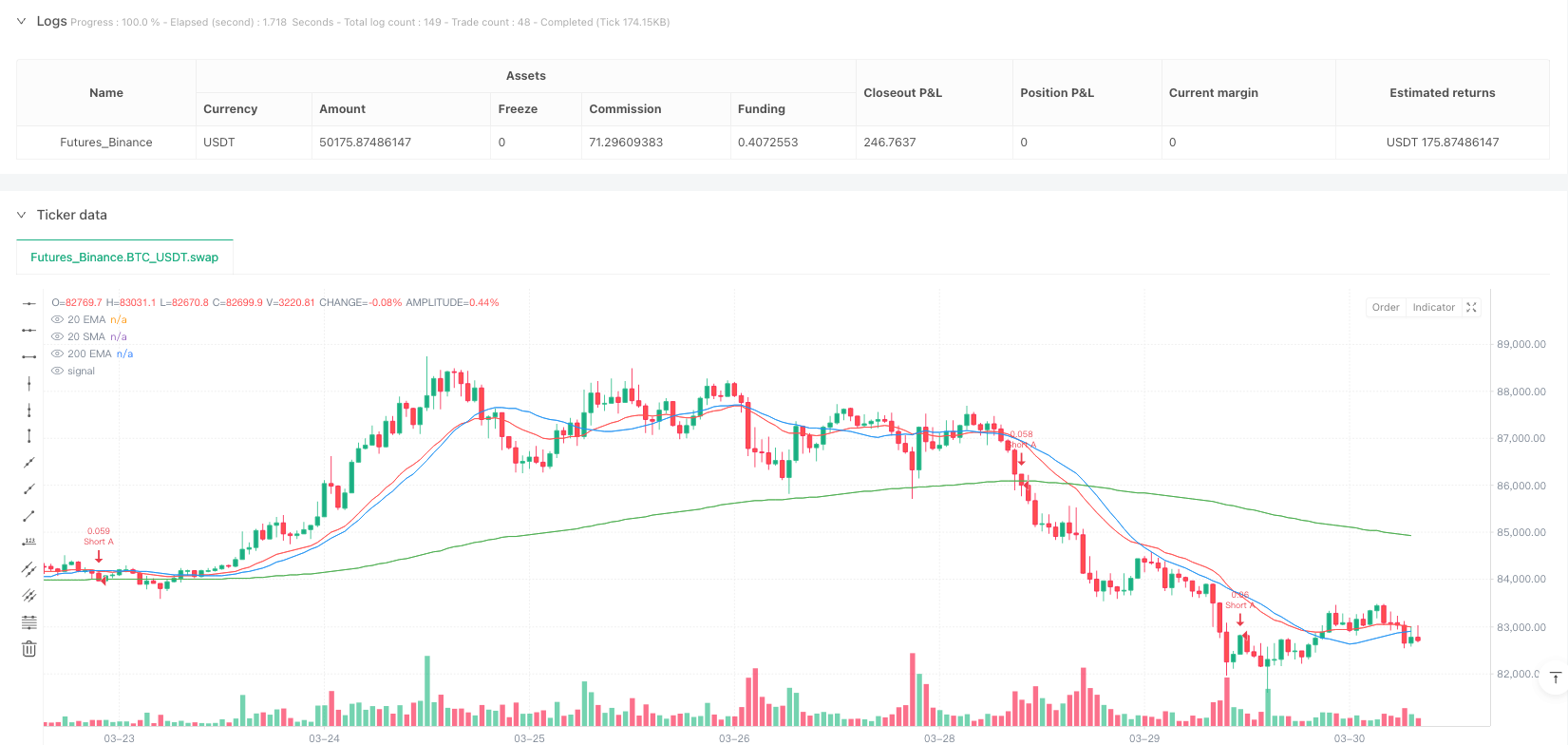
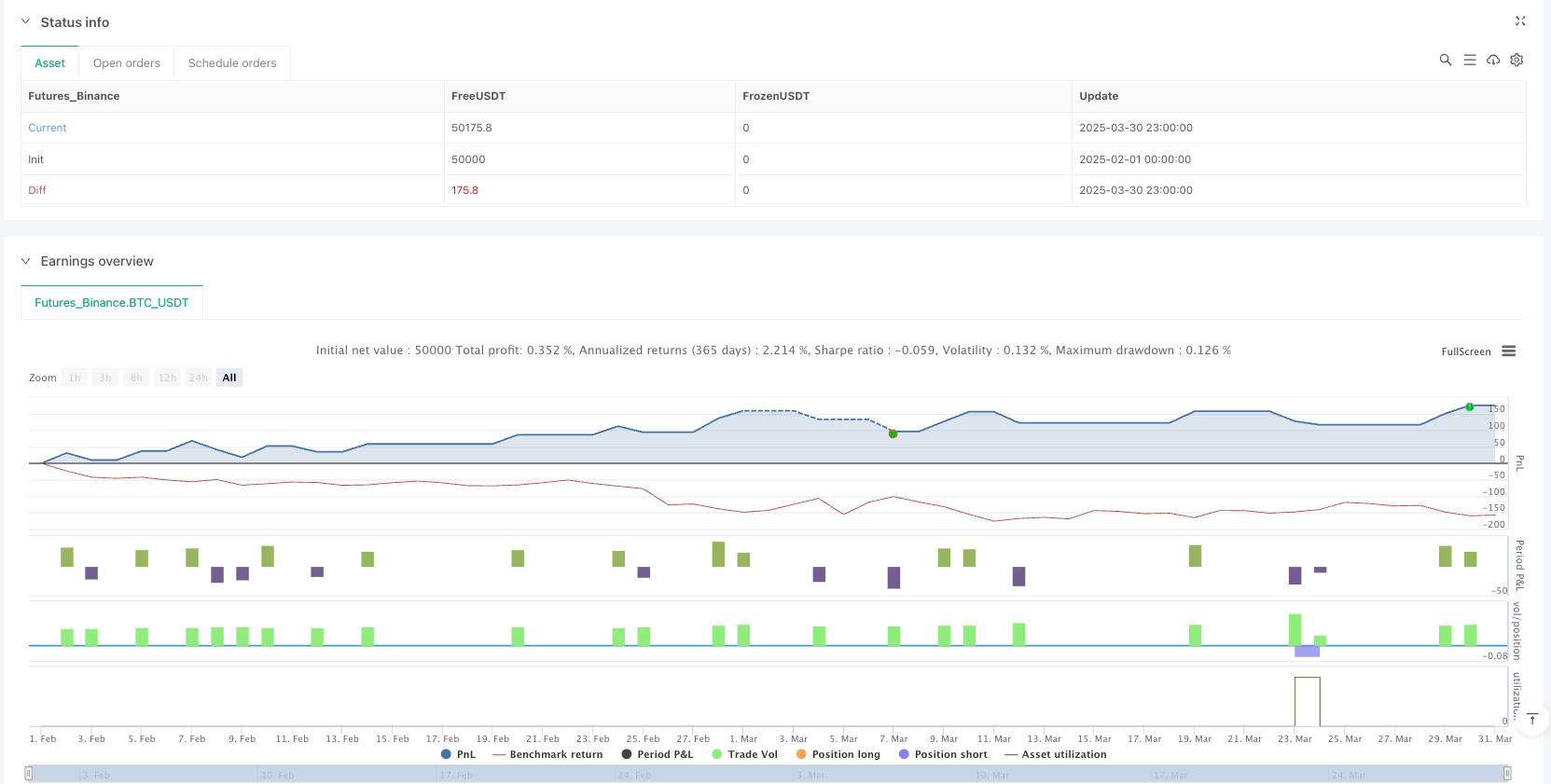
[trans]
概述
这个策略是一个基于多指标确认和分级评估系统的短线交易策略。它通过分析蜡烛图大小、交易量变化和RSI指标来评估交易信号的强度,将信号分为A、B、C三个等级,其中A级信号最强,C级信号最弱。该策略同时整合了风险管理功能,包括自动设置止盈和止损点位,并提供图表标签和交易提醒功能,方便交易者实时跟踪交易信号。策略基于均线交叉、RSI趋势确认和价格相对于均线位置等多重条件,确保交易方向与主要趋势保持一致,同时要求交易量增加和足够的蜡烛体大小来确认动量。
策略原理
该策略的核心原理基于以下几个关键元素的组合:
-
趋势判断: 使用200 EMA作为主要趋势判断工具。价格在200 EMA之上寻找做多机会,在200 EMA之下寻找做空机会。
-
均线交叉信号: 策略使用20周期的EMA和SMA,当这两条均线交叉时产生初步信号。做多信号需要EMA上穿SMA,做空信号需要EMA下穿SMA。
-
RSI确认: 使用9周期RSI指标,做多时要求RSI大于50,做空时要求RSI小于50。
-
蜡烛体大小评估: 策略分析蜡烛体大小与过去20根蜡烛平均体积的比较,判断当前价格动量。
-
交易量确认: 要求当前交易量大于前一周期交易量,确保有足够的市场参与度。
-
信号分级系统:
- A级(最强): 蜡烛体非常大(比20周期平均值大2倍)、交易量上升且RSI强烈确认方向(RSI>55或<45)
- B级(中等): 蜡烛体较大、交易量上升
- C级(较弱): 蜡烛体较大,但只有交易量上升或RSI确认其中之一
-
风险管理: 包含可调节的止盈(默认0.5%)和止损(默认0.3%)水平,以进场价格的百分比设置。
策略通过这些多重确认条件,确保只在有足够市场动量和趋势确认的情况下进场交易,减少假信号。
策略优势
-
分级评估系统: 最大的优势在于其独特的信号分级机制,使交易者可以根据自己的风险偏好选择只交易强度最高的信号(A级),或者包含更多的交易机会(B级和C级)。
-
多重确认机制: 结合技术指标(RSI,均线)、价格行为(蜡烛体大小)和市场参与度(交易量)的多重确认,有效降低假信号概率。
-
内置风险管理: 自动化的止盈止损设置确保每笔交易风险可控,避免单笔交易造成过大损失。
-
视觉反馈系统: 交易信号触发时自动在图表上标注标签,清晰显示交易方向和信号强度,方便交易者快速识别。
-
警报功能: 整合了TradingView的警报系统,可以通过弹窗、电子邮件或手机通知提醒交易者。
-
适应不同市场条件: 通过信号分级和多指标确认,策略可以在不同波动性环境下保持相对稳定的表现。
-
可定制性: 提供了多个关键参数的自定义选项,包括RSI长度、均线周期、止盈止损比例以及要交易的信号等级,使策略可以根据个人偏好和市场条件进行调整。
-
趋势跟随与动量结合: 策略有效结合了趋势跟随(均线)和动量确认(RSI,蜡烛大小),形成了较为完整的交易系统。
策略风险
-
过滤过度: 多重确认机制可能导致错过一些有效交易机会,特别是只交易A级信号时,可能会大大减少交易频率。
-
参数敏感性: 策略使用多个技术指标和参数,这些参数的细微变化可能导致性能差异较大。例如,RSI长度、均线周期和蜡烛体大小的判断标准都可能需要根据不同市场条件进行调整。
-
固定百分比止盈止损: 策略使用固定百分比的止盈止损,这可能不适合所有市场条件。在高波动性环境下,固定的止损水平可能过小,而在低波动性环境下,可能过大。
-
市场噪音影响: 在1分钟时间框架上,市场噪音较大,可能导致更多假信号,尤其是在市场横盘或波动性较低时期。
-
流动性风险: 在非交易时段或低流动性时期,交易信号质量可能下降,同时滑点风险增加。
-
连续亏损风险: 即使使用分级系统,市场突然变化时仍可能出现连续亏损情况,需要有适当的资金管理策略配合。
-
反趋势风险: 策略主要基于短期均线交叉和RSI确认,在强烈反趋势行情中可能产生错误信号。
缓解这些风险的方法包括:使用更长时间框架的过滤条件、动态调整止盈止损水平、在特定市场时段(如波动性较大或流动性充足的时期)交易、定期回测并优化参数,以及严格控制每笔交易的风险敞口。
策略优化方向
-
动态止盈止损: 将固定百分比的止盈止损改为基于市场波动性(如ATR指标)的动态水平,更好地适应不同市场条件。优化代码可以是:
atr = ta.atr(14) longSL = close - atr * slMultiplier longTP = close + atr * tpMultiplier -
时间过滤: 添加交易时间过滤,只在市场波动性较大和流动性充足的时段交易,例如美股市场开盘时段或欧美市场重叠时段:
timeFilter = (hour >= 14 and hour < 16) or (hour >= 9 and hour < 11) -
多时间框架分析: 整合更高时间框架的趋势确认,只在更高时间框架趋势方向一致时交易:
higherTimeframeTrend = request.security(syminfo.ticker, "15", close > ta.ema(close, 200)) longCondition = longBase and higherTimeframeTrend -
连续信号加强: 可以考虑连续出现的相同方向信号加强信号强度,或者在短期内多次出现相同方向的信号作为更强确认:
consecutiveLongSignals = longBase and longBase[1] -
自适应指标参数: 使用自适应的RSI和均线长度,根据市场波动性自动调整参数:
adaptiveLength = math.round(ta.atr(14) / ta.atr(14)[20] * baseLength) adaptiveRsi = ta.rsi(close, math.max(2, adaptiveLength)) -
盈亏比优化: 根据不同的信号级别设置不同的盈亏比,例如A级信号可以使用更大的盈亏比,而C级信号使用更保守的设置:
if setupGrade == "A" tpMultiplier = 2.0 else if setupGrade == "B" tpMultiplier = 1.5 else tpMultiplier = 1.0 -
加入波动率过滤: 在过低波动率环境中避免交易,减少横盘市场的假信号:
volatilityFilter = ta.atr(14) > ta.sma(ta.atr(14), 20) * 0.8 -
部分利润锁定机制: 实现部分利润锁定机制,当价格移动到一定程度时,移动止损到成本位或锁定部分利润:
if (strategy.position_size > 0 and close > entryPrice * (1 + partialTpPerc/100))
    strategy.exit("Partial", "Long", qty_percent=50)
这些优化方向主要解决策略在不同市场条件下的适应性问题,提高信号质量并更好地管理风险,同时保持策略的核心逻辑不变。
总结
这个US30多级趋势确认与风险管理策略是一个结合了多重技术指标、趋势确认和动量分析的短线交易系统。其独特之处在于使用分级评估系统(A、B、C级)对交易信号进行质量评估,使交易者可以根据自己的风险偏好选择信号质量。策略通过均线交叉、RSI确认、蜡烛体大小和交易量变化等多维度分析,提高了信号的可靠性。
内置的风险管理功能和清晰的视觉反馈使其成为一个相对完整的交易系统。然而,该策略在短时间框架上运行时可能面临市场噪音大、参数敏感和固定止盈止损不够灵活等挑战。通过整合动态风险管理、多时间框架分析和市场条件过滤等优化方向,该策略有潜力在保持核心优势的同时,进一步提高在不同市场环境下的适应性和稳定性。
对于偏好规则明确、风险可控的短线交易策略的交易者来说,这个系统提供了一个良好的起点,可以通过进一步的回测和优化,根据个人交易风格和目标市场特性进行定制,发展成为一个个性化的交易系统。 ||
Overview
This strategy is a short-term trading system based on multiple indicator confirmations and a graded evaluation system. It analyzes candle size, volume changes, and the RSI indicator to assess signal strength, categorizing signals into three grades: A, B, and C, with Grade A being the strongest and Grade C the weakest. The strategy integrates risk management functionality, including automatic setting of take profit and stop loss levels, and provides chart labels and trade alerts to help traders track signals in real-time. The strategy is based on moving average crossovers, RSI trend confirmation, and price position relative to moving averages, ensuring trade direction aligns with the primary trend while requiring increasing volume and sufficient candle body size to confirm momentum.
Strategy Principles
The core principles of this strategy combine several key elements:
-
Trend Determination: Uses the 200 EMA as the primary trend determination tool. The strategy looks for long opportunities when price is above the 200 EMA and short opportunities when price is below it.
-
Moving Average Crossover Signals: The strategy employs 20-period EMA and SMA. Initial signals are generated when these two moving averages cross. A long signal requires the EMA to cross above the SMA, while a short signal requires the EMA to cross below the SMA.
-
RSI Confirmation: Uses a 9-period RSI indicator, requiring the RSI to be above 50 for long trades and below 50 for short trades.
-
Candle Body Size Assessment: The strategy analyzes candle body size compared to the average body size of the past 20 candles to judge current price momentum.
-
Volume Confirmation: Requires current volume to be greater than the previous period's volume, ensuring sufficient market participation.
-
Signal Grading System:
- Grade A (Strongest): Very large candle body (2x the 20-period average), rising volume, and strong RSI direction confirmation (RSI > 55 or < 45)
- Grade B (Moderate): Large candle body and rising volume
- Grade C (Weak): Large candle body with either rising volume or RSI confirmation, but not both
-
Risk Management: Includes adjustable take profit (default 0.5%) and stop loss (default 0.3%) levels, set as a percentage of the entry price.
Through these multiple confirmation conditions, the strategy ensures trades are only entered when there is sufficient market momentum and trend confirmation, reducing false signals.
Strategy Advantages
-
Graded Evaluation System: The greatest advantage lies in its unique signal grading mechanism, allowing traders to choose to trade only the highest strength signals (Grade A) or include more trading opportunities (Grades B and C).
-
Multiple Confirmation Mechanism: The combination of technical indicators (RSI, moving averages), price action (candle body size), and market participation (volume) provides multiple confirmations that effectively reduce the probability of false signals.
-
Built-in Risk Management: Automated take profit and stop loss settings ensure controllable risk for each trade, preventing single trades from causing excessive losses.
-
Visual Feedback System: Automatically labels triggered trade signals on the chart, clearly displaying trade direction and signal strength, making it easy for traders to quickly identify opportunities.
-
Alert Functionality: Integrates with TradingView's alert system, which can remind traders via popups, emails, or mobile notifications.
-
Adaptability to Different Market Conditions: Through signal grading and multi-indicator confirmation, the strategy can maintain relatively stable performance under different volatility environments.
-
Customizability: Provides customization options for multiple key parameters, including RSI length, moving average periods, take profit/stop loss ratios, and the signal grades to trade, allowing the strategy to be adjusted according to personal preferences and market conditions.
-
Combination of Trend Following and Momentum: The strategy effectively combines trend following (moving averages) and momentum confirmation (RSI, candle size), forming a relatively complete trading system.
Strategy Risks
-
Excessive Filtering: Multiple confirmation mechanisms may cause some valid trading opportunities to be missed, especially when trading only Grade A signals, which may significantly reduce trading frequency.
-
Parameter Sensitivity: The strategy uses multiple technical indicators and parameters, and slight changes in these parameters may lead to significant performance differences. For example, RSI length, moving average periods, and candle body size judgment criteria may all need to be adjusted according to different market conditions.
-
Fixed Percentage Take Profit/Stop Loss: The strategy uses fixed percentage take profit and stop loss levels, which may not be suitable for all market conditions. In high volatility environments, the fixed stop loss level may be too small, while in low volatility environments, it may be too large.
-
Market Noise Impact: On a 1-minute timeframe, market noise is greater, potentially leading to more false signals, especially during market consolidation or low volatility periods.
-
Liquidity Risk: During non-trading sessions or periods of low liquidity, signal quality may deteriorate, and slippage risk increases.
-
Consecutive Loss Risk: Even with the grading system, consecutive losses may still occur when the market suddenly changes, requiring an appropriate money management strategy.
-
Counter-trend Risk: The strategy is primarily based on short-term moving average crossovers and RSI confirmation, which may generate incorrect signals in strong counter-trend markets.
Methods to mitigate these risks include: using longer timeframe filtering conditions, dynamically adjusting take profit and stop loss levels, trading during specific market sessions (such as periods of higher volatility or ample liquidity), regularly backtesting and optimizing parameters, and strictly controlling risk exposure for each trade.
Strategy Optimization Directions
-
Dynamic Take Profit/Stop Loss: Change the fixed percentage take profit/stop loss to dynamic levels based on market volatility (such as the ATR indicator) to better adapt to different market conditions. Optimization code could be:
atr = ta.atr(14) longSL = close - atr * slMultiplier longTP = close + atr * tpMultiplier -
Time Filtering: Add trading time filters to only trade during periods of higher volatility and sufficient liquidity, such as US market opening hours or during the overlap of European and US markets:
timeFilter = (hour >= 14 and hour < 16) or (hour >= 9 and hour < 11) -
Multiple Timeframe Analysis: Integrate higher timeframe trend confirmation, trading only when the trend direction on higher timeframes is consistent:
higherTimeframeTrend = request.security(syminfo.ticker, "15", close > ta.ema(close, 200)) longCondition = longBase and higherTimeframeTrend -
Consecutive Signal Strengthening: Consider strengthening signal intensity for consecutive signals in the same direction, or use multiple signals in the same direction within a short period as stronger confirmation:
consecutiveLongSignals = longBase and longBase[1] -
Adaptive Indicator Parameters: Use adaptive RSI and moving average lengths that automatically adjust parameters based on market volatility:
adaptiveLength = math.round(ta.atr(14) / ta.atr(14)[20] * baseLength) adaptiveRsi = ta.rsi(close, math.max(2, adaptiveLength)) -
Risk-Reward Ratio Optimization: Set different risk-reward ratios based on different signal grades. For example, Grade A signals can use a larger risk-reward ratio, while Grade C signals use more conservative settings:
if setupGrade == "A" tpMultiplier = 2.0 else if setupGrade == "B" tpMultiplier = 1.5 else tpMultiplier = 1.0 -
Volatility Filtering: Avoid trading in low volatility environments to reduce false signals in ranging markets:
volatilityFilter = ta.atr(14) > ta.sma(ta.atr(14), 20) * 0.8 -
Partial Profit Locking Mechanism: Implement a partial profit locking mechanism that moves the stop loss to breakeven or locks in partial profits when the price moves a certain distance:
if (strategy.position_size > 0 and close > entryPrice * (1 + partialTpPerc/100))
    strategy.exit("Partial", "Long", qty_percent=50)
These optimization directions primarily address the strategy's adaptability to different market conditions, improve signal quality, and better manage risk while maintaining the core logic of the strategy.
Summary
This US30 Multi-Grade Trend Confirmation Risk Management Strategy is a short-term trading system that combines multiple technical indicators, trend confirmation, and momentum analysis. Its uniqueness lies in using a graded evaluation system (Grades A, B, C) to assess trade signal quality, allowing traders to choose signals based on their risk preferences. The strategy improves signal reliability through multidimensional analysis including moving average crossovers, RSI confirmation, candle body size, and volume changes.
The built-in risk management functionality and clear visual feedback make it a relatively complete trading system. However, the strategy may face challenges such as high market noise, parameter sensitivity, and inflexible fixed take profit/stop loss when running on short timeframes. By integrating dynamic risk management, multi-timeframe analysis, and market condition filtering, the strategy has the potential to further improve its adaptability and stability across different market environments while maintaining its core advantages.
For traders who prefer clear rules and controlled risk in short-term trading strategies, this system provides a good starting point that can be customized through further backtesting and optimization based on personal trading style and target market characteristics, developing into a personalized trading system.[/trans]
Source (PineScript)
/*backtest
start: 2025-02-01 00:00:00
end: 2025-03-31 00:00:00
period: 1h
basePeriod: 1h
exchanges: [{"eid":"Futures_Binance","currency":"BTC_USDT"}]
*/

//@version=5
strategy("US30 1-min Strategy with TP/SL, Grades, Alerts", overlay=true, default_qty_type=strategy.percent_of_equity, default_qty_value=10)

// === Inputs ===
rsiLength     = input.int(9, title="RSI Length")
maLength      = input.int(20, title="MA Length (SMA & EMA)")
ema200Length  = input.int(200, title="200 EMA Length")
tpPerc        = input.float(0.5, title="Take Profit %", step=0.1)
slPerc        = input.float(0.3, title="Stop Loss %", step=0.1)

// Grade filters
allowA        = input.bool(true, title="Trade A-Grade Setups")
allowB        = input.bool(true, title="Trade B-Grade Setups")
allowC        = input.bool(false, title="Trade C-Grade Setups")

// === Indicators ===
rsi = ta.rsi(close, rsiLength)
sma = ta.sma(close, maLength)
ema = ta.ema(close, maLength)
ema200 = ta.ema(close, ema200Length)
volumeRising = volume > volume[1]

// === Candle Size Helpers ===
avgBody = ta.sma(math.abs(close - open), 20)
candleBody = math.abs(close - open)
candleLarge = candleBody > avgBody
candleVeryLarge = candleBody > avgBody * 2

// === Setup Grade Conditions ===
gradeA = candleVeryLarge and volumeRising and rsi > 55 or rsi < 45
gradeB = candleLarge and volumeRising
gradeC = candleLarge

// === Setup Conditions ===
// --- Long ---
longBase = close > ema200 and ta.crossover(ema, sma) and rsi > 50 and close > ema and close > sma
// --- Short ---
shortBase = close < ema200 and ta.crossunder(ema, sma) and rsi < 50 and close < ema and close < sma

// === Determine Grade ===
setupGrade = ""
isTrade = false

if longBase
    if gradeA and allowA
        setupGrade := "A"
        isTrade := true
    else if gradeB and allowB
        setupGrade := "B"
        isTrade := true
    else if gradeC and allowC
        setupGrade := "C"
        isTrade := true

if shortBase
    if gradeA and allowA
        setupGrade := "A"
        isTrade := true
    else if gradeB and allowB
        setupGrade := "B"
        isTrade := true
    else if gradeC and allowC
        setupGrade := "C"
        isTrade := true

// === Entry & TP/SL ===
longTP = close * (1 + tpPerc / 100)
longSL = close * (1 - slPerc / 100)
shortTP = close * (1 - tpPerc / 100)
shortSL = close * (1 + slPerc / 100)

// Entry
if longBase and isTrade and (setupGrade == "A" or setupGrade == "B" or setupGrade == "C")
    strategy.entry("Long " + setupGrade, strategy.long)
    strategy.exit("TP/SL", "Long " + setupGrade, limit=longTP, stop=longSL)
    label.new(bar_index, high, "Long " + setupGrade, style=label.style_label_up, color=color.green, textcolor=color.white)
    alert("LONG " + setupGrade + " setup triggered!", alert.freq_once_per_bar)

if shortBase and isTrade and (setupGrade == "A" or setupGrade == "B" or setupGrade == "C")
    strategy.entry("Short " + setupGrade, strategy.short)
    strategy.exit("TP/SL", "Short " + setupGrade, limit=shortTP, stop=shortSL)
    label.new(bar_index, low, "Short " + setupGrade, style=label.style_label_down, color=color.red, textcolor=color.white)
    alert("SHORT " + setupGrade + " setup triggered!", alert.freq_once_per_bar)


// === Plotting MAs ===
plot(ema, title="20 EMA", color=color.red)
plot(sma, title="20 SMA", color=color.blue)
plot(ema200, title="200 EMA", color=color.green)
Detail
https://www.fmz.com/strategy/489033
Last Modified
2025-04-01 13:41:30