
22 KiB
Name
SSL通道双阶梯利润策略-SSL-Channel-Dual-Tranche-Profit-Strategy
Author
ianzeng123
Strategy Description
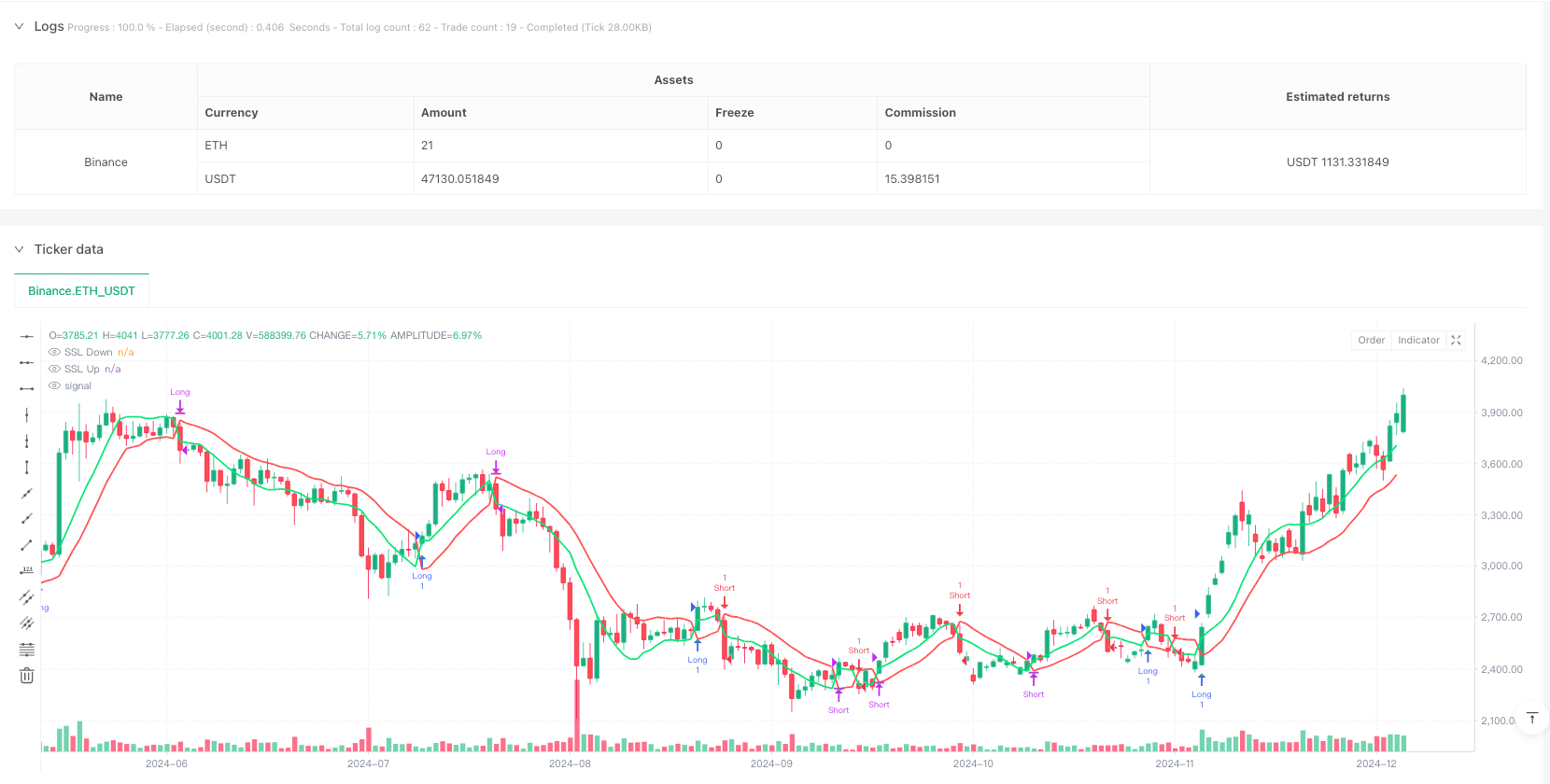
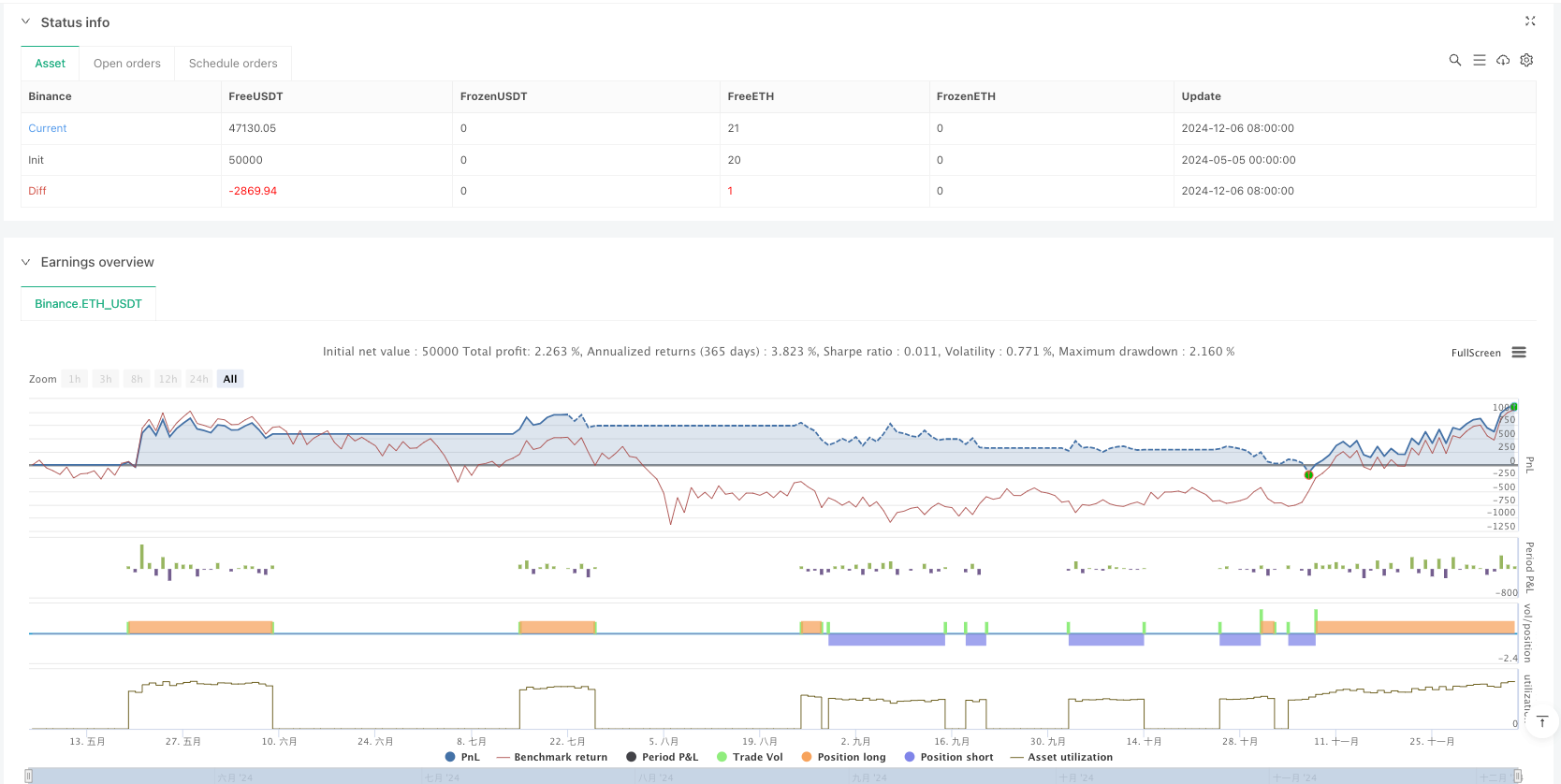
[trans]
概述
SSL通道双阶梯利润策略是一种基于SSL通道(Semantic SSL Channel)指标的量化交易系统,该策略结合了趋势跟踪与精细的仓位管理方法。该策略核心是通过SSL通道的穿越信号来确定市场趋势方向,并在趋势反转时入场交易。其独特之处在于采用了双阶梯退出机制——将仓位分为两部分:第一部分在达到固定盈利目标时退出,第二部分则通过移动止损进行管理,以最大化捕捉趋势行情。此外,策略还整合了平均真实波幅(ATR)指标进行动态风险管理,使风险控制更加精准且适应市场波动性变化。
策略原理
SSL通道双阶梯利润策略的技术原理主要包含以下几个关键组成部分:
-
SSL通道构建:策略首先计算高价和低价的简单移动平均线(SMA),分别作为SSL通道的基础。通过设定趋势状态变量Hlv(基于收盘价与高价SMA和低价SMA的关系),确定上行通道线和下行通道线的位置。
-
趋势识别机制:当收盘价突破高价SMA时,Hlv值设为1(上升趋势);当收盘价跌破低价SMA时,Hlv值设为-1(下降趋势)。策略在Hlv从-1变为1时产生买入信号,在Hlv从1变为-1时产生卖出信号。
-
双阶梯退出系统:
- 第一阶梯(50%仓位):设定固定盈利目标为1倍ATR
- 第二阶梯(剩余50%仓位):在第一阶梯达到后,初始将止损移至入场价格(保本位),并在价格达到2倍ATR盈利时启动移动止损机制
-
动态风险管理:
- 入场时设置初始止损为1.5倍ATR
- 第一阶梯盈利后,止损移至保本位置
- 价格进一步突破后,采用基于ATR的移动止损(追踪高点或低点减去/加上1倍ATR)
-
趋势反转保护:无论价格是否达到止损或止盈条件,当SSL通道翻转(即产生相反方向的信号)时,策略会立即平仓以保护已有利润。
策略优势
通过对代码的深入分析,该策略展现出多方面的优势:
-
趋势捕捉能力:策略利用SSL通道指标有效识别市场趋势转变点,能够及时捕捉趋势初始阶段,同时在趋势反转时迅速退出,避免回撤。
-
风险分散机制:双阶梯退出设计使策略在保守和进取之间取得平衡,既能锁定部分利润,又能最大程度地捕捉延续性趋势。
-
动态适应市场波动:通过整合ATR指标,策略能够根据市场实际波动幅度自动调整止损和止盈水平,使其在不同波动率环境中都能保持良好表现。
-
灵活的资金管理:50%仓位的分阶段管理方式既保障了稳定收益,又为最大化潜在利润创造了条件,使策略能够在不同市场环境中保持竞争力。
-
自适应性保护机制:随着价格向有利方向移动,移动止损系统自动提升保护水平,确保在行情逆转时能够保留大部分收益。
-
清晰的进出场逻辑:策略的信号系统简洁明了,避免了过度优化和复杂参数设置,提高了策略在实盘环境中的可靠性和稳定性。
策略风险
尽管该策略设计精巧,但仍存在以下潜在风险和局限性:
-
震荡市场表现欠佳:作为趋势跟踪策略,在横盘震荡市场中可能产生频繁的假信号,导致连续亏损交易。解决方法:可考虑增加范围波动指标过滤信号,或在震荡市场中暂停交易。
-
固定ATR倍数风险:策略使用固定的ATR倍数设置止损和止盈,这在极端市场条件下可能不够灵活。解决方法:考虑根据历史波动率分位数动态调整ATR倍数,或增加波动率适应机制。
-
缺乏市场环境过滤:策略未区分不同的市场环境,可能在不适合趋势跟踪的阶段持续交易。解决方法:引入市场环境分类指标,如ADX或波动率指标,在低趋势强度环境中减少交易频率。
-
第一阶梯过早退出风险:固定1倍ATR的盈利目标可能在强趋势中过早退出50%仓位,降低整体收益。解决方法:可考虑根据趋势强度动态调整第一阶梯的盈利目标。
-
缺乏仓位规模优化:代码中没有根据风险调整仓位大小的机制,可能导致风险敞口不均衡。解决方法:引入基于波动率的仓位大小计算,确保每笔交易的风险暴露一致。
策略优化方向
基于代码分析,以下是该策略可改进的优化方向:
-
加入市场过滤条件:引入ADX(平均方向指数)或类似指标衡量趋势强度,仅在趋势明显的市场环境中交易,避免震荡市场的假信号。这样可以显著提高信号质量和整体胜率。
-
动态调整ATR倍数:根据历史波动率水平自动调整ATR倍数,在低波动率环境中使用更大倍数,高波动率环境中使用更小倍数,以适应不同市场条件。
-
优化第一阶梯退出机制:可考虑在强趋势确认后(如趋势持续时间或强度达到特定阈值)减少第一阶梯的退出比例,或设置动态退出目标,而不是固定的50%。
-
加入多时间框架确认:整合更长时间周期的趋势方向作为过滤条件,确保在主趋势方向上进行交易,提高成功率。
-
引入交易量确认:将成交量作为额外的确认指标,只有在成交量增加的情况下才确认趋势变化信号,减少虚假突破。
-
优化移动止损机制:当前移动止损基于收盘价,可考虑使用Chandelier Exit或Parabolic SAR等更专业的移动止损系统,提高止损的灵敏度和精确度。
-
季节性和时间过滤:分析策略在不同时间段、季节性周期的表现,在历史表现最佳的时段增加仓位,或仅在特定时间段内交易。
总结
SSL通道双阶梯利润策略是一个结合了技术指标和精细仓位管理的全面交易系统。其核心优势在于有效的趋势捕捉能力和风险控制机制,特别是双阶梯退出系统的设计,在保护资金安全和最大化趋势收益之间取得了良好平衡。
通过使用SSL通道指标作为趋势识别工具,结合ATR动态风险管理体系,策略能够适应不同市场条件下的波动性变化。双阶梯退出设计不仅提供了稳定的利润锁定机制,同时也保留了捕捉大趋势的可能性。
尽管在震荡市场环境中可能面临挑战,但通过引入趋势强度过滤、优化ATR参数设置、改进移动止损机制等措施,该策略有很大的提升空间。特别是加入多时间框架确认和交易量分析,可以进一步提高信号质量和整体胜率。
总体而言,SSL通道双阶梯利润策略展现了量化交易系统设计的核心要素:明确的进出场规则、系统的风险管理和适应市场变化的能力。对于寻求趋势跟踪策略的交易者来说,该策略提供了一个坚实的基础框架,在此基础上可以根据个人风险偏好和交易目标进行进一步定制和优化。 ||
Overview
The SSL Channel Dual-Tranche Profit Strategy is a quantitative trading system based on the SSL Channel (Semantic SSL Channel) indicator, combining trend following with sophisticated position management methods. The core of this strategy is to determine market trend direction through SSL channel crossover signals and enter trades when trends reverse. Its distinctive feature is the dual-tranche exit mechanism—dividing positions into two parts: the first part exits at a fixed profit target, while the second part is managed through a trailing stop to maximize capture of trending markets. Additionally, the strategy integrates the Average True Range (ATR) indicator for dynamic risk management, making risk control more precise and adaptable to changes in market volatility.
Strategy Principles
The technical principles of the SSL Channel Dual-Tranche Profit Strategy include the following key components:
-
SSL Channel Construction: The strategy first calculates Simple Moving Averages (SMAs) of high and low prices, which serve as the foundation for the SSL channel. By setting a trend state variable Hlv (based on the relationship between closing price and high/low SMAs), it determines the positions of the upper and lower channel lines.
-
Trend Identification Mechanism: When the closing price breaks above the high price SMA, the Hlv value is set to 1 (uptrend); when the closing price falls below the low price SMA, the Hlv value is set to -1 (downtrend). The strategy generates a buy signal when Hlv changes from -1 to 1, and a sell signal when Hlv changes from 1 to -1.
-
Dual-Tranche Exit System:
- First tranche (50% position): Sets a fixed profit target of 1x ATR
- Second tranche (remaining 50%): After the first tranche is achieved, initially moves the stop-loss to entry price (breakeven), and activates a trailing stop mechanism when the price reaches 2x ATR profit
-
Dynamic Risk Management:
- Sets initial stop-loss at 1.5x ATR at entry
- Moves stop-loss to breakeven after first tranche profit
- Implements ATR-based trailing stop (tracking highest/lowest points minus/plus 1x ATR) after further price breakout
-
Trend Reversal Protection: Regardless of whether price reaches stop-loss or take-profit conditions, when the SSL channel flips (generating an opposite signal), the strategy immediately closes positions to protect existing profits.
Strategy Advantages
Through in-depth analysis of the code, this strategy demonstrates multiple advantages:
-
Trend Capture Capability: The strategy effectively identifies market trend turning points using the SSL Channel indicator, capturing the initial phase of trends in a timely manner while quickly exiting during trend reversals to avoid drawdowns.
-
Risk Diversification Mechanism: The dual-tranche exit design strikes a balance between conservative and aggressive approaches, both locking in partial profits and maximizing the capture of extended trends.
-
Dynamic Adaptation to Market Volatility: By integrating the ATR indicator, the strategy automatically adjusts stop-loss and take-profit levels according to actual market volatility, maintaining good performance in different volatility environments.
-
Flexible Capital Management: The 50% position stage management method both ensures stable returns and creates conditions for maximizing potential profits, enabling the strategy to remain competitive in different market environments.
-
Adaptive Protection Mechanism: As prices move favorably, the trailing stop system automatically elevates protection levels, ensuring that most gains are preserved when the market reverses.
-
Clear Entry and Exit Logic: The strategy's signal system is concise and straightforward, avoiding excessive optimization and complex parameter settings, enhancing the reliability and stability of the strategy in live trading environments.
Strategy Risks
Despite its sophisticated design, the strategy still has the following potential risks and limitations:
-
Poor Performance in Ranging Markets: As a trend-following strategy, it may generate frequent false signals in sideways consolidating markets, leading to consecutive losing trades. Solution: Consider adding range-bound indicators to filter signals, or pause trading during consolidation phases.
-
Fixed ATR Multiplier Risk: The strategy uses fixed ATR multipliers for setting stop-losses and take-profits, which may not be flexible enough in extreme market conditions. Solution: Consider dynamically adjusting ATR multipliers based on historical volatility percentiles, or adding volatility adaptation mechanisms.
-
Lack of Market Environment Filtering: The strategy does not differentiate between different market environments, potentially continuing to trade during phases unsuitable for trend following. Solution: Introduce market environment classification indicators, such as ADX or volatility indicators, to reduce trading frequency in low trend-strength environments.
-
Early Exit Risk for First Tranche: The fixed 1x ATR profit target may exit 50% of the position too early in strong trends, reducing overall returns. Solution: Consider dynamically adjusting the first tranche profit target based on trend strength.
-
Lack of Position Sizing Optimization: The code lacks a mechanism to adjust position size based on risk, potentially leading to unbalanced risk exposure. Solution: Introduce volatility-based position size calculations to ensure consistent risk exposure for each trade.
Strategy Optimization Directions
Based on code analysis, here are improvement directions for the strategy:
-
Add Market Filtering Conditions: Introduce ADX (Average Directional Index) or similar indicators to measure trend strength, trading only in obvious trending market environments to avoid false signals in ranging markets. This can significantly improve signal quality and overall win rate.
-
Dynamic Adjustment of ATR Multipliers: Automatically adjust ATR multipliers based on historical volatility levels, using larger multipliers in low-volatility environments and smaller multipliers in high-volatility environments to adapt to different market conditions.
-
Optimize First Tranche Exit Mechanism: Consider reducing the exit proportion of the first tranche after strong trend confirmation (such as when trend duration or strength reaches specific thresholds), or setting dynamic exit targets rather than a fixed 50%.
-
Incorporate Multi-Timeframe Confirmation: Integrate trend direction from longer timeframes as filtering conditions to ensure trading in the direction of the main trend, improving success rates.
-
Introduce Volume Confirmation: Use volume as an additional confirmation indicator, only confirming trend change signals when volume increases, reducing false breakouts.
-
Optimize Trailing Stop Mechanism: The current trailing stop is based on closing prices; consider using more professional trailing stop systems such as Chandelier Exit or Parabolic SAR to improve the sensitivity and precision of stops.
-
Seasonality and Time Filtering: Analyze strategy performance across different time periods and seasonal cycles, increasing position size during historically best-performing periods, or only trading during specific time periods.
Summary
The SSL Channel Dual-Tranche Profit Strategy is a comprehensive trading system combining technical indicators with sophisticated position management. Its core strengths lie in effective trend capture capability and risk control mechanisms, particularly the dual-tranche exit system design, which achieves a good balance between protecting capital safety and maximizing trend returns.
By using the SSL Channel indicator as a trend identification tool, combined with an ATR dynamic risk management system, the strategy can adapt to volatility changes under different market conditions. The dual-tranche exit design not only provides a stable profit-locking mechanism but also retains the possibility of capturing major trends.
Although it may face challenges in ranging market environments, there is significant room for improvement through introducing trend strength filtering, optimizing ATR parameter settings, and improving trailing stop mechanisms. Particularly, adding multi-timeframe confirmation and volume analysis can further enhance signal quality and overall win rate.
Overall, the SSL Channel Dual-Tranche Profit Strategy demonstrates the core elements of quantitative trading system design: clear entry and exit rules, systematic risk management, and the ability to adapt to market changes. For traders seeking trend-following strategies, this strategy provides a solid foundational framework upon which further customization and optimization can be built according to individual risk preferences and trading objectives.[/trans]
Source (PineScript)
/*backtest
start: 2024-05-05 00:00:00
end: 2024-12-07 00:00:00
period: 1d
basePeriod: 1d
exchanges: [{"eid":"Binance","currency":"ETH_USDT"}]
*/

// This Pine Script™ code is subject to the terms of the Mozilla Public License 2.0 at https://mozilla.org/MPL/2.0/
// © AlanCaoShengJin

//@version=5
strategy("SSL Channel Strategy with Two-Tranche Exits", overlay=true)

// Inputs
len = input.int(10, title="Period")
atrPeriod = input.int(14, title="ATR Period")

// Calculate SMAs and ATR
smaHigh = ta.sma(high, len)
smaLow = ta.sma(low, len)
atrValue = ta.atr(atrPeriod)

// Trend state (Hlv)
var int Hlv = na
Hlv := close > smaHigh ? 1 : close < smaLow ? -1 : Hlv[1]

// SSL channel lines
sslDown = Hlv < 0 ? smaHigh : smaLow
sslUp   = Hlv < 0 ? smaLow : smaHigh

// Plot SSL lines
plot(sslDown, title="SSL Down", color=color.red, linewidth=2)
plot(sslUp, title="SSL Up", color=color.lime, linewidth=2)

// Trading signals
buySignal = Hlv[1] == -1 and Hlv == 1
sellSignal = Hlv[1] == 1 and Hlv == -1

// Plot signals for debugging
plotshape(buySignal, title="Buy Signal", style=shape.triangleup, location=location.belowbar, color=color.green, size=size.small)
plotshape(sellSignal, title="Sell Signal", style=shape.triangledown, location=location.abovebar, color=color.red, size=size.small)

// Variables for long trade management
var float longEntryPrice = na
var float longAtrAtEntry = na
var float longEntryQty = na
var bool longFirstTrancheTaken = false
var float longTrailingStopPrice = na
var int longTrailingStartBar = na

// Variables for short trade management
var float shortEntryPrice = na
var float shortAtrAtEntry = na
var float shortEntryQty = na
var bool shortFirstTrancheTaken = false
var float shortTrailingStopPrice = na
var int shortTrailingStartBar = na

// Reset variables when no position is open
if strategy.position_size == 0
    longEntryPrice := na
    longAtrAtEntry := na
    longEntryQty := na
    longFirstTrancheTaken := false
    longTrailingStopPrice := na
    longTrailingStartBar := na
    shortEntryPrice := na
    shortAtrAtEntry := na
    shortEntryQty := na
    shortFirstTrancheTaken := false
    shortTrailingStopPrice := na
    shortTrailingStartBar := na

// **Long Trade Logic**

// Entry for long trades
if buySignal and strategy.position_size == 0
    strategy.entry("Long", strategy.long)
    longEntryPrice := close
    longAtrAtEntry := atrValue
    longEntryQty := strategy.position_size
    longFirstTrancheTaken := false
    longTrailingStartBar := na
    // Set take-profit for first tranche (50%) at 1x ATR
    strategy.exit("Long TP1", "Long", limit=longEntryPrice + longAtrAtEntry, qty=longEntryQty / 2)
    // Set initial stop-loss at 1.5x ATR below entry
    strategy.exit("Long SL", "Long", stop=longEntryPrice - 1.5 * longAtrAtEntry)

// Manage long trade
if strategy.position_size > 0
    // Detect if first tranche has been taken
    if not longFirstTrancheTaken and strategy.position_size < longEntryQty
        longFirstTrancheTaken := true
        // Move stop-loss to breakeven
        strategy.exit("Long SL", "Long", stop=longEntryPrice)
        // Add a label for debugging
        label.new(bar_index, high, "First Tranche Taken", color=color.blue, style=label.style_label_down)

    // After first tranche, manage the remaining 50%
    if longFirstTrancheTaken
        // Initiate trailing stop at 2x ATR
        if close >= longEntryPrice + 2 * longAtrAtEntry and na(longTrailingStartBar)
            longTrailingStartBar := bar_index
            // Add a label for debugging
            label.new(bar_index, high, "Trailing Stop Initiated", color=color.purple, style=label.style_label_down)
        // Update trailing stop
        if not na(longTrailingStartBar)
            highestCloseSinceTrail = ta.highest(close, bar_index - longTrailingStartBar + 1)
            longTrailingStopPrice := highestCloseSinceTrail - longAtrAtEntry
            strategy.exit("Long SL", "Long", stop=longTrailingStopPrice)


// Exit long trade on SSL channel flip
if strategy.position_size > 0 and sellSignal
    strategy.close("Long", comment="SSL Flip")

// **Short Trade Logic**

// Entry for short trades
if sellSignal and strategy.position_size == 0
    strategy.entry("Short", strategy.short)
    shortEntryPrice := close
    shortAtrAtEntry := atrValue
    shortEntryQty := strategy.position_size
    shortFirstTrancheTaken := false
    shortTrailingStartBar := na
    // Set take-profit for first tranche (50%) at 1x ATR below entry
    strategy.exit("Short TP1", "Short", limit=shortEntryPrice - shortAtrAtEntry, qty=math.abs(shortEntryQty) / 2)
    // Set initial stop-loss at 1.5x ATR above entry
    strategy.exit("Short SL", "Short", stop=shortEntryPrice + 1.5 * shortAtrAtEntry)

// Manage short trade
if strategy.position_size < 0
    // Detect if first tranche has been taken
    if not shortFirstTrancheTaken and strategy.position_size > shortEntryQty
        shortFirstTrancheTaken := true
        // Move stop-loss to breakeven
        strategy.exit("Short SL", "Short", stop=shortEntryPrice)
        // Add a label for debugging
        label.new(bar_index, low, "First Tranche Taken", color=color.blue, style=label.style_label_up)

    // After first tranche, manage the remaining 50%
    if shortFirstTrancheTaken
        // Initiate trailing stop at 2x ATR
        if close <= shortEntryPrice - 2 * shortAtrAtEntry and na(shortTrailingStartBar)
            shortTrailingStartBar := bar_index
            // Add a label for debugging
            label.new(bar_index, low, "Trailing Stop Initiated", color=color.purple, style=label.style_label_up)
        // Update trailing stop
        if not na(shortTrailingStartBar)
            lowestCloseSinceTrail = ta.lowest(close, bar_index - shortTrailingStartBar + 1)
            shortTrailingStopPrice := lowestCloseSinceTrail + shortAtrAtEntry
            strategy.exit("Short SL", "Short", stop=shortTrailingStopPrice)


// Exit short trade on SSL channel flip
if strategy.position_size < 0 and buySignal
    strategy.close("Short", comment="SSL Flip")
Detail
https://www.fmz.com/strategy/483937
Last Modified
2025-04-03 15:25:40