
17 KiB
Name
SMA-ATR动态风险回报比趋势跟踪策略-SMA-ATR-Dynamic-Risk-Reward-Trend-Following-Strategy
Author
ianzeng123
Strategy Description
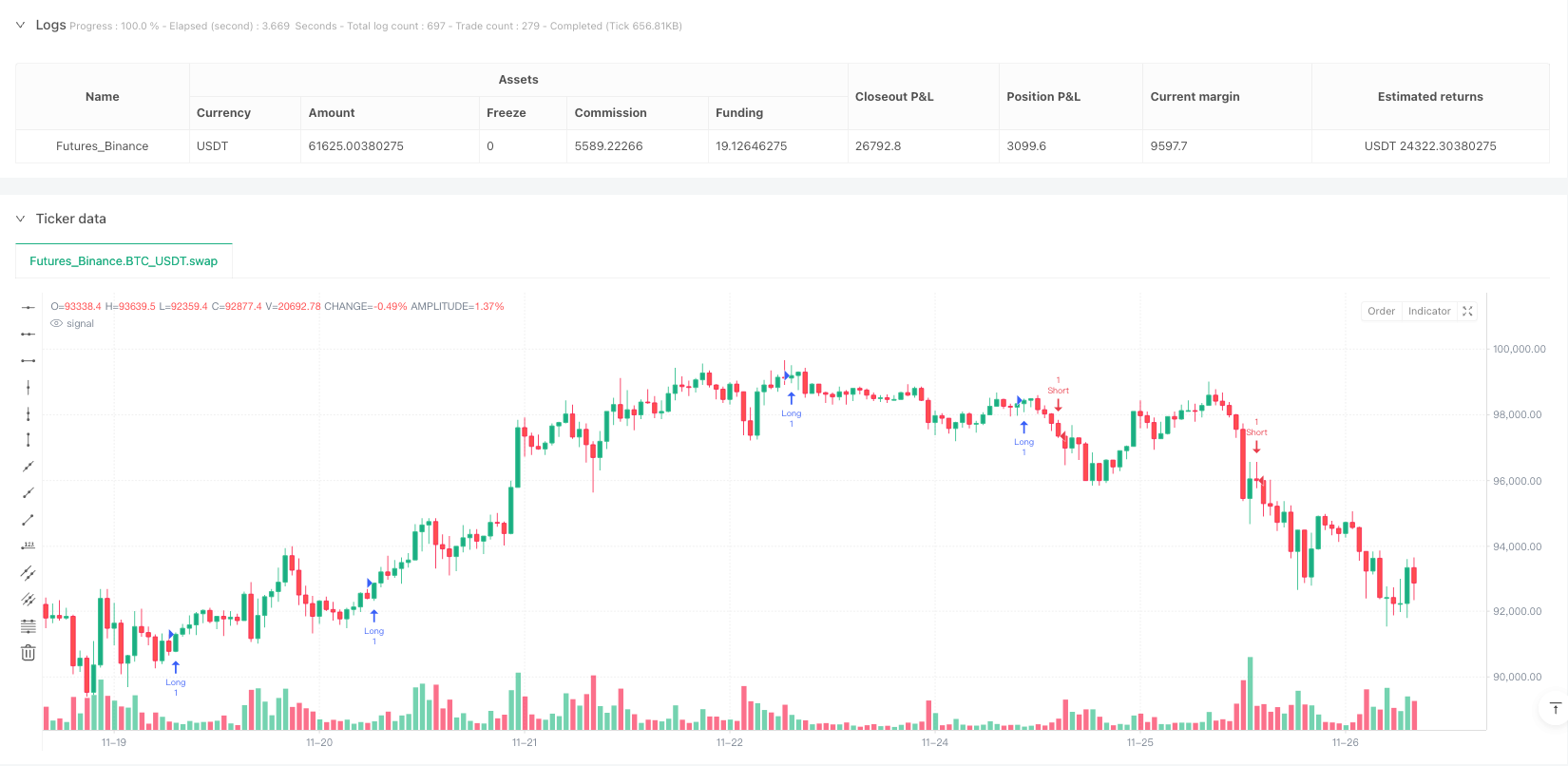
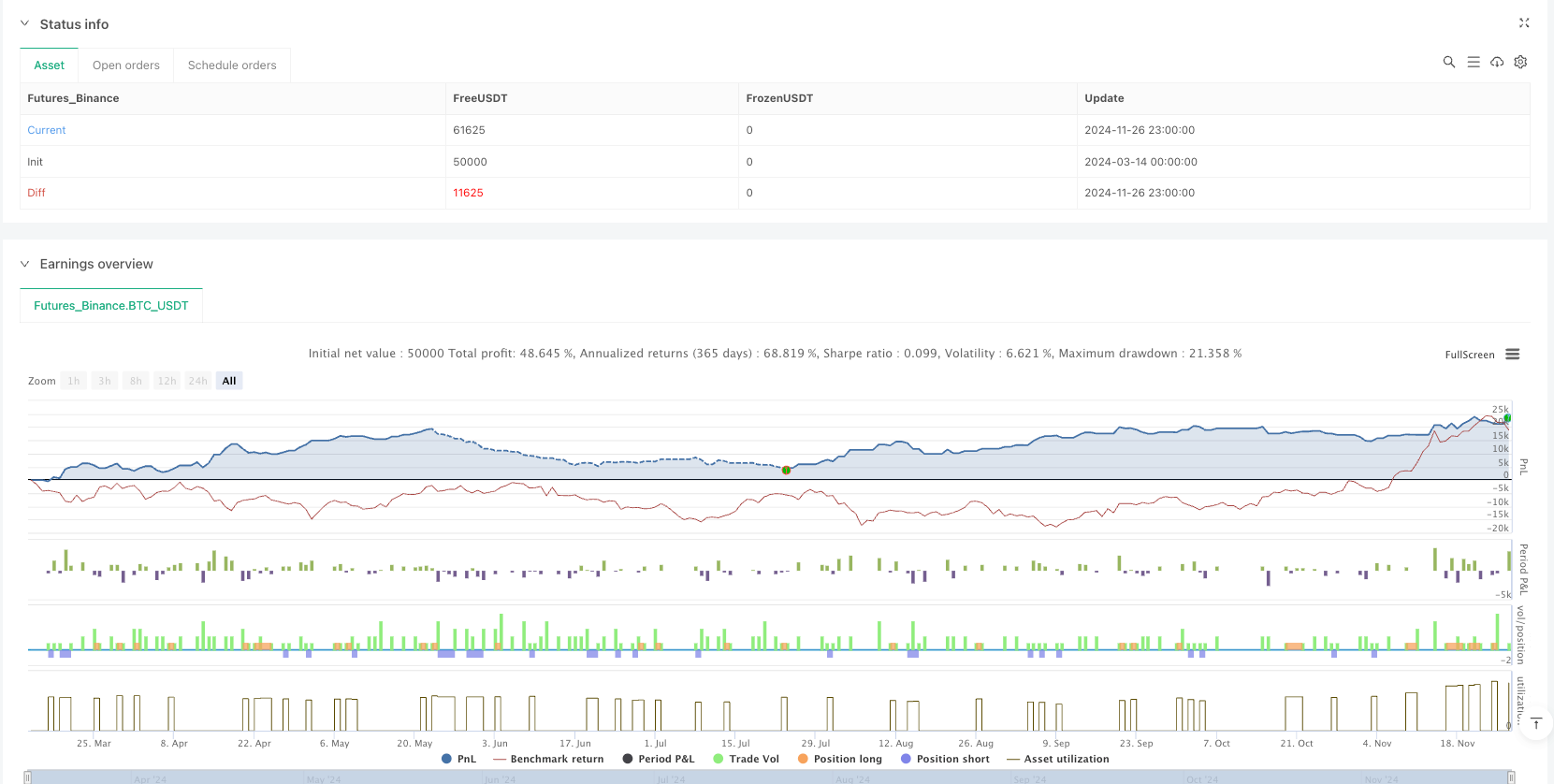
[trans]
概述
SMA-ATR动态风险回报比趋势跟踪策略是一种技术分析驱动的量化交易系统,该策略巧妙地结合了三重简单移动平均线(SMA)和真实波幅(ATR)指标来识别市场趋势并执行交易。该策略的核心特点是采用动态风险回报比率,根据特定市场条件自动调整止盈水平,从而在不同市场环境中优化交易表现。策略利用7、25和99周期的SMA交叉信号确定入场点,并使用ATR指标设置止损和止盈位置,形成一个完整的趋势跟踪交易系统。
策略原理
该策略的运作原理基于多周期移动平均线交叉系统与动态风险管理的结合:
-
趋势识别机制:
- 使用三重SMA(7、25和99周期)建立多层次趋势确认系统
- 当短期SMA(7周期)上穿中期SMA(25周期)且价格位于长期SMA(99周期)上方时,触发做多信号
- 当短期SMA(7周期)下穿中期SMA(25周期)且价格位于长期SMA(99周期)下方时,触发做空信号
-
动态风险回报比调整:
- 默认风险回报比为2.0倍
- 在特定条件下(短期SMA与长期SMA或中期SMA交叉),风险回报比自动提高至6.0倍
- 这种调整允许策略在强趋势信号出现时追求更高的利润目标
-
ATR基础的风险管理:
- 使用14周期ATR乘以自定义乘数(默认1.0)计算波动性
- 多头止损设置在低点减去ATR值的位置
- 空头止损设置在高点加上ATR值的位置
- 止盈水平基于当前价格加上或减去(ATR乘以风险回报比)计算
策略的核心逻辑在于通过多周期移动平均线确认趋势方向,同时根据市场条件动态调整风险回报率,在强趋势环境中追求更高收益,实现智能化风险管理。
策略优势
-
多层次趋势确认:
- 三重SMA系统提供多层次趋势确认,减少假突破交易
- 短期、中期和长期SMA的组合有效过滤市场噪音
- 价格相对于长期SMA的位置提供额外的趋势确认,增强信号可靠性
-
动态风险管理:
- 风险回报比根据信号强度自动调整,优化资金管理
- 在强信号(如短期SMA与长期SMA交叉)时追求更高收益
- 灵活的风险管理框架适应不同市场条件
-
基于市场波动性的止损策略:
- ATR指标确保止损水平基于实际市场波动性设置
- 自适应止损机制,在波动性增加时自动扩大止损范围,在波动性减小时收窄止损范围
- 止损设计考虑价格的自然波动,减少被市场噪音触发的概率
-
完整的交易系统:
- 策略包含明确的入场、出场和风险管理规则,形成完整交易系统
- 自动化执行减少情绪干扰
- 适合不同市场条件的自适应参数调整
策略风险
-
趋势反转风险:
- 作为趋势跟踪策略,在市场横盘或快速反转时可能表现不佳
- 三重SMA系统可能在震荡市场中产生频繁的假信号
- 缓解方法:可以添加额外过滤器(如波动率指标或动量确认)减少震荡市场中的交易频率
-
固定ATR乘数的局限性:
- 当前策略使用固定的ATR乘数(1.0),可能不适合所有市场环境
- 在极端波动期间,固定乘数可能导致止损过宽或过窄
- 解决方案:考虑实现自适应ATR乘数,根据历史波动率统计动态调整
-
参数敏感性:
- SMA周期(7、25、99)的选择可能对策略性能产生显著影响
- 过度优化风险 - 特定参数组合可能仅在特定市场条件下表现良好
- 风险缓解:进行稳健性测试,评估参数微小变化对策略性能的影响
-
滑点和流动性风险:
- 在低流动性市场或高波动期间,可能面临执行滑点问题
- 基于ATR的止损和止盈可能在极端市场条件下不足以保护资本
- 解决方法:增加保证金要求,减小仓位大小,或在波动性异常高时暂停交易
策略优化方向
-
增加过滤信号机制:
- 加入趋势强度指标(如ADX),仅在确认趋势强度达到阈值时进行交易
- 整合成交量确认,要求信号出现时成交量增加,提高信号质量
- 原理:多指标确认能显著减少假信号,提高胜率
-
实现自适应参数:
- 将固定的SMA周期改为基于市场波动性或周期性自动调整的动态参数
- 根据历史波动率统计调整ATR乘数,在低波动期使用较小乘数,高波动期使用较大乘数
- 好处:自适应参数能更好适应不同市场环境,提高策略稳健性
-
优化动态风险回报调整机制:
- 将当前的二元风险回报机制(2.0或6.0)改为连续调整模型
- 基于趋势强度指标(如ADX)、市场波动率或最近交易表现动态调整风险回报比
- 改进理由:更细致的风险回报调整能更准确地反映市场状态,优化资金管理效果
-
添加时间过滤器:
- 分析不同时间段(日内、日间、周间)的策略表现,避免在表现不佳的时段交易
- 考虑市场季节性因素,调整在特定市场环境下的交易频率
- 优势:时间过滤可以避免在统计上不利的时段交易,提高整体表现
-
集成机器学习模型:
- 使用机器学习算法预测SMA交叉信号的可靠性
- 基于历史数据训练模型,识别高概率获利的市场模式
- 价值:机器学习可以发现传统技术指标难以捕捉的复杂模式,提高策略预测能力
总结
SMA-ATR动态风险回报比趋势跟踪策略提供了一个结构完善的趋势跟踪交易系统,通过多周期移动平均线识别市场趋势,并结合ATR指标实现动态风险管理。策略最显著的创新点在于根据特定市场条件自动调整风险回报比,使交易系统能够在强趋势环境中追求更高收益,同时在常规交易中保持稳健的风险控制。
该策略结合了技术分析的经典元素(SMA交叉、ATR止损)与现代量化交易概念(动态风险管理),适合中长期趋势跟踪交易。虽然策略在震荡市场中可能面临挑战,但通过建议的优化方向(如增加过滤器、自适应参数和机器学习集成),可以进一步提高其在不同市场环境中的表现。
总体而言,这是一个平衡了简洁性和有效性的量化交易策略,为趋势跟踪交易者提供了一个可靠的框架,同时通过动态风险管理元素增强了策略的适应性和盈利潜力。 ||
Overview
The SMA-ATR Dynamic Risk-Reward Trend Following Strategy is a technical analysis-driven quantitative trading system that cleverly combines triple Simple Moving Averages (SMA) and Average True Range (ATR) indicators to identify market trends and execute trades. The core feature of this strategy is its dynamic risk-reward ratio, which automatically adjusts profit targets based on specific market conditions, thereby optimizing trading performance across different market environments. The strategy uses SMA crossovers with periods of 7, 25, and 99 to determine entry points, and utilizes the ATR indicator to set stop-loss and take-profit levels, forming a complete trend-following trading system.
Strategy Principles
The strategy operates based on a combination of multi-period moving average crossover systems and dynamic risk management:
-
Trend Identification Mechanism:
- Uses triple SMAs (7, 25, and 99 periods) to establish a multi-layered trend confirmation system
- Triggers a long signal when the short-term SMA (7-period) crosses above the medium-term SMA (25-period) and price is above the long-term SMA (99-period)
- Triggers a short signal when the short-term SMA (7-period) crosses below the medium-term SMA (25-period) and price is below the long-term SMA (99-period)
-
Dynamic Risk-Reward Ratio Adjustment:
- Default risk-reward ratio is 2.0
- Under specific conditions (when short-term SMA crosses the long-term SMA or medium-term SMA), the risk-reward ratio automatically increases to 6.0
- This adjustment allows the strategy to pursue higher profit targets when strong trend signals appear
-
ATR-Based Risk Management:
- Uses 14-period ATR multiplied by a custom multiplier (default 1.0) to calculate volatility
- Long stop-loss is set at the low minus the ATR value
- Short stop-loss is set at the high plus the ATR value
- Take-profit levels are calculated based on current price plus or minus (ATR multiplied by the risk-reward ratio)
The core logic of the strategy is to confirm trend direction through multi-period moving averages while dynamically adjusting the risk-reward ratio based on market conditions, pursuing higher returns in strong trending environments and implementing intelligent risk management.
Strategy Advantages
-
Multi-Layered Trend Confirmation:
- Triple SMA system provides multi-layered trend confirmation, reducing false breakout trades
- The combination of short, medium, and long-term SMAs effectively filters market noise
- Price position relative to the long-term SMA provides additional trend confirmation, enhancing signal reliability
-
Dynamic Risk Management:
- Risk-reward ratio automatically adjusts based on signal strength, optimizing capital management
- Pursues higher returns when strong signals (such as short-term SMA crossing long-term SMA) occur
- Flexible risk management framework adapts to different market conditions
-
Volatility-Based Stop-Loss Strategy:
- ATR indicator ensures stop-loss levels are set based on actual market volatility
- Adaptive stop-loss mechanism automatically widens stop-loss range when volatility increases and narrows it when volatility decreases
- Stop-loss design considers natural price fluctuations, reducing the probability of being triggered by market noise
-
Complete Trading System:
- Strategy includes clear entry, exit, and risk management rules, forming a complete trading system
- Automated execution reduces emotional interference
- Adaptive parameter adjustments suitable for different market conditions
Strategy Risks
-
Trend Reversal Risk:
- As a trend-following strategy, it may perform poorly in ranging markets or during rapid reversals
- The triple SMA system may generate frequent false signals in oscillating markets
- Mitigation method: Additional filters (such as volatility indicators or momentum confirmation) can be added to reduce trading frequency in oscillating markets
-
Limitations of Fixed ATR Multiplier:
- The current strategy uses a fixed ATR multiplier (1.0), which may not be suitable for all market environments
- During periods of extreme volatility, a fixed multiplier may result in stop-losses that are too wide or too narrow
- Solution: Consider implementing an adaptive ATR multiplier that dynamically adjusts based on historical volatility statistics
-
Parameter Sensitivity:
- The selection of SMA periods (7, 25, 99) may significantly impact strategy performance
- Risk of over-optimization - specific parameter combinations may only perform well under specific market conditions
- Risk mitigation: Conduct robustness testing to evaluate the impact of small parameter changes on strategy performance
-
Slippage and Liquidity Risk:
- May face execution slippage issues in low liquidity markets or during high volatility periods
- ATR-based stop-losses and take-profits may not be sufficient to protect capital under extreme market conditions
- Solution: Increase margin requirements, reduce position size, or pause trading during abnormally high volatility
Strategy Optimization Directions
-
Add Signal Filtering Mechanisms:
- Incorporate trend strength indicators (such as ADX), only trading when trend strength reaches a threshold
- Integrate volume confirmation, requiring increased volume when signals appear to improve signal quality
- Rationale: Multi-indicator confirmation can significantly reduce false signals and improve win rate
-
Implement Adaptive Parameters:
- Change fixed SMA periods to dynamic parameters that automatically adjust based on market volatility or cyclicality
- Adjust the ATR multiplier based on historical volatility statistics, using smaller multipliers during low volatility periods and larger multipliers during high volatility periods
- Benefit: Adaptive parameters can better accommodate different market environments, improving strategy robustness
-
Optimize Dynamic Risk-Reward Adjustment Mechanism:
- Transform the current binary risk-reward mechanism (2.0 or 6.0) into a continuous adjustment model
- Dynamically adjust the risk-reward ratio based on trend strength indicators (such as ADX), market volatility, or recent trading performance
- Improvement rationale: More detailed risk-reward adjustments can more accurately reflect market conditions, optimizing capital management effects
-
Add Time Filters:
- Analyze strategy performance across different time periods (intraday, daily, weekly), avoiding trading during underperforming periods
- Consider market seasonality factors, adjusting trading frequency in specific market environments
- Advantage: Time filtering can avoid trading during statistically unfavorable periods, improving overall performance
-
Integrate Machine Learning Models:
- Use machine learning algorithms to predict the reliability of SMA crossover signals
- Train models based on historical data to identify high-probability profitable market patterns
- Value: Machine learning can discover complex patterns difficult to capture with traditional technical indicators, enhancing strategy prediction capabilities
Summary
The SMA-ATR Dynamic Risk-Reward Trend Following Strategy provides a well-structured trend-following trading system that identifies market trends through multi-period moving averages and implements dynamic risk management using the ATR indicator. The most significant innovation of the strategy is its automatic adjustment of the risk-reward ratio based on specific market conditions, allowing the trading system to pursue higher returns in strong trending environments while maintaining robust risk control during regular trading.
This strategy combines classic elements of technical analysis (SMA crossovers, ATR stop-losses) with modern quantitative trading concepts (dynamic risk management), making it suitable for medium to long-term trend-following trading. While the strategy may face challenges in oscillating markets, through the suggested optimization directions (such as adding filters, adaptive parameters, and machine learning integration), its performance across different market environments can be further improved.
Overall, this is a quantitative trading strategy that balances simplicity and effectiveness, providing trend-following traders with a reliable framework while enhancing the strategy's adaptability and profit potential through dynamic risk management elements. [/trans]
Source (PineScript)
/*backtest
start: 2024-03-14 00:00:00
end: 2024-11-27 00:00:00
period: 1h
basePeriod: 1h
exchanges: [{"eid":"Futures_Binance","currency":"BTC_USDT"}]
*/

//@version=5
strategy("TRH Backtest SMA ATR Variable RR", overlay=true)

// SMA Settings
sma7 = ta.sma(close, 7)
sma25 = ta.sma(close, 25)
sma99 = ta.sma(close, 99)

// ATR Settings
atrLength = input.int(14, title="ATR Length")
atrMultiplier = input.float(1.0, title="ATR Multiplier")
atr = ta.atr(atrLength) * atrMultiplier

// Entry and Exit Conditions
longCondition = ta.crossover(sma7, sma25) and close > sma99
shortCondition = ta.crossunder(sma7, sma25) and close < sma99
longCross = ta.crossover(sma7, sma99) or ta.crossover(sma7, sma25)
shortCross = ta.crossunder(sma7, sma99) or ta.crossunder(sma7, sma25)

// Trade Execution
if (longCondition)
    strategy.entry("Long", strategy.long)

if (shortCondition)
    strategy.entry("Short", strategy.short)

// Variable Risk Reward
riskRewardRatio = 2.0
if (longCross or shortCross)
    riskRewardRatio = 6.0

// ATR Based Stop Loss and Take Profit
longStopLoss = low - atr
shortStopLoss = high + atr
longTakeProfit = close + (atr * riskRewardRatio)
shortTakeProfit = close - (atr * riskRewardRatio)

// Apply Stop Loss and Take Profit
strategy.exit("Exit Long", "Long", stop=longStopLoss, limit=longTakeProfit)
strategy.exit("Exit Short", "Short", stop=shortStopLoss, limit=shortTakeProfit)
Detail
https://www.fmz.com/strategy/486571
Last Modified
2025-03-14 09:45:55