
11 KiB
Name
RSI基于百分比止盈止损的交易策略-RSI-based-Trading-Strategy-with-Percentage-based-Take-Profit-and-Stop-Loss
Author
ChaoZhang
Strategy Description
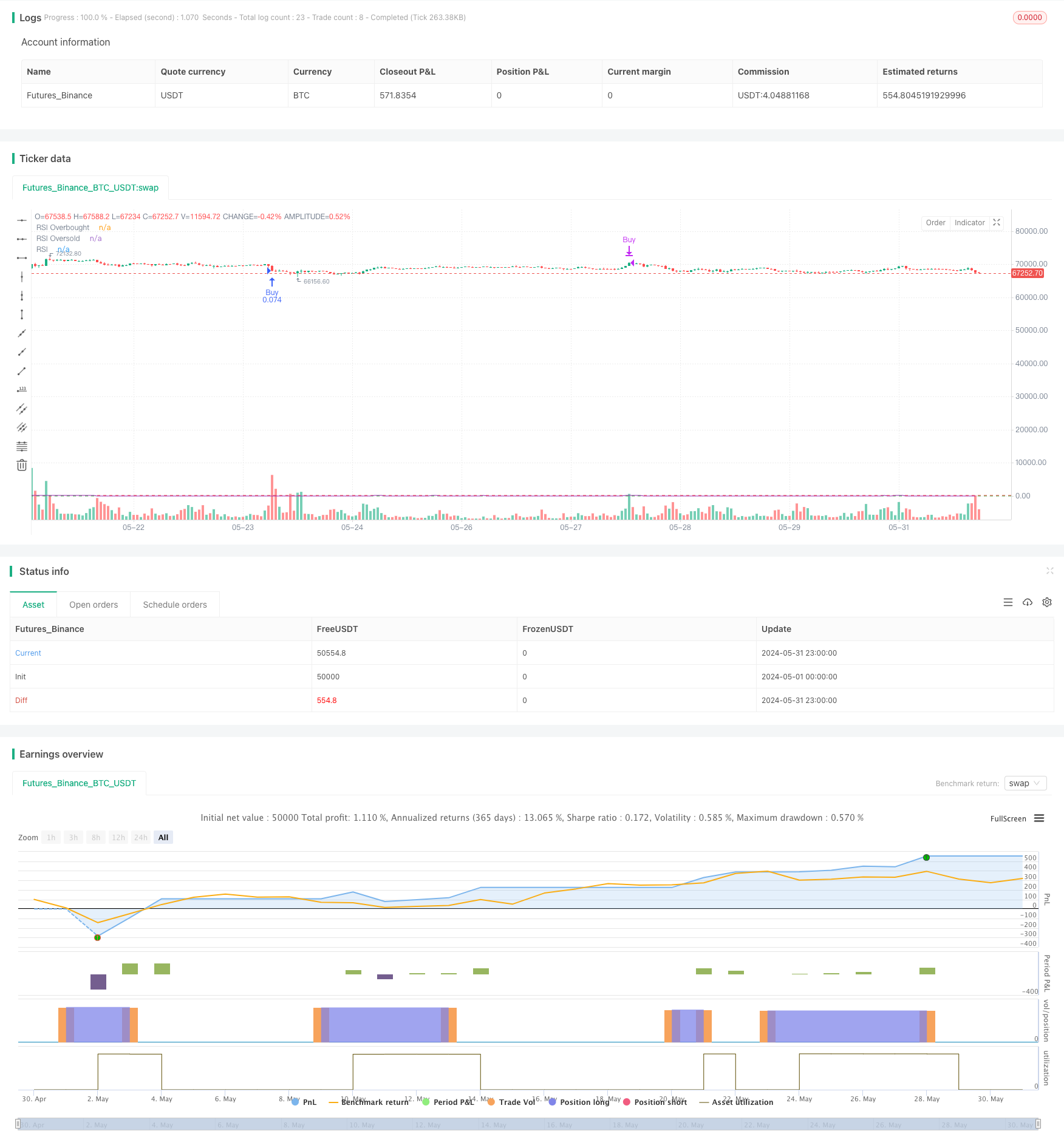
[trans]
概述
该策略基于相对强弱指数(RSI)技术指标,通过分析资产的超买和超卖状态来进行交易决策。当RSI低于超卖阈值时触发买入信号,当RSI高于超买阈值时触发卖出信号。同时,策略采用了基于百分比的止盈止损机制,通过设定固定的获利百分比和亏损百分比来控制风险和锁定利润。该策略旨在捕捉市场的短期波动,并在趋势反转时及时平仓,以实现稳健的收益。
策略原理
- 计算指定周期的RSI指标值。
- 判断RSI是否低于超卖阈值,若是则触发买入信号,开仓做多。
- 计算开仓价格、止损价格和止盈价格。止损价格为开仓价格乘以(1-止损百分比),止盈价格为开仓价格乘以(1+止盈百分比)。
- 持仓过程中实时监控价格变动:
- 当前价格触及止损价格时,平仓止损。
- 当前价格触及止盈价格时,平仓止盈。
- 当RSI上穿超买阈值时,平仓。
- 若RSI再次低于超卖阈值,则重复步骤2-4,开启下一个交易周期。
优势分析
- 简单易用:该策略基于经典的RSI指标,原理简单,易于理解和实现。
- 趋势适应性强:通过RSI指标捕捉市场超买超卖状态,适应不同的市场趋势。
- 风险可控:采用固定百分比止盈止损,严格控制每笔交易的风险敞口。
- 及时止盈:设定明确的获利目标,当价格达到止盈位时果断平仓,防止利润回吐。
- 减少频繁交易:RSI指标具有一定的滤波功能,可以过滤掉部分噪声信号,减少频繁交易。
风险分析
- 参数敏感性:策略的表现对RSI周期、超买超卖阈值以及止盈止损百分比等参数较为敏感,不同参数可能带来不同结果。
- 振荡市中表现欠佳:在震荡市场环境下,RSI指标可能会频繁触发交易信号,导致过度交易和盈利能力下降。
- 趋势调整风险:在强趋势突然调整的情况下,固定百分比止损可能无法及时保护账户,引发较大回撤。
- 盈亏比风险:固定百分比止盈止损可能导致盈亏比不平衡,从而影响策略的长期稳定性。
优化方向
- 动态调整参数:根据不同市场状态,动态优化RSI周期、超买超卖阈值和止盈止损百分比等参数,提高策略的适应性。
- 引入趋势过滤:结合其他趋势指标,如移动平均线,对RSI信号进行进一步确认,减少振荡市中的虚假信号。
- 优化止盈止损机制:采用更加灵活的止盈止损方法,如移动止损、波动率止损等,提高风险控制能力。
- 加入仓位管理:根据市场波动性和账户风险状况,动态调整每笔交易的仓位大小,平衡收益与风险。
- 结合其他指标:将RSI与其他技术指标如MACD、布林带等结合使用,提高信号的可靠性和稳健性。
总结
RSI基于百分比止盈止损的交易策略通过捕捉市场的超买超卖状态,结合固定百分比止盈止损机制,在趋势反转时及时平仓,以获取稳健收益。该策略原理简单易懂,风险可控,适应性强。但同时也存在参数敏感性、震荡市表现欠佳、趋势调整风险等问题。通过动态调整参数、引入趋势过滤、优化止盈止损机制、加入仓位管理以及结合其他指标等方式,可以进一步提升策略的稳健性和盈利能力,更好地适应多变的市场环境。
||
Overview
This strategy is based on the Relative Strength Index (RSI) technical indicator, making trading decisions by analyzing the overbought and oversold conditions of an asset. When the RSI falls below the oversold threshold, a buy signal is triggered, and when the RSI rises above the overbought threshold, a sell signal is triggered. Additionally, the strategy employs a percentage-based take profit and stop loss mechanism, controlling risk and locking in profits by setting fixed profit and loss percentages. The strategy aims to capture short-term market fluctuations and promptly close positions when the trend reverses, achieving steady returns.
Strategy Principle
- Calculate the RSI indicator value for a specified period.
- Determine if the RSI is below the oversold threshold. If so, trigger a buy signal and open a long position.
- Calculate the entry price, stop loss price, and take profit price. The stop loss price is the entry price multiplied by (1 - stop loss percentage), and the take profit price is the entry price multiplied by (1 + take profit percentage).
- Continuously monitor price changes during the holding period:
- When the current price reaches the stop loss price, close the position with a stop loss.
- When the current price reaches the take profit price, close the position with a take profit.
- When the RSI crosses above the overbought threshold, close the position.
- If the RSI falls below the oversold threshold again, repeat steps 2-4 to start the next trading cycle.
Advantage Analysis
- Simple and easy to use: The strategy is based on the classic RSI indicator, with a simple principle that is easy to understand and implement.
- Strong adaptability to trends: By capturing overbought and oversold market conditions using the RSI indicator, the strategy adapts to different market trends.
- Controllable risk: Fixed percentage take profit and stop loss are used to strictly control the risk exposure of each trade.
- Timely profit-taking: Clear profit targets are set, and positions are decisively closed when the price reaches the take profit level to prevent profit erosion.
- Reduced frequent trading: The RSI indicator has a certain filtering function, which can filter out some noise signals and reduce frequent trading.
Risk Analysis
- Parameter sensitivity: The strategy's performance is sensitive to parameters such as RSI period, overbought/oversold thresholds, and take profit/stop loss percentages, and different parameters may lead to different results.
- Poor performance in oscillating markets: In oscillating market conditions, the RSI indicator may frequently trigger trading signals, leading to overtrading and decreased profitability.
- Trend adjustment risk: In cases where a strong trend suddenly adjusts, fixed percentage stop loss may not protect the account in a timely manner, causing significant drawdowns.
- Profit/loss ratio risk: Fixed percentage take profit and stop loss may lead to an unbalanced profit/loss ratio, affecting the long-term stability of the strategy.
Optimization Direction
- Dynamic parameter adjustment: Dynamically optimize parameters such as RSI period, overbought/oversold thresholds, and take profit/stop loss percentages based on different market conditions to improve the strategy's adaptability.
- Introduce trend filters: Combine other trend indicators, such as moving averages, to further confirm RSI signals and reduce false signals in oscillating markets.
- Optimize take profit and stop loss mechanisms: Adopt more flexible take profit and stop loss methods, such as trailing stop loss or volatility-based stop loss, to enhance risk control capabilities.
- Incorporate position sizing: Dynamically adjust the position size of each trade based on market volatility and account risk conditions to balance returns and risks.
- Combine with other indicators: Use RSI in conjunction with other technical indicators such as MACD, Bollinger Bands, etc., to improve the reliability and robustness of signals.
Summary
The RSI-based trading strategy with percentage-based take profit and stop loss captures overbought and oversold market conditions, combined with a fixed percentage take profit and stop loss mechanism, promptly closing positions when the trend reverses to achieve steady returns. The strategy's principle is simple and easy to understand, with controllable risk and strong adaptability. However, it also faces issues such as parameter sensitivity, poor performance in oscillating markets, and trend adjustment risks. By dynamically adjusting parameters, introducing trend filters, optimizing take profit and stop loss mechanisms, incorporating position sizing, and combining with other indicators, the strategy's robustness and profitability can be further enhanced to better adapt to changing market environments. [/trans]
Source (PineScript)
/*backtest
start: 2024-05-01 00:00:00
end: 2024-05-31 23:59:59
period: 1h
basePeriod: 15m
exchanges: [{"eid":"Futures_Binance","currency":"BTC_USDT"}]
*/

//@version=5
strategy("RSI Strategy with Adjustable TP and SL", overlay=true,
     default_qty_type=strategy.percent_of_equity,
     default_qty_value=10,
     initial_capital=100000,
     currency=currency.USD,
     commission_type=strategy.commission.percent,
     commission_value=0.1)

// RSI settings
rsiPeriod = input.int(14, title="RSI Period")
rsiOverbought = input.int(70, title="RSI Overbought Level", minval=50, maxval=100)
rsiOversold = input.int(30, title="RSI Oversold Level", minval=0, maxval=50)

// Fixed TP and SL settings
takeProfitPct = input.float(20, title="Take Profit Percentage", step=0.1) / 100
stopLossPct = input.float(5, title="Stop Loss Percentage", step=0.1) / 100

// Calculate RSI
rsiValue = ta.rsi(close, rsiPeriod)

// Plot RSI
hline(rsiOverbought, "RSI Overbought", color=color.red)
hline(rsiOversold, "RSI Oversold", color=color.green)
plot(rsiValue, title="RSI", color=color.purple)

// Entry conditions
buyCondition = ta.crossunder(rsiValue, rsiOversold)
sellCondition = ta.crossover(rsiValue, rsiOverbought)

// Calculate stop loss and take profit prices
var float entryPrice = na
var float stopLossLevel = na
var float takeProfitLevel = na

if (buyCondition)
    entryPrice := close
    stopLossLevel := entryPrice * (1 - stopLossPct)
    takeProfitLevel := entryPrice * (1 + takeProfitPct)
    strategy.entry("Buy", strategy.long)

// Close positions when TP or SL is hit
if (strategy.position_size > 0)
    if (close <= stopLossLevel)
        strategy.close("Buy", comment="Stop Loss Hit")
    if (close >= takeProfitLevel)
        strategy.close("Buy", comment="Take Profit Hit")

// Close positions when RSI crosses above overbought level
if (sellCondition)
    strategy.close("Buy", comment="RSI Overbought")

// Optional: Add alerts
alertcondition(buyCondition, title="Buy Alert", message="RSI crossed below oversold level")
alertcondition(sellCondition, title="Sell Alert", message="RSI crossed above overbought level")
Detail
https://www.fmz.com/strategy/453650
Last Modified
2024-06-07 15:04:39