
21 KiB
Name
指数移动平均与动态追踪止损的多维度趋势交易系统-Multi-dimensional-Trend-Trading-System-with-EMA-and-Dynamic-Trailing-Stop
Author
ianzeng123
Strategy Description
[trans]
概述
指数移动平均与动态追踪止损的多维度趋势交易系统是一个为MetaTrader 5(MT5)平台设计的自动化交易机器人。该策略核心融合了指数移动平均线(EMA)过滤、动态追踪止损机制以及基于风险管理的仓位计算方法,旨在优化交易入场和出场时机。该系统主要利用EMA趋势过滤器确保交易方向与市场趋势一致,通过动态追踪止损保护已获利润,同时采用精确的风险百分比方法自动计算适当的交易量,最大限度地控制每笔交易的风险敞口。此外,该策略还提供时间过滤功能,允许交易者设定特定的交易时段,避开流动性较低的市场环境,从而提升整体交易质量。
策略原理
该交易系统的运作基于几个关键组件和逻辑:
-
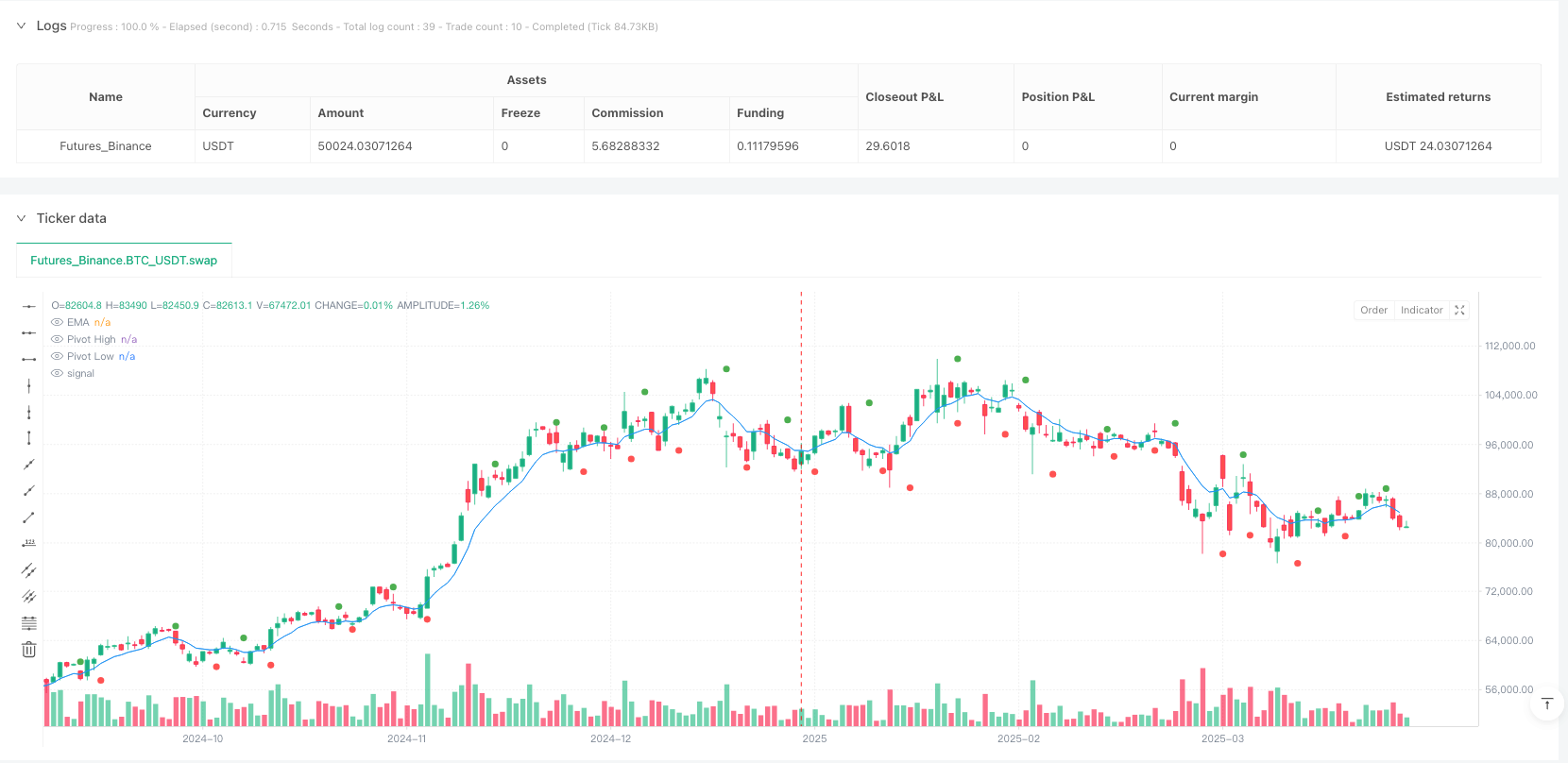
EMA趋势过滤:系统默认使用8周期EMA作为趋势指标,仅在EMA上升时执行买入操作,在EMA下降时执行卖出操作。这确保了交易方向与短期趋势保持一致,减少了逆势交易的可能性。
-
关键价位识别机制:策略使用pivot高点和低点(局部极值)作为关键价格水平,通过设定的回溯周期(默认为3个柱)来识别这些关键点位。这些pivot点位被用作止损和止盈计算的参考点,也作为挂单的触发价格。
-
智能订单执行:
- 多头入场:当价格低于最近的pivot高点一定距离,且EMA趋势向上时,在pivot高点位置设置买入止损单(Buy Stop)。
- 空头入场:当价格高于最近的pivot低点一定距离,且EMA趋势向下时,在pivot低点位置设置卖出止损单(Sell Stop)。
-
风险管理系统:策略默认将每笔交易的风险设定为账户资金的4%,通过此参数自动计算适当的交易量,确保风险控制的一致性。
-
动态止损机制:一旦交易盈利超过设定的触发点数(默认15点),追踪止损功能将激活,止损线会跟随价格移动,保护已实现的利润,同时允许交易继续获利。
-
时间过滤器:交易者可以设定交易的起始和结束小时,避免在特定时段(如流动性差、波动性低的市场环境)进行交易。如果价格在非交易时段移动,系统会自动平仓以保护利润。
策略优势
深入分析该策略的代码结构和逻辑,可以总结出以下显著优势:
-
趋势同步交易:通过EMA过滤机制,策略确保只在既定趋势方向上交易,大大提高了交易信号的质量和可靠性,避免了频繁的震荡市场假突破。
-
精确的风险控制:基于账户百分比的风险管理方法允许策略在不同市场条件和账户规模下保持一致的风险水平,防止过度杠杆和资金管理不当导致的账户侵蚀。
-
动态保护机制:追踪止损功能提供了双重保护 - 既限制了最大亏损(通过固定止损),又保护已获利润(通过追踪止损),这在波动市场中尤为重要。
-
基于关键价位的入场:使用pivot点作为入场信号,使得策略能够在技术上显著的价格水平进行交易,这些水平通常代表支撑或阻力位,提高了交易的精确性。
-
自适应性强:多个可自定义参数允许交易者根据不同市场条件和个人风险偏好调整策略,增强了策略的适应性和长期可用性。
-
避免低效时段:时间过滤功能确保策略仅在预设的高效市场时段内运行,避免了在市场波动性较低或流动性不足时段的低效交易。
-
视觉反馈:策略提供了EMA和pivot点的图形显示,使交易者能够直观地理解交易逻辑和市场状况,便于策略优化和性能评估。
策略风险
尽管该策略设计精良,但仍存在一些潜在风险和限制,需要交易者充分了解:
-
快速市场滑点风险:在极端市场条件下,特别是在重大新闻发布或黑天鹅事件期间,止损订单可能无法以设定价格执行,导致实际亏损超过预期。缓解方法是在波动性极高的时期适当降低交易量或暂停自动交易。
-
趋势反转风险:8周期EMA属于短期指标,在横盘或快速反转的市场中可能产生错误信号。可以考虑增加多重时间框架分析或额外的趋势确认指标来降低这一风险。
-
参数优化风险:过度优化策略参数可能导致"曲线拟合"问题,即策略在历史数据上表现良好但在实际交易中表现不佳。建议使用合理的样本外测试和前向验证来验证参数的稳健性。
-
系统依赖风险:作为完全自动化的系统,该策略依赖于交易平台(MT5)的稳定性和连接性。技术问题可能导致订单执行延迟或失败。维持可靠的网络连接和定期监控系统运行状态是必要的。
-
固定点数风险:策略使用固定点数来设置止损、止盈和追踪止损触发点,这在不同波动性环境下可能不够灵活。考虑使用基于ATR(平均真实波幅)的动态点数可能更为适合不同的市场条件。
策略优化方向
基于对代码的深入分析,以下是该策略可以进一步优化的方向:
-
动态参数调整:将固定点数(如止损、止盈)转换为基于市场波动性的动态计算,例如使用ATR指标来调整这些参数,使策略能够更好地适应不同市场条件和时间框架。
-
多重时间框架分析:引入更长期的趋势过滤器,例如在更高时间框架上计算额外的EMA,只在短期和长期趋势一致时才执行交易,这将减少假信号并提高整体胜率。
-
入场优化:当前策略使用简单的pivot点作为入场信号,可以考虑增加额外的确认指标,如相对强弱指数(RSI)、随机指标或MACD以增强入场精确性。
-
智能时间过滤:将固定时间过滤升级为基于市场会话的智能过滤,自动识别亚洲、欧洲和美国交易时段的高波动性和低波动性期间,优化交易执行时机。
-
风险动态调整:基于近期策略表现动态调整风险百分比,例如,在连续亏损后自动降低风险敞口,在盈利趋势中逐步恢复正常风险水平,实现更智能的资金管理。
-
相关性分析:在多品种交易时,引入相关性过滤,避免在高度相关的市场中同时持有类似方向的多个头寸,从而降低整体投资组合风险。
-
机器学习增强:考虑引入基本的机器学习算法来优化参数选择或预测最佳交易时机,这将使策略从历史模式中学习并自我改进。
总结
指数移动平均与动态追踪止损的多维度趋势交易系统是一个设计周到的自动化交易解决方案,特别适合希望在趋势明确的市场环境中进行系统化交易的投资者。该策略通过EMA趋势过滤确保交易方向与市场趋势保持一致,结合pivot点位的精确入场和动态追踪止损出场机制,构建了一个完整的交易系统框架。
策略的主要优势在于其对风险的精确控制、趋势同步的交易方法以及灵活的参数设置,这使其能够适应不同的市场环境。然而,交易者需要意识到潜在的滑点风险、趋势反转风险以及固定参数在不同市场环境中的局限性。
通过引入基于ATR的动态参数、多重时间框架分析和更复杂的入场确认机制,该策略可以进一步优化,提高其在各种市场条件下的鲁棒性和稳定性。无论是经验丰富的交易者还是自动化交易新手,这个策略都提供了一个坚实的基础,可以根据个人风险偏好和交易目标进行调整和扩展。
||
Overview
The Multi-dimensional Trend Trading System with EMA and Dynamic Trailing Stop is an automated trading bot designed for the MetaTrader 5 (MT5) platform. This strategy integrates Exponential Moving Average (EMA) filtering, dynamic trailing stop loss mechanisms, and a risk-based position sizing method to optimize trade entries and exits. The system primarily uses an EMA trend filter to ensure trading direction aligns with market trends, employs dynamic trailing stops to protect accumulated profits, and utilizes a precise risk percentage method to automatically calculate appropriate trade volumes, maximizing control over risk exposure per trade. Additionally, the strategy offers time filtering capabilities, allowing traders to set specific trading sessions to avoid low-liquidity market environments, thereby enhancing overall trading quality.
Strategy Principles
The trading system operates based on several key components and logic:
-
EMA Trend Filtering: The system defaults to using an 8-period EMA as a trend indicator, executing buy operations only when the EMA is rising and sell operations when the EMA is falling. This ensures trading direction remains consistent with short-term trends, reducing the likelihood of counter-trend trading.
-
Key Price Level Identification Mechanism: The strategy uses pivot highs and lows (local extremes) as critical price levels, identifying these key points through a set lookback period (default is 3 bars). These pivot points serve as reference points for stop loss and take profit calculations, as well as trigger prices for pending orders.
-
Smart Order Execution:
- Long Entry: When price is below a recent pivot high by a certain distance and the EMA trend is upward, a Buy Stop order is placed at the pivot high position.
- Short Entry: When price is above a recent pivot low by a certain distance and the EMA trend is downward, a Sell Stop order is placed at the pivot low position.
-
Risk Management System: The strategy defaults to setting the risk for each trade at 4% of account funds, automatically calculating appropriate trade volume through this parameter to ensure consistent risk control.
-
Dynamic Stop Loss Mechanism: Once a trade profits beyond a set trigger point value (default 15 points), the trailing stop function activates, moving the stop loss line with price movement to protect realized profits while allowing trades to continue profiting.
-
Time Filter: Traders can set start and end hours for trading, avoiding specific periods (such as low liquidity, low volatility market environments). If prices move during non-trading hours, the system automatically closes positions to protect profits.
Strategy Advantages
Through deep analysis of the strategy's code structure and logic, the following significant advantages can be summarized:
-
Trend-Synchronized Trading: Through the EMA filtering mechanism, the strategy ensures trading only in the established trend direction, greatly improving the quality and reliability of trading signals and avoiding frequent false breakouts in oscillating markets.
-
Precise Risk Control: The account percentage-based risk management method allows the strategy to maintain consistent risk levels under different market conditions and account sizes, preventing excessive leverage and improper fund management that could lead to account erosion.
-
Dynamic Protection Mechanism: The trailing stop function provides dual protection - both limiting maximum losses (through fixed stops) and protecting earned profits (through trailing stops), which is particularly important in volatile markets.
-
Key Level-Based Entry: Using pivot points as entry signals enables the strategy to trade at technically significant price levels, which often represent support or resistance levels, increasing trading precision.
-
Strong Adaptability: Multiple customizable parameters allow traders to adjust the strategy according to different market conditions and personal risk preferences, enhancing strategy adaptability and long-term usability.
-
Avoidance of Inefficient Periods: The time filtering function ensures the strategy runs only during preset efficient market periods, avoiding inefficient trading during periods of lower market volatility or insufficient liquidity.
-
Visual Feedback: The strategy provides graphical display of EMA and pivot points, allowing traders to intuitively understand trading logic and market conditions, facilitating strategy optimization and performance evaluation.
Strategy Risks
Despite being well-designed, the strategy still has some potential risks and limitations that traders need to fully understand:
-
Rapid Market Slippage Risk: Under extreme market conditions, especially during major news releases or black swan events, stop loss orders may not execute at set prices, resulting in actual losses exceeding expectations. Mitigating methods include appropriately reducing trading volume or pausing automated trading during periods of extreme volatility.
-
Trend Reversal Risk: The 8-period EMA is a short-term indicator and may produce false signals in sideways or rapidly reversing markets. Consider adding multiple timeframe analysis or additional trend confirmation indicators to reduce this risk.
-
Parameter Optimization Risk: Excessive optimization of strategy parameters may lead to "curve fitting" problems, where the strategy performs well on historical data but poorly in actual trading. It is recommended to use reasonable out-of-sample testing and forward validation to verify parameter robustness.
-
System Dependency Risk: As a fully automated system, the strategy depends on the stability and connectivity of the trading platform (MT5). Technical issues may cause order execution delays or failures. Maintaining reliable network connections and regularly monitoring system operational status is necessary.
-
Fixed Point Risk: The strategy uses fixed points to set stop losses, take profits, and trailing stop trigger points, which may not be flexible enough in different volatility environments. Consider using ATR (Average True Range) based dynamic points, which may be more suitable for varying market conditions.
Strategy Optimization Directions
Based on in-depth analysis of the code, here are directions for further optimization of the strategy:
-
Dynamic Parameter Adjustment: Convert fixed points (such as stop loss, take profit) to volatility-based dynamic calculations, for example, using the ATR indicator to adjust these parameters, enabling the strategy to better adapt to different market conditions and timeframes.
-
Multiple Timeframe Analysis: Introduce longer-term trend filters, such as calculating additional EMAs on higher timeframes, executing trades only when short-term and long-term trends align, which will reduce false signals and improve overall win rates.
-
Entry Optimization: The current strategy uses simple pivot points as entry signals; consider adding additional confirmation indicators such as Relative Strength Index (RSI), Stochastic, or MACD to enhance entry precision.
-
Intelligent Time Filtering: Upgrade fixed time filtering to session-based intelligent filtering, automatically identifying high and low volatility periods during Asian, European, and American trading sessions to optimize trade execution timing.
-
Dynamic Risk Adjustment: Dynamically adjust risk percentage based on recent strategy performance, for example, automatically reducing risk exposure after consecutive losses and gradually restoring normal risk levels during profitable trends, implementing more intelligent fund management.
-
Correlation Analysis: When trading multiple instruments, introduce correlation filtering to avoid simultaneously holding similar directional positions in highly correlated markets, thereby reducing overall portfolio risk.
-
Machine Learning Enhancement: Consider introducing basic machine learning algorithms to optimize parameter selection or predict optimal trading times, allowing the strategy to learn from historical patterns and self-improve.
Summary
The Multi-dimensional Trend Trading System with EMA and Dynamic Trailing Stop is a thoughtfully designed automated trading solution, particularly suitable for investors seeking systematic trading in clearly trending market environments. The strategy ensures trading direction remains consistent with market trends through EMA trend filtering, combined with precise entry using pivot points and dynamic trailing stop exit mechanisms, constructing a complete trading system framework.
The strategy's main advantages lie in its precise control of risk, trend-synchronized trading method, and flexible parameter settings, enabling it to adapt to different market environments. However, traders need to be aware of potential slippage risks, trend reversal risks, and the limitations of fixed parameters in different market environments.
By introducing ATR-based dynamic parameters, multiple timeframe analysis, and more complex entry confirmation mechanisms, the strategy can be further optimized to improve its robustness and stability across various market conditions. Whether for experienced traders or automated trading newcomers, this strategy provides a solid foundation that can be adjusted and expanded according to personal risk preferences and trading objectives. [/trans]
Source (PineScript)
/*backtest
start: 2025-01-01 00:00:00
end: 2025-03-31 00:00:00
period: 1d
basePeriod: 1d
exchanges: [{"eid":"Futures_Binance","currency":"BTC_USDT"}]
*/

//@version=6
strategy("Trend Robot with EMA & Trailing Stop", overlay=true, initial_capital=10000, default_qty_type=strategy.percent_of_equity, default_qty_value=4)

//===== Inputs =====//
riskPercent       = input.float(title="Risk Percent", defval=4.0, step=0.1)
tpPoints          = input.int(title="Take Profit Points", defval=300)
slPoints          = input.int(title="Stop Loss Points", defval=150)
tslTriggerPoints  = input.int(title="Trailing SL Trigger Points", defval=15)
tslPoints         = input.int(title="Trailing SL Points", defval=10)
orderDistPoints   = input.int(title="Order Distance Points", defval=50)
emaPeriod         = input.int(title="EMA Period", defval=8)
useEmaFilter      = input.bool(title="Use EMA Filter", defval=true)
startHour         = input.int(title="Start Hour (0 = no restriction)", defval=0, minval=0, maxval=23)
endHour           = input.int(title="End Hour (0 = no restriction)", defval=0, minval=0, maxval=23)
barsN             = input.int(title="Pivot Lookback (BarsN)", defval=3)

//===== Conversion Factor =====//
// syminfo.mintick is used as the smallest price increment.
minTick = syminfo.mintick

//===== EMA Calculation & Filter Conditions =====//
emaValue = ta.ema(close, emaPeriod)
isEmaBullish = not useEmaFilter or (emaValue > emaValue[1])
isEmaBearish = not useEmaFilter or (emaValue < emaValue[1])

//===== Time Filter =====//
currentHour = hour(time)
sessionOK = true
if startHour != 0 and currentHour < startHour
    sessionOK := false
if endHour != 0 and currentHour >= endHour
    sessionOK := false

//===== Out-of-Session Position Closing =====//
if not sessionOK and strategy.position_size != 0
    // Close all existing positions when outside session hours
    strategy.close("Long", comment="Session Close")
    strategy.close("Short", comment="Session Close")

//===== Pivot (Local Extreme) Detection =====//
// ta.pivothigh and ta.pivotlow return a value only at the pivot bar (after lookback period).
pivotHigh = ta.pivothigh(high, barsN, barsN)
pivotLow  = ta.pivotlow(low, barsN, barsN)

//===== Entry Conditions & Orders =====//
// Only evaluate at confirmed (closed) bars and during valid session.
if barstate.isconfirmed and sessionOK
    //---- Long Entry Condition ----//
    if strategy.position_size <= 0 and isEmaBullish and not na(pivotHigh)
        if close < (pivotHigh - orderDistPoints * minTick)
            // Place a Buy Stop order at the pivotHigh price.
            strategy.order("Long", strategy.long, stop=pivotHigh, comment="BuyStop")
            // Attach an exit order with SL, TP and trailing stop parameters.
            strategy.exit("Long Exit", from_entry="Long", stop=pivotHigh - slPoints * minTick, limit=pivotHigh + tpPoints * minTick, trail_points=tslTriggerPoints, trail_offset=tslPoints)

    //---- Short Entry Condition ----//
    if strategy.position_size >= 0 and isEmaBearish and not na(pivotLow)
        if close > (pivotLow + orderDistPoints * minTick)
            // Place a Sell Stop order at the pivotLow price.
            strategy.order("Short", strategy.short, stop=pivotLow, comment="SellStop")
            // Attach an exit order with SL, TP and trailing stop parameters.
            strategy.exit("Short Exit", from_entry="Short", stop=pivotLow + slPoints * minTick, limit=pivotLow - tpPoints * minTick, trail_points=tslTriggerPoints, trail_offset=tslPoints)

//===== Plots for Visual Reference =====//
plot(emaValue, color=color.blue, title="EMA")
plot(pivotHigh, style=plot.style_circles, color=color.green, title="Pivot High")
plot(pivotLow,  style=plot.style_circles, color=color.red, title="Pivot Low")
Detail
https://www.fmz.com/strategy/489024
Last Modified
2025-04-01 11:21:46