
16 KiB
Name
尺度移动均线与双布林线动量混合交易系统-Hybrid-Keltner-Channel-EMA-Based-Trading-System-with-ATR-Risk-Management
Author
ianzeng123
Strategy Description
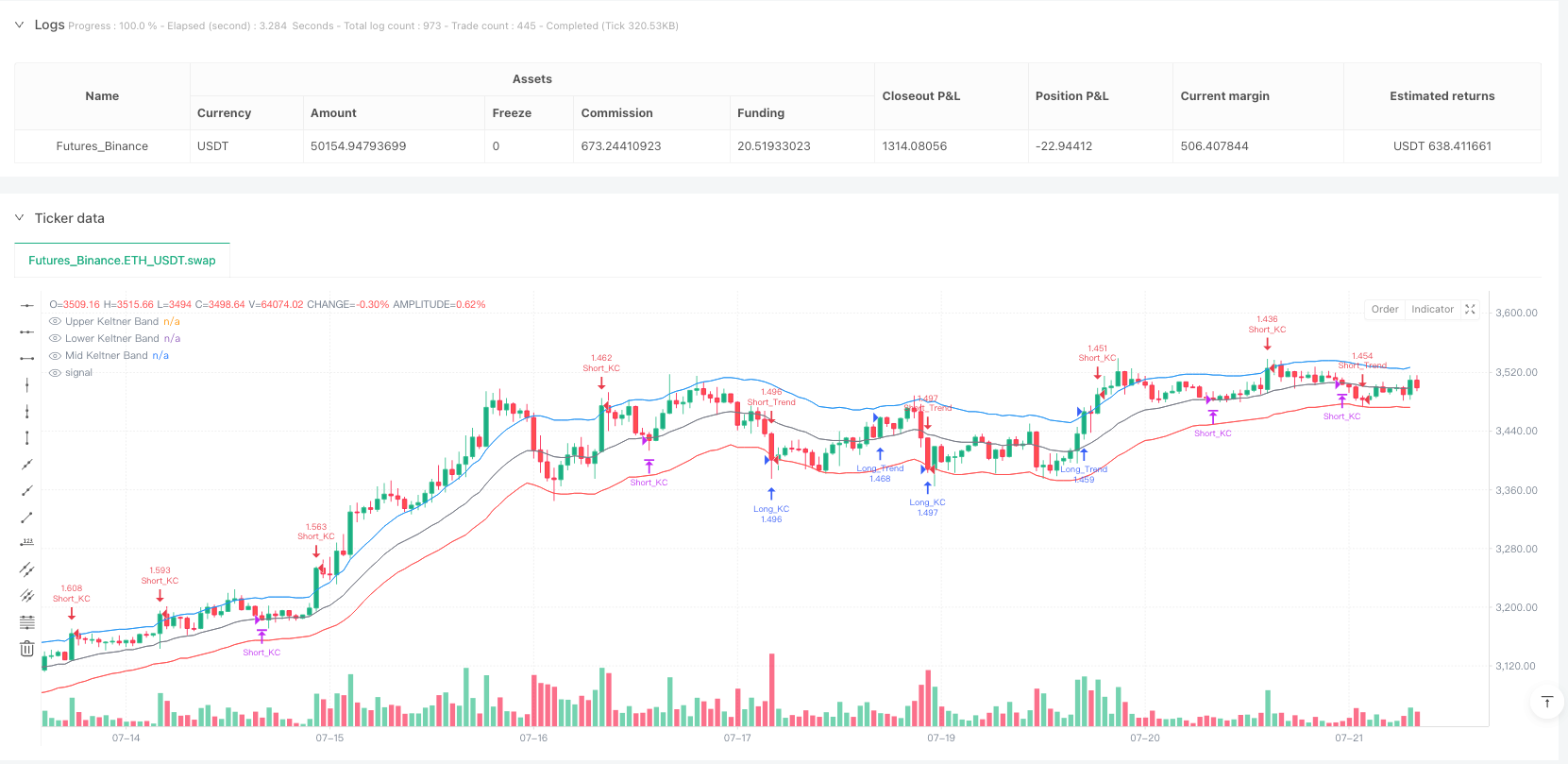
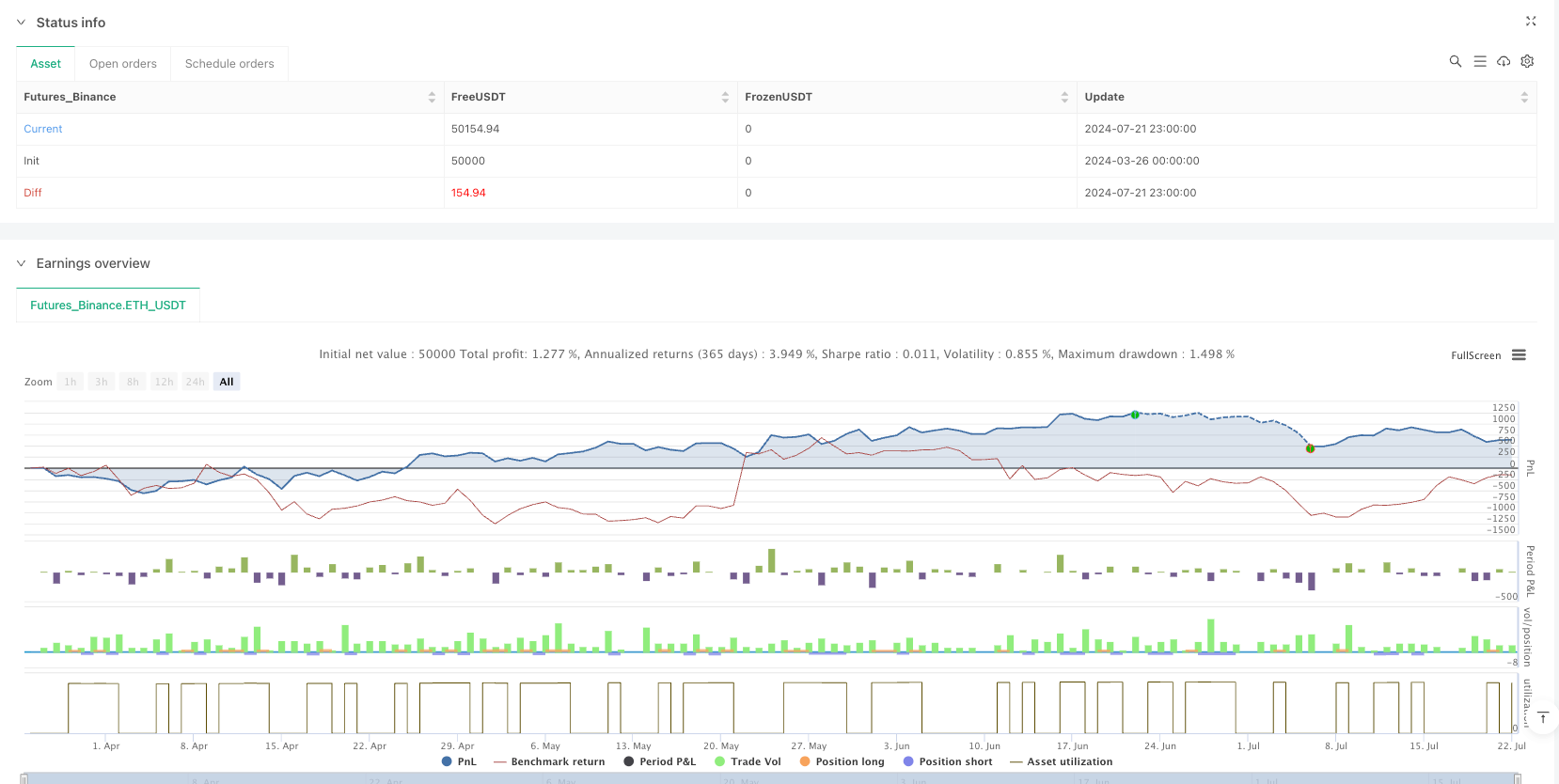
[trans]
概述
该策略是一个结合了肯特纳通道(Keltner Channel)和多重指数移动平均线(EMA)的混合交易系统。它通过监测价格与肯特纳通道边界的互动来捕捉超买超卖条件,同时利用短期与中期EMA的交叉点来确认趋势动量。这种双重方法使交易者能够在各种市场条件下进行交易:既可在价格达到通道边缘时进行反转交易,也可在确认趋势时顺势而为。该系统还整合了基于真实波幅(ATR)的风险管理参数,为止损和获利目标提供动态调整能力。
策略原理
本策略的核心依靠两种不同的交易信号系统:
-
肯特纳通道反转交易:
- 当价格突破下轨(lowerKC)时触发做多信号(longEntryKC)
- 当价格突破上轨(upperKC)时触发做空信号(shortEntryKC)
- 反转交易在价格回归中轨(emaBasis)时平仓
-
趋势跟踪交易:
- 当9周期EMA上穿21周期EMA且价格位于50周期EMA上方时,触发做多信号(longEntryTrend)
- 当9周期EMA下穿21周期EMA且价格位于50周期EMA下方时,触发做空信号(shortEntryTrend)
- 趋势交易在短期EMA重新穿越中期EMA时平仓
肯特纳通道本身通过20周期的EMA作为中轨,上下轨分别为中轨加减1.5倍的ATR值。这种构建方式使通道能够根据市场波动性动态调整宽度,在高波动时期自动扩张,低波动时期自动收缩。
系统的风险管理机制采用基于ATR的动态止损和获利目标:
- 做多止损设置在入场价格下方1.5倍ATR处
- 做空止损设置在入场价格上方1.5倍ATR处
- 做多获利目标设置在入场价格上方3倍ATR处(2×1.5ATR)
- 做空获利目标设置在入场价格下方3倍ATR处(2×1.5ATR)
策略优势
-
多策略融合:结合了反转交易和趋势跟踪两种策略,使系统能够在不同市场环境中保持灵活性,既能捕捉短期价格反转,也能跟随中长期趋势。
-
动态风险管理:通过ATR计算的止损和获利目标会随市场波动性自动调整,在高波动时期提供更宽的止损空间,低波动时期收紧风险控制。
-
信号确认机制:趋势交易部分要求多重条件同时满足(短期与中期EMA交叉以及价格位于长期EMA的正确一侧),大大减少了虚假信号。
-
适应性强:肯特纳通道宽度会根据市场波动性自动调整,使策略能够适应各种市场环境,不必手动调整参数。
-
完整的交易周期:策略清晰定义了入场、出场、止损和获利条件,形成完整的交易框架。
-
自动化提醒:集成了TradingView警报功能,可以实现全自动化交易信号通知。
策略风险
-
假突破风险:在高波动市场中,价格可能频繁触及肯特纳通道边界后又迅速返回,产生虚假的反转信号。缓解方法:可考虑增加确认条件,如要求价格在通道外停留一定时间或结合其他技术指标。
-
趋势变化滞后:EMA交叉信号本质上是滞后指标,可能导致在趋势转折点附近的入场或出场不够及时。缓解方法:可以考虑引入更敏感的动量指标作为辅助确认。
-
止损幅度不足:在某些极端波动情况下,1.5倍ATR的止损设置可能不足以避免被市场噪音触及。缓解方法:针对特定高波动品种,可考虑将止损倍数调整为2倍或更高。
-
多重信号冲突:反转策略和趋势策略可能同时产生相反的信号,造成决策困难。缓解方法:可建立信号优先级或在不同时间框架上分别应用两种策略。
-
参数敏感性:策略性能对肯特纳通道乘数(mult)和EMA周期的选择较为敏感。缓解方法:建议在实盘前进行充分的参数优化和回测验证。
策略优化方向
-
增加交易时间过滤:可以添加交易时间窗口过滤器,避开市场开盘和收盘时的异常波动和低流动性时段,只在市场最活跃的时段执行交易信号。
-
引入波动率判断:可以增加ATR相对历史值的判断,在波动率过高时暂停反转交易,仅执行趋势交易;在波动率过低时则优先考虑反转交易。
-
优化资金管理:当前策略使用固定比例(10%)进行仓位管理,可以改进为基于波动率的动态仓位调整,在低波动率环境增加仓位,高波动率环境减少仓位。
-
增加交易过滤条件:可以添加更多过滤条件来提高信号质量,例如:
- 结合RSI指标过滤肯特纳通道反转信号
- 要求成交量确认EMA交叉信号
- 只在主要趋势方向执行交易
-
多时间框架分析:引入更高时间框架的趋势判断,只在高时间框架趋势方向上执行低时间框架信号。
-
优化获利方式:目前使用固定倍数ATR作为获利目标,可以改进为尾随止损机制,以最大化捕捉趋势利润。
总结
该肯特纳通道与EMA混合交易系统是一个全面而灵活的交易策略,通过结合反转和趋势跟踪信号,实现了在不同市场环境下的适应性。其核心优势在于动态的通道宽度调整和基于ATR的风险管理,使策略能够自动适应市场波动性的变化。然而,策略仍存在一些固有风险,如假突破和信号滞后等问题。
通过一系列优化措施,如增加交易过滤条件、优化资金管理和引入多时间框架分析等,该策略有较大的改进空间。对于交易者而言,建议在实盘应用前,先在不同市场条件和时间框架下进行充分回测,并根据具体交易品种的特性调整参数设置。总的来说,这是一个结构完善、逻辑清晰且具有很强实用性的量化交易策略。 ||
Overview
This strategy is a hybrid trading system combining Keltner Channels and multiple Exponential Moving Averages (EMAs). It captures overbought and oversold conditions by monitoring price interactions with Keltner Channel boundaries while confirming trend momentum through short-term and medium-term EMA crossovers. This dual approach enables traders to operate in various market conditions: executing reversal trades when prices reach channel edges and trend-following trades when trends are confirmed. The system also incorporates Average True Range (ATR) based risk management parameters, providing dynamic adjustment capabilities for stop-losses and profit targets.
Strategy Principles
The core of this strategy relies on two distinct trading signal systems:
-
Keltner Channel Reversal Trades:
- Long signals (longEntryKC) trigger when price breaks below the lower band (lowerKC)
- Short signals (shortEntryKC) trigger when price breaks above the upper band (upperKC)
- Reversal trades close when price returns to the middle band (emaBasis)
-
Trend-Following Trades:
- Long signals (longEntryTrend) trigger when 9-period EMA crosses above 21-period EMA with price above 50-period EMA
- Short signals (shortEntryTrend) trigger when 9-period EMA crosses below 21-period EMA with price below 50-period EMA
- Trend trades close when the short-term EMA crosses back over the medium-term EMA
The Keltner Channel itself is constructed with a 20-period EMA as the middle band, with upper and lower bands calculated by adding and subtracting 1.5 times the ATR value. This construction allows the channel to dynamically adjust its width according to market volatility, automatically expanding during high volatility periods and contracting during low volatility periods.
The system's risk management mechanism employs ATR-based dynamic stop-losses and profit targets:
- Long stop-losses are set 1.5 times ATR below entry price
- Short stop-losses are set 1.5 times ATR above entry price
- Long profit targets are set 3 times ATR above entry price (2×1.5 ATR)
- Short profit targets are set 3 times ATR below entry price (2×1.5 ATR)
Strategy Advantages
-
Multiple Strategy Integration: Combines reversal trading and trend following strategies, enabling the system to maintain flexibility across different market environments, capturing both short-term price reversals and following medium to long-term trends.
-
Dynamic Risk Management: Stop-losses and profit targets calculated through ATR automatically adjust with market volatility, providing wider stop-loss margins during high volatility periods and tightening risk control during low volatility periods.
-
Signal Confirmation Mechanism: The trend trading component requires multiple conditions to be simultaneously satisfied (short-term and medium-term EMA crossover plus price position relative to long-term EMA), significantly reducing false signals.
-
Strong Adaptability: Keltner Channel width automatically adjusts according to market volatility, allowing the strategy to adapt to various market environments without manual parameter adjustments.
-
Complete Trading Cycle: The strategy clearly defines entry, exit, stop-loss, and profit conditions, forming a comprehensive trading framework.
-
Automated Alerts: Integration with TradingView alert functionality enables fully automated trading signal notifications.
Strategy Risks
-
False Breakout Risk: In highly volatile markets, prices may frequently touch Keltner Channel boundaries and quickly return, generating false reversal signals. Mitigation: Consider adding confirmation conditions, such as requiring price to remain outside the channel for a certain period or incorporating additional technical indicators.
-
Trend Change Lag: EMA crossover signals are inherently lagging indicators, potentially causing delayed entries or exits near trend turning points. Mitigation: Consider introducing more sensitive momentum indicators as auxiliary confirmation.
-
Insufficient Stop-Loss Range: In some extreme volatility situations, a 1.5 times ATR stop-loss setting may be insufficient to avoid being triggered by market noise. Mitigation: For specific high-volatility instruments, consider adjusting the stop-loss multiplier to 2 times or higher.
-
Multiple Signal Conflicts: Reversal and trend strategies may simultaneously generate opposing signals, creating decision-making difficulties. Mitigation: Establish signal priority or apply the two strategies on different timeframes.
-
Parameter Sensitivity: Strategy performance is relatively sensitive to the choice of Keltner Channel multiplier (mult) and EMA periods. Mitigation: Thorough parameter optimization and backtesting verification are recommended before live trading.
Strategy Optimization Directions
-
Add Trading Time Filters: Implement trading time window filters to avoid abnormal volatility and low liquidity periods at market open and close, executing trade signals only during the most active market sessions.
-
Introduce Volatility Assessment: Add ATR relative to historical values judgment, pausing reversal trades during excessive volatility periods and only executing trend trades; prioritizing reversal trades during low volatility periods.
-
Optimize Capital Management: The current strategy uses a fixed proportion (10%) for position management, which could be improved to volatility-based dynamic position adjustment, increasing positions in low volatility environments and reducing positions in high volatility environments.
-
Add Trading Filter Conditions: Incorporate additional filtering conditions to improve signal quality, such as:
- Combining RSI indicators to filter Keltner Channel reversal signals
- Requiring volume confirmation for EMA crossover signals
- Only executing trades in the direction of the primary trend
-
Multi-Timeframe Analysis: Introduce higher timeframe trend judgments, only executing lower timeframe signals in the direction of higher timeframe trends.
-
Optimize Profit-Taking Method: Currently using fixed multiple ATR as profit targets, this could be improved to a trailing stop mechanism to maximize trend profit capture.
Summary
This Keltner Channel and EMA hybrid trading system is a comprehensive and flexible trading strategy that achieves adaptability across different market environments by combining reversal and trend-following signals. Its core strengths lie in dynamic channel width adjustment and ATR-based risk management, allowing the strategy to automatically adapt to changes in market volatility. However, the strategy still has some inherent risks, such as false breakouts and signal lag issues.
Through a series of optimization measures, such as adding trading filters, optimizing capital management, and introducing multi-timeframe analysis, this strategy has significant room for improvement. For traders, it is recommended to thoroughly backtest across different market conditions and timeframes before live application, and adjust parameter settings according to specific trading instrument characteristics. Overall, this is a well-structured, logically clear, and highly practical quantitative trading strategy.[/trans]
Source (PineScript)
/*backtest
start: 2024-03-26 00:00:00
end: 2024-07-22 00:00:00
period: 1h
basePeriod: 1h
exchanges: [{"eid":"Futures_Binance","currency":"ETH_USDT"}]
*/

//@version=5
strategy("Keltner Channel Strategy", overlay=true, default_qty_type=strategy.percent_of_equity, default_qty_value=10)

// Keltner Channel Settings
length = 20
mult = 1.5
emaBasis = ta.ema(close, length)
atrVal = ta.atr(length)

upperKC = emaBasis + (mult * atrVal)
lowerKC = emaBasis - (mult * atrVal)

// Entry Conditions for Different Strategies
longEntryKC = ta.crossunder(close, lowerKC)
shortEntryKC = ta.crossover(close, upperKC)

longEntryTrend = ta.crossover(ta.ema(close, 9), ta.ema(close, 21)) and close > ta.ema(close, 50)
shortEntryTrend = ta.crossunder(ta.ema(close, 9), ta.ema(close, 21)) and close < ta.ema(close, 50)

// Stop-Loss and Take-Profit Levels
atrMultiplier = 1.5
stopLossLong = close - (atrMultiplier * atrVal)
stopLossShort = close + (atrMultiplier * atrVal)
takeProfitLong = close + (2 * atrMultiplier * atrVal)
takeProfitShort = close - (2 * atrMultiplier * atrVal)

// Exit Conditions
exitLongKC = ta.crossover(close, emaBasis)
exitShortKC = ta.crossunder(close, emaBasis)
exitLongTrend = ta.crossunder(ta.ema(close, 9), ta.ema(close, 21))
exitShortTrend = ta.crossover(ta.ema(close, 9), ta.ema(close, 21))

// Plot Keltner Channels
plot(upperKC, title="Upper Keltner Band", color=color.blue)
plot(lowerKC, title="Lower Keltner Band", color=color.red)
plot(emaBasis, title="Mid Keltner Band", color=color.gray)

// Execute Trades
strategy.entry("Long_KC", strategy.long, when=longEntryKC)
strategy.close("Long_KC", when=exitLongKC)
strategy.entry("Short_KC", strategy.short, when=shortEntryKC)
strategy.close("Short_KC", when=exitShortKC)

strategy.entry("Long_Trend", strategy.long, when=longEntryTrend)
strategy.close("Long_Trend", when=exitLongTrend)
strategy.entry("Short_Trend", strategy.short, when=shortEntryTrend)
strategy.close("Short_Trend", when=exitShortTrend)

// Stop-Loss and Take-Profit Implementation
strategy.exit("Long_KC_Exit", from_entry="Long_KC", stop=stopLossLong, limit=takeProfitLong)
strategy.exit("Short_KC_Exit", from_entry="Short_KC", stop=stopLossShort, limit=takeProfitShort)
strategy.exit("Long_Trend_Exit", from_entry="Long_Trend", stop=stopLossLong, limit=takeProfitLong)
strategy.exit("Short_Trend_Exit", from_entry="Short_Trend", stop=stopLossShort, limit=takeProfitShort)

// Alerts
alertcondition(longEntryKC, title="Long Entry KC Alert", message="Price touched Lower Keltner Band - Possible Long Setup")
alertcondition(shortEntryKC, title="Short Entry KC Alert", message="Price touched Upper Keltner Band - Possible Short Setup")
alertcondition(longEntryTrend, title="Long Entry Trend Alert", message="9 EMA crossed above 21 EMA - Possible Long Setup")
alertcondition(shortEntryTrend, title="Short Entry Trend Alert", message="9 EMA crossed below 21 EMA - Possible Short Setup")
Detail
https://www.fmz.com/strategy/488273
Last Modified
2025-03-26 14:21:48