
7.4 KiB
Name
多重移动平均与随机震荡交叉量化策略-Multiple-Moving-Average-and-Stochastic-Oscillator-Crossover-Quantitative-Strategy
Author
ChaoZhang
Strategy Description
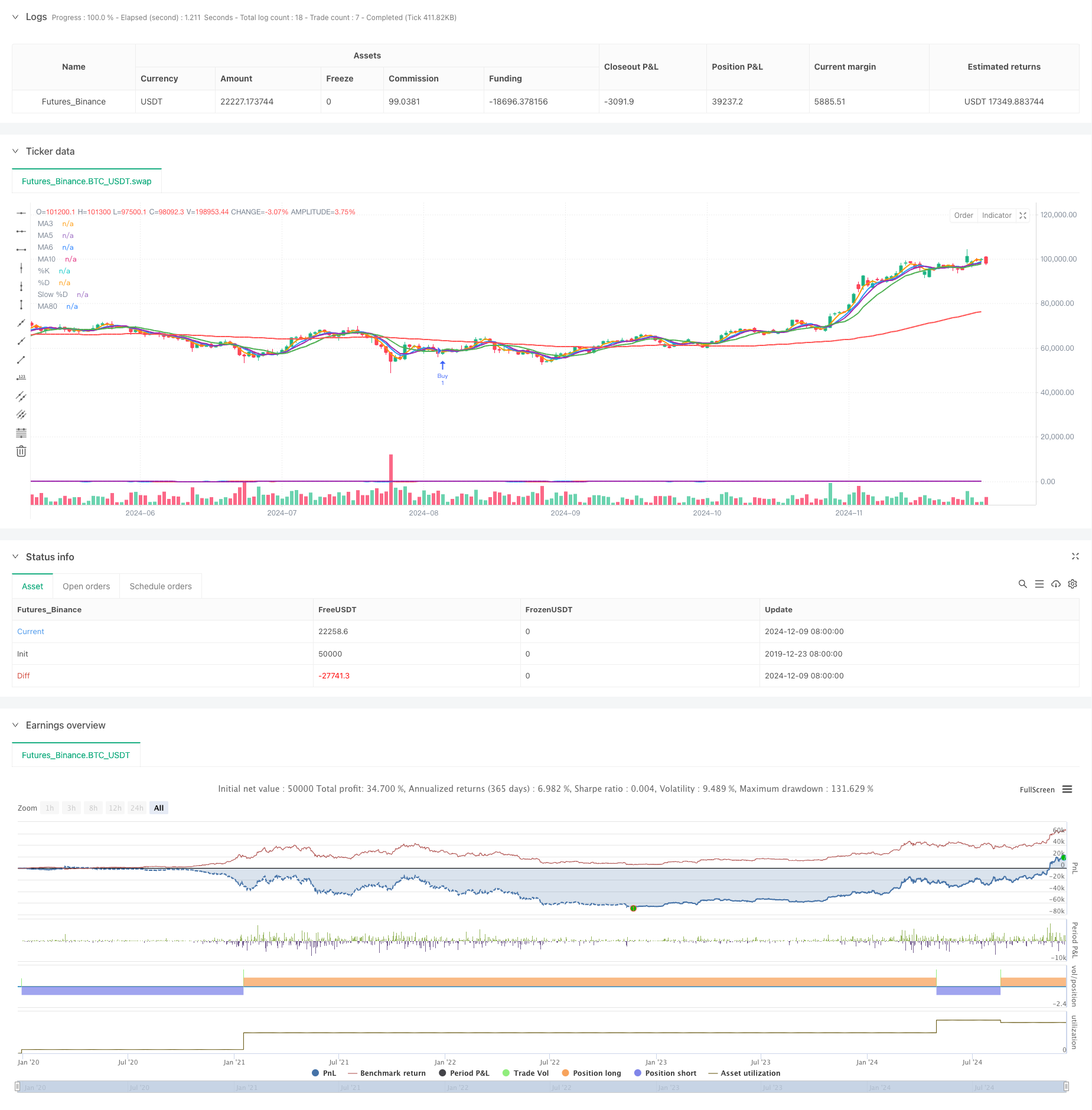
[trans]
概述
该策略是一个基于多重移动平均线和随机震荡指标交叉信号的量化交易策略。策略综合运用了短期、中期和长期移动平均线,结合随机震荡指标的超买超卖特性,通过多重信号确认来捕捉市场趋势转折点和交易机会。策略的核心在于通过多重技术指标的交叉确认,提高交易信号的可靠性。
策略原理
策略采用了3日、5日、6日、10日和80日五条移动平均线,以及随机震荡指标(Stochastic Oscillator)。交易信号的触发基于以下条件:
- 买入信号:当MA10上穿MA5和MA6,同时随机震荡指标的K线上穿D线时触发。
- 卖出信号:当MA5下穿MA10和MA6,同时随机震荡指标的D线下穿K线时触发。 策略使用15周期的%K值和9周期的%D值,通过滑动平均进一步平滑信号。
策略优势
- 多重确认机制:通过多条移动平均线和随机震荡指标的交叉确认,有效降低假突破的风险。
- 趋势跟踪与震荡结合:既能捕捉趋势,又能识别超买超卖区域,提高交易的准确性。
- 信号稳定性:采用多重移动平均线的交叉确认,能够过滤掉市场噪音。
- 适应性强:可以适用于不同的市场环境和时间周期。
策略风险
- 滞后性风险:移动平均线本质上是滞后指标,可能导致入场和出场时机略有延迟。
- 震荡市风险:在横盘震荡市场中可能产生频繁的假信号。
- 参数敏感性:多重指标的参数设置需要充分测试,不同市场环境可能需要调整。
- 信号冲突:多重指标可能产生相互矛盾的信号,需要建立清晰的优先级机制。
策略优化方向
- 动态参数调整:可以根据市场波动率自动调整移动平均线周期和随机震荡器参数。
- 增加趋势过滤:引入ADX等趋势指标,在强趋势期间调整策略参数。
- 优化止损机制:增加跟踪止损和固定止损的组合使用。
- 添加成交量确认:结合成交量指标进行信号确认,提高可靠性。
- 市场环境识别:增加市场环境判断模块,在不同市场条件下使用不同的参数设置。
总结
该策略通过多重移动平均线和随机震荡指标的组合使用,建立了一个相对完善的交易系统。策略的优势在于信号的可靠性和系统的稳定性,但也需要注意控制交易成本和市场环境的适应性。通过持续优化和完善,该策略有望在实际交易中取得稳定的收益。 ||
Overview
This strategy is a quantitative trading approach that combines multiple moving averages with stochastic oscillator crossover signals. It utilizes short-term, medium-term, and long-term moving averages, along with the overbought/oversold characteristics of the stochastic oscillator, to capture market trend reversals and trading opportunities through multiple signal confirmations. The strategy's core strength lies in its use of multiple technical indicators for cross-validation to enhance signal reliability.
Strategy Principle
The strategy employs five moving averages (3-day, 5-day, 6-day, 10-day, and 80-day) and the Stochastic Oscillator. Trading signals are triggered based on the following conditions:
- Buy Signal: When MA10 crosses above both MA5 and MA6, coinciding with the Stochastic %K line crossing above the %D line.
- Sell Signal: When MA5 crosses below both MA10 and MA6, coinciding with the Stochastic %D line crossing below the %K line. The strategy uses a 15-period %K and 9-period %D with additional smoothing through moving averages.
Strategy Advantages
- Multiple Confirmation Mechanism: Reduces false breakout risks through cross-validation of multiple moving averages and stochastic oscillator signals.
- Combined Trend Following and Oscillation: Captures both trending movements and overbought/oversold conditions, improving trading accuracy.
- Signal Stability: Filters market noise through multiple moving average crossover confirmations.
- High Adaptability: Applicable across different market conditions and timeframes.
Strategy Risks
- Lag Risk: Moving averages are inherently lagging indicators, potentially causing delayed entry and exit points.
- Sideways Market Risk: May generate frequent false signals in range-bound markets.
- Parameter Sensitivity: Multiple indicator parameters require thorough testing and may need adjustment for different market conditions.
- Signal Conflict: Multiple indicators may generate contradictory signals, requiring a clear priority mechanism.
Strategy Optimization Directions
- Dynamic Parameter Adjustment: Automatically adjust moving average periods and stochastic oscillator parameters based on market volatility.
- Enhanced Trend Filtering: Incorporate ADX or similar trend indicators to adjust strategy parameters during strong trends.
- Stop Loss Optimization: Implement a combination of trailing and fixed stop losses.
- Volume Confirmation: Integrate volume indicators for signal validation to improve reliability.
- Market Environment Recognition: Add market condition assessment modules to adapt parameters to different market states.
Summary
This strategy establishes a comprehensive trading system through the combination of multiple moving averages and stochastic oscillator. Its strengths lie in signal reliability and system stability, though attention must be paid to trading costs and market condition adaptability. Through continuous optimization and refinement, this strategy shows promise for achieving stable returns in real trading conditions.[/trans]
Source (PineScript)
/*backtest
start: 2019-12-23 08:00:00
end: 2024-12-10 08:00:00
period: 1d
basePeriod: 1d
exchanges: [{"eid":"Futures_Binance","currency":"BTC_USDT"}]
*/

//@version=5
strategy(title="Moving Average and Stochastic Crossover Strategy", overlay=true)

// Calculate the moving averages
ma3 = ta.sma(close, 3)
ma5 = ta.sma(close, 5)
ma6 = ta.sma(close, 6)
ma10 = ta.sma(close, 10)
ma80 = ta.sma(close, 80)

// Stochastic Oscillator with settings %K(15), %D(9), and slowing 9
k = ta.stoch(close, high, low, 15)
d = ta.sma(k, 9)
slow_d = ta.sma(d, 9)

// Buy signal confirmation: MA10 crosses above MA5, MA6, and K line crosses above D line
buySignalConfirmation = ta.crossover(ma10, ma5) and ta.crossover(ma10, ma6) and ta.crossover(k, d)

// Sell signal confirmation: MA5 crosses above MA10, MA6, and D line crosses above K line
sellSignalConfirmation = ta.crossunder(ma5, ma10) and ta.crossunder(ma5, ma6) and ta.crossunder(d, k)

// Strategy logic
if (buySignalConfirmation)
    strategy.entry("Buy", strategy.long)

if (sellSignalConfirmation)
    strategy.entry("Sell", strategy.short)

// Plot the moving averages and Stochastic Oscillator for visualization
plot(ma3, color=color.orange, title="MA3", linewidth=2)
plot(ma5, color=color.blue, title="MA5", linewidth=2)
plot(ma6, color=color.purple, title="MA6", linewidth=2)
plot(ma10, color=color.green, title="MA10", linewidth=2)
plot(ma80, color=color.red, title="MA80", linewidth=2)

plot(k, color=color.blue, title="%K", linewidth=2)
plot(d, color=color.red, title="%D", linewidth=2)
plot(slow_d, color=color.purple, title="Slow %D", linewidth=2)
Detail
https://www.fmz.com/strategy/474883
Last Modified
2024-12-12 17:23:02