
11 KiB
Name
多重指数移动平均线交易策略Multiple-Exponential-Moving-Average-Trading-Strategy
Author
ChaoZhang
Strategy Description
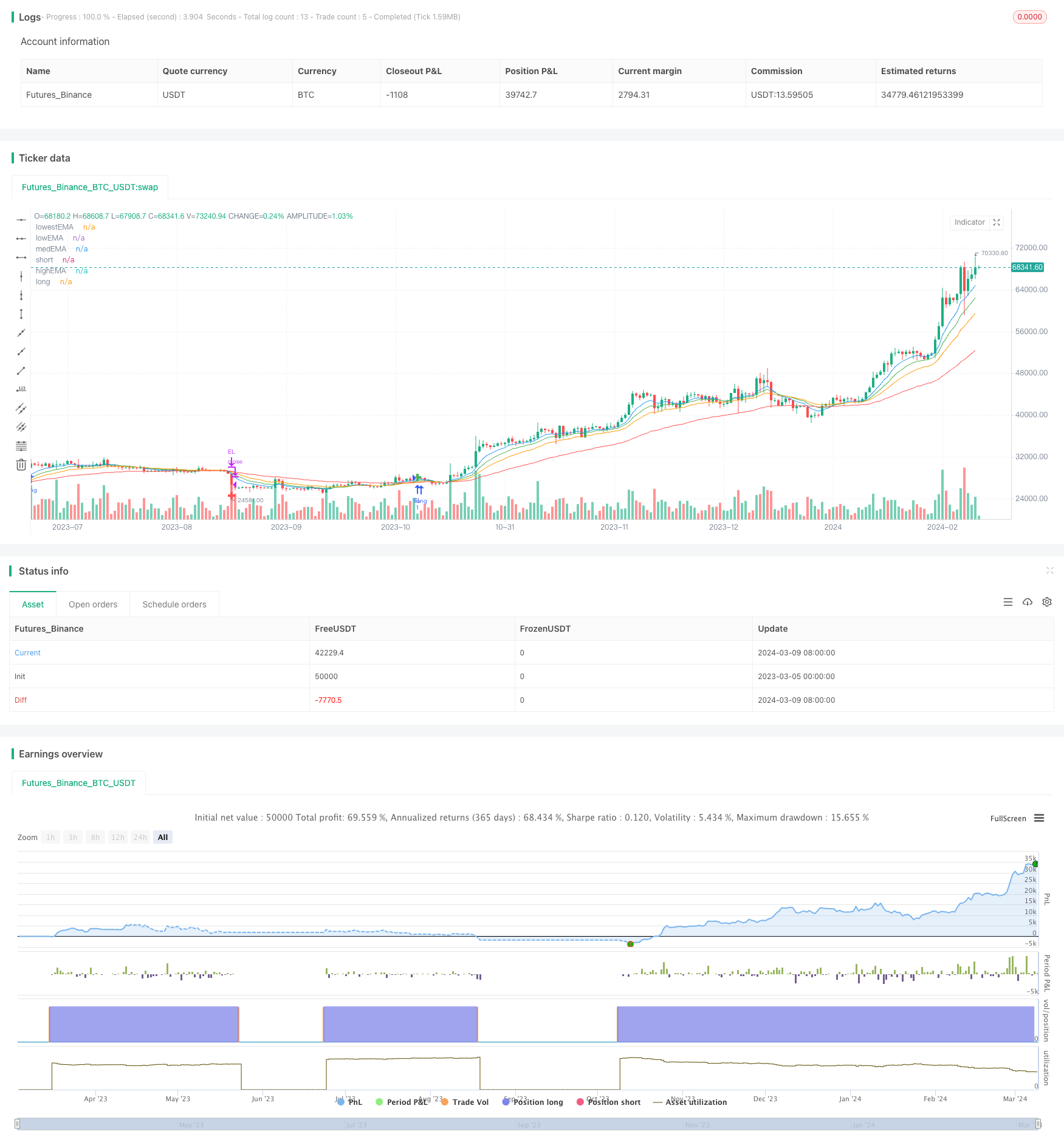 [trans]
概述(Overview)
该策略综合利用了多条指数移动平均线(Exponential Moving Average, EMA)来识别潜在的市场交易入场点和出场点。通过比较不同周期的EMA走势,判断当前市场趋势,在趋势形成初期介入交易,趋势结束初期平仓。
策略原理(Strategy Principle)
该策略使用了4条不同周期的EMA作为核心指标,分别为超短期EMA(默认8期)、短期EMA(默认13期)、中期EMA(默认21期)和长期EMA(默认55期)。当长期EMA位于其他三条EMA下方时,判断当前可能处于上升趋势初期,此时策略开多仓;当长期EMA位于其他三条EMA上方时,判断当前可能处于下降趋势初期,此时策略平掉所有多仓。通过EMA的这种多空排列组合来识别趋势转折点,捕捉初生趋势。
EMA相比简单移动平均线(SMA)更加重视近期价格,因此EMA走势更灵敏,能更快速地反应价格变化。不同周期EMA的交叉情况则反映了不同时间尺度下的趋势强弱。长期EMA是最稳健的,代表大的市场趋势;中短期EMA相对灵敏,反映市场中短期趋势。它们共同构成了该策略的核心逻辑。
优势分析(Advantage Analysis)
-
适用性广:该策略基于价格本身的EMA指标,适用于多数流动性好、走势相对光滑的品种,如各类期货、外汇、主流数字货币等。
-
趋势跟踪:通过比较不同周期EMA的位置关系来判断趋势,一定程度上能捕捉趋势形成初期,跟踪趋势。
-
参数灵活:EMA的周期参数可以根据品种特点、Investment Horizon等灵活调整,具有一定的适应性。
-
逻辑清晰:策略基于简单的EMA多空排列组合产生交易信号,逻辑清晰明了,容易理解和实现。
风险分析(Risk Analysis)
-
EMA延迟:EMA本质上是一种趋势跟踪指标,存在一定的延迟性,在震荡市可能会发生较多虚假信号。
-
参数敏感:EMA周期参数的选择对策略表现有较大影响,并且参数优化后未必能在样本外数据上保持良好表现。
-
缺乏过滤:该策略缺乏对交易信号的进一步过滤,全部信号生成后都会进行交易,可能会发生一些低质量交易。
-
固定仓位:目前策略每次开仓都是固定1个单位,缺乏基于风险的动态仓位控制,风险管理方面不够完善。
优化方向(Optimization Direction)
-
引入趋势过滤:在EMA信号基础上,增加ATR、ADX等趋势强度过滤指标,过滤掉弱趋势和震荡期的信号。
-
引入波动率过滤:在趋势过滤基础上,可进一步引入波动率过滤,如布林带宽度等,过滤掉高波动率可能导致的低质量信号。
-
优化止损:目前策略缺乏明确的止损逻辑,可以在引入趋势和波动率过滤后,增加基于ATR或百分比的动态止损,控制单笔最大亏损。
-
动态仓位:可以基于品种波动率、账户价值比例等,对策略每次开仓的数量进行动态控制,在降低风险的同时追求更高的绝对收益。
-
优化参数:不同品种、不同周期,EMA的最优参数可能不同,需要根据品种特点分别进行参数寻优,提高策略的适用性。
总结(Summary)
该策略通过比较4条不同周期EMA的多空排列组合来识别趋势转折点,捕捉趋势形成初期,思路简单清晰。它的优势在于适用范围广、逻辑清晰、参数灵活,能较好地跟踪趋势;但同时也存在EMA指标固有的延迟性,以及参数敏感、缺乏过滤、固定仓位等问题。未来可以从引入趋势和波动率过滤、优化止损、动态仓位、参数优化等方面来提高该策略的稳健性和盈利能力,使其更加完善和可靠。
||
Overview
This strategy combines multiple Exponential Moving Averages (EMAs) to identify potential entry and exit points in the market. By comparing the trends of EMAs with different periods, it determines the current market trend and enters trades at the beginning of the trend formation and closes positions at the beginning of the trend's end.
Strategy Principle
This strategy uses 4 EMAs with different periods as core indicators, namely ultra-short-term EMA (default 8 periods), short-term EMA (default 13 periods), medium-term EMA (default 21 periods), and long-term EMA (default 55 periods). When the long-term EMA is below the other three EMAs, it is judged that the current market may be at the beginning of an upward trend, and the strategy opens a long position; when the long-term EMA is above the other three EMAs, it is judged that the current market may be at the beginning of a downward trend, and the strategy closes all long positions. The strategy identifies trend turning points by this combination of long and short EMA arrangements to capture nascent trends.
Compared to Simple Moving Average (SMA), EMA places more emphasis on recent prices and thus its trend is more sensitive and can react to price changes more quickly. The crossover of EMAs with different periods reflects the strength of trends on different time scales. The long-term EMA is the most stable and represents the significant market trend; the medium and short-term EMAs are relatively sensitive and reflect the short and medium-term market trends. They together constitute the core logic of this strategy.
Advantage Analysis
-
Wide applicability: This strategy is based on the EMA indicator of the price itself and is applicable to most varieties with good liquidity and relatively smooth trends, such as various futures, forex, mainstream cryptocurrencies, etc.
-
Trend tracking: By comparing the position relationship of EMAs with different periods to determine the trend, it can capture the beginning of trend formation to a certain extent and track the trend.
-
Flexible parameters: The period parameters of EMA can be flexibly adjusted according to the characteristics of varieties, investment horizon, etc., and have certain adaptability.
-
Clear logic: The strategy generates trading signals based on a simple combination of long and short EMA arrangements, and the logic is clear and easy to understand and implement.
Risk Analysis
-
EMA lag: EMA is essentially a trend-tracking indicator and has a certain lag, which may generate more false signals in a turbulent market.
-
Parameter sensitivity: The selection of EMA period parameters has a significant impact on the strategy performance, and the parameters optimized may not maintain good performance on out-of-sample data.
-
Lack of filtering: This strategy lacks further filtering of trading signals, and all generated signals will be traded, which may result in some low-quality trades.
-
Fixed position: Currently, the strategy opens a fixed 1 unit position each time, lacking dynamic position control based on risk, and risk management is not perfect enough.
Optimization Direction
-
Introduce trend filtering: On the basis of EMA signals, add trend strength filtering indicators such as ATR and ADX to filter out signals from weak trends and turbulent periods.
-
Introduce volatility filtering: On the basis of trend filtering, volatility filtering such as Bollinger Band width can be further introduced to filter out low-quality signals that may be caused by high volatility.
-
Optimize stop-loss: Currently, the strategy lacks a clear stop-loss logic. After introducing trend and volatility filtering, dynamic stop-loss based on ATR or percentage can be added to control the maximum loss of a single trade.
-
Dynamic position: Based on the volatility of varieties, the proportion of account value, etc., the number of positions opened by the strategy each time can be dynamically controlled to pursue higher absolute returns while reducing risk.
-
Optimize parameters: For different varieties and different periods, the optimal parameters of EMA may be different, and parameter optimization needs to be performed separately according to the characteristics of varieties to improve the applicability of the strategy.
Summary
This strategy identifies trend turning points by comparing the long and short arrangement combinations of 4 EMAs with different periods to capture the beginning of trend formation. The idea is simple and clear. Its advantages lie in its wide range of applicability, clear logic, and flexible parameters, and it can track trends well; but at the same time, it also has the inherent lag of EMA indicators, as well as problems such as parameter sensitivity, lack of filtering, and fixed position. In the future, the robustness and profitability of this strategy can be improved from aspects such as introducing trend and volatility filtering, optimizing stop-loss, dynamic position, and parameter optimization to make it more complete and reliable.
[/trans]
Strategy Arguments
| Argument | Default | Description |
|---|---|---|
| v_input_int_1 | 8 | Lowest EMA |
| v_input_int_2 | 13 | Low EMA |
| v_input_int_3 | 21 | Med EMA |
| v_input_int_4 | 55 | High EMA |
Source (PineScript)
/*backtest
start: 2023-03-05 00:00:00
end: 2024-03-10 00:00:00
period: 1d
basePeriod: 1h
exchanges: [{"eid":"Futures_Binance","currency":"BTC_USDT"}]
*/

// This Pine Script™ code is subject to the terms of the Mozilla Public License 2.0 at https://mozilla.org/MPL/2.0/
// © n1ghthawk

//@version=5
strategy("donmo's 4ema", overlay=true, margin_long=100, margin_short=100)

float long = na
float short = na

lowestEMAPeriodInput = input.int(8, "Lowest EMA")
lowEMAPeriodInput = input.int(13, "Low EMA")
medEMAPeriodInput = input.int(21, "Med EMA")
highEMAPeriodInput = input.int(55, "High EMA")

lowestEMA = ta.ema(close, lowestEMAPeriodInput)
lowEMA = ta.ema(close, lowEMAPeriodInput)
medEMA = ta.ema(close, medEMAPeriodInput)
highEMA = ta.ema(close, highEMAPeriodInput)


emaLongCondition = highEMA<medEMA and highEMA<lowEMA and highEMA<lowestEMA
emaShortCondition = highEMA>medEMA and highEMA>lowEMA and highEMA>lowestEMA

longCondition = ta.change(emaLongCondition)
shortCondition = ta.change(emaShortCondition)

notInTrade = strategy.position_size <= 0
if longCondition and emaLongCondition and notInTrade
    long:=high
    strategy.entry("EL", strategy.long)

if shortCondition and emaShortCondition
    short:=low
    strategy.close("EL")


plot(long+3,title = 'long', color = color.green, linewidth = 4, style = plot.style_cross)
plot(short-3,title = 'short', color = color.red, linewidth = 4, style = plot.style_cross)

plot(lowestEMA, title = "lowestEMA", color=color.blue)
plot(lowEMA, title = "lowEMA", color=color.green)
plot(medEMA, title = "medEMA", color=color.orange)
plot(highEMA, title = "highEMA", color=color.red)
Detail
https://www.fmz.com/strategy/444387
Last Modified
2024-03-11 16:17:20