
17 KiB
Name
多重均线与ATR动态波动策略-Multi-Moving-Average-ATR-Dynamic-Volatility-Strategy
Author
ianzeng123
Strategy Description
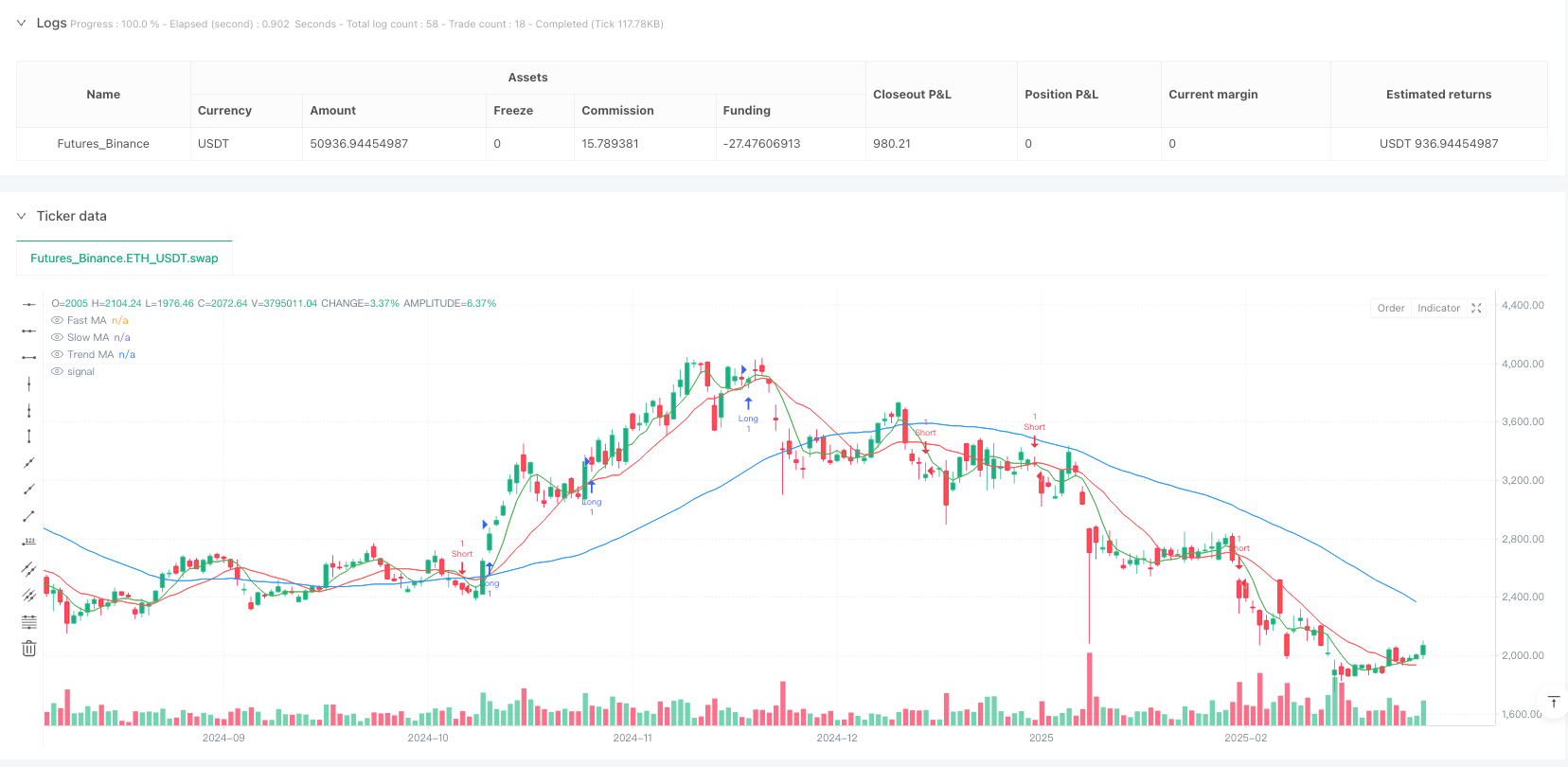
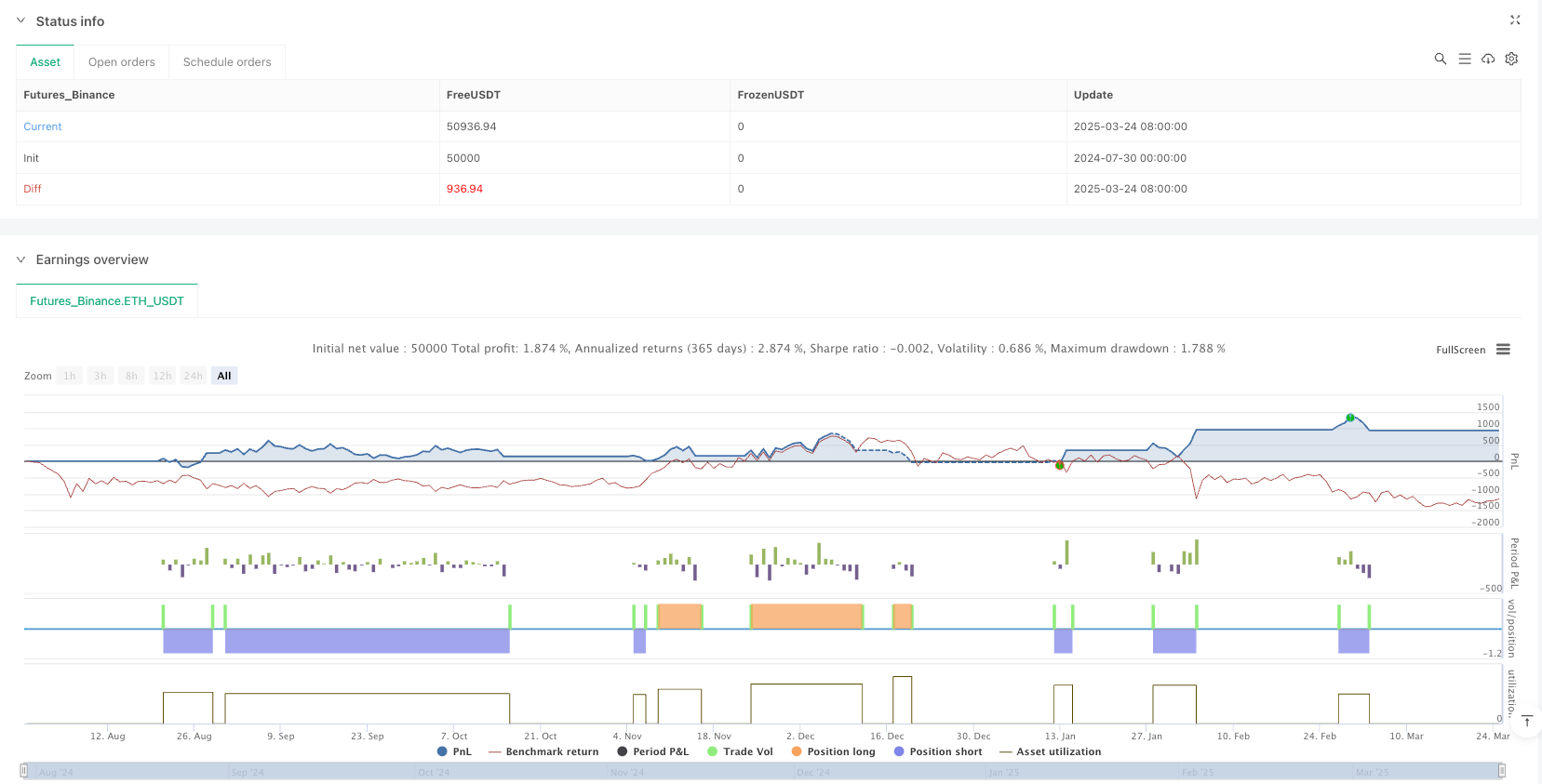
[trans]
概述
这是一个结合了多重移动平均线和真实波幅(ATR)指标的趋势跟踪交易策略。该策略核心思想是通过快速移动平均线与慢速移动平均线的交叉来识别入场信号,同时利用长期移动平均线作为趋势过滤器,确保交易方向与整体市场趋势保持一致。此外,策略采用ATR指标动态设置止损和止盈水平,使其能够根据市场波动性自动调整风险管理参数,同时还实现了在预设时间段内运行的功能,可以专注于特定的交易时段。
策略原理
该策略的核心原理包括以下几个关键组成部分:
-
多重移动平均线系统:策略同时使用三条移动平均线,分别为快速MA(5周期)、慢速MA(13周期)和趋势MA(50周期)。快慢均线交叉提供交易信号,而趋势均线则确定整体市场方向。
-
趋势确认机制:策略要求价格位于趋势均线之上才进行多头交易,位于趋势均线之下才进行空头交易,这有效地过滤了逆势交易信号。
-
基于ATR的风险管理:使用14周期ATR计算市场波动性,并通过乘数(1.5)设置止损位置。这种方法使止损水平能够根据市场实际波动情况自动调整,避免了固定点数止损的缺陷。
-
动态利润目标:采用ATR与利润目标乘数(2.0)的乘积来设置止盈水平,这使策略能够在不同波动环境下调整预期利润。
-
时间过滤:策略仅在设定的交易时段(2023年1月1日至2025年12月31日)内执行交易信号,这有助于避免特定时期的不利市场条件。
-
追踪止损机制:策略实施了基于ATR的追踪止损,可以在价格向有利方向移动时锁定部分利润,同时给予价格足够的呼吸空间。
策略优势
深入分析该策略代码,可以总结出以下显著优势:
-
趋势与动量结合:策略巧妙地结合了趋势跟踪(通过趋势MA)和动量交易(通过快慢均线交叉)两种方法,有助于捕捉强势趋势中的有利入场点。
-
自适应风险管理:基于ATR的止损和止盈设置使策略能够根据市场波动性自动调整风险参数,这比固定点数设置更为智能,可以适应不同市场环境。
-
完整的交易系统:策略包含明确的入场、出场条件和风险管理规则,形成了一个完整的交易系统,无需交易者主观判断。
-
参数可调性:策略提供多个可调参数,如均线周期、ATR乘数和利润目标乘数,使其可以根据不同市场特性或个人风险偏好进行优化。
-
时间过滤功能:通过设定特定的交易时段,策略可以避免在历史上表现不佳的时期进行交易,这是一种有效的风险控制措施。
-
可视化支持:策略在图表上绘制所有关键移动平均线,便于交易者直观理解当前市场结构和潜在信号。
策略风险
尽管该策略设计合理,但仍存在以下风险和局限性:
-
均线滞后性:所有基于移动平均线的策略都存在信号滞后的问题,快速反转行情中可能导致较大回撤或错过初始走势。
-
假突破风险:快慢均线交叉可能产生假突破信号,尤其在波动性较低的盘整市场中更为明显。
-
参数敏感性:策略性能可能对所选参数值高度敏感,如均线周期或ATR乘数的微小变化可能导致显著不同的结果。
-
潜在过度优化:针对特定历史数据优化的参数可能无法在未来市场中表现同样出色,存在过度拟合风险。
-
市场环境依赖:该策略在强趋势市场中可能表现出色,但在震荡市场或低波动率环境中可能频繁产生亏损交易。
-
单一时间框架限制:策略仅基于单一时间框架的数据,缺乏多时间框架确认,可能错过更大周期的重要市场结构。
对于这些风险,可采取以下解决方法:
- 添加额外过滤条件,如波动率阈值或动量确认指标
- 实施分级仓位管理,而非全仓交易
- 定期重新优化参数,适应变化的市场环境
- 增加多时间框架分析作为确认机制
策略优化方向
基于对代码的深入分析,该策略可以从以下几个方向进行优化:
-
多时间框架分析:整合更高时间框架的趋势确认信号,可以提高交易质量。例如,只在日线趋势方向与当前交易时间框架一致时才执行交易。
-
波动率过滤:加入波动率过滤条件,如只在ATR值高于特定阈值时才执行交易,避免在低波动环境中的虚假信号。
-
动态参数调整:根据市场条件自动调整ATR乘数和利润目标乘数,例如在高波动性环境中增加ATR乘数以避免过早止损。
-
加入成交量确认:将成交量指标整合到入场条件中,只在成交量支持的情况下执行交易信号,可以降低假突破风险。
-
智能仓位管理:实施基于ATR的动态仓位管理系统,在高波动环境中减少仓位大小,在低波动环境中适当增加。
-
优化出场机制:考虑添加基于市场结构或指标反转的出场条件,而不仅依赖止损和止盈水平。
-
季节性分析:研究特定市场的季节性模式,可能进一步优化交易时段设置。
这些优化可以增强策略的稳健性,减少回撤,并提高整体风险调整后收益。
总结
多重均线与ATR动态波动策略是一个结构完善的量化交易系统,它巧妙结合了趋势跟踪与动量交易原则,并配备了自适应风险管理机制。通过使用不同周期的移动平均线来识别趋势和生成交易信号,同时利用ATR指标动态设置止损和止盈水平,该策略能够适应不同市场环境的波动性变化。
虽然该策略面临均线滞后性和假突破等固有风险,但其完整的交易规则和风险管理框架为交易者提供了一个可操作且可扩展的系统。通过添加多时间框架分析、波动率过滤和智能仓位管理等优化措施,可以进一步提升策略的稳健性和长期盈利能力。
总体而言,这是一个平衡了信号生成和风险控制的策略,特别适合那些希望在遵循明确交易规则的同时,保持一定灵活性以适应市场变化的交易者。该策略不仅体现了技术分析的核心原则,也展示了量化交易的系统化特点,为长期一致性交易提供了坚实基础。 ||
Overview
This is a trend-following trading strategy that combines multiple moving averages with the Average True Range (ATR) indicator. The core concept involves identifying entry signals through crossovers between fast and slow moving averages, while using a long-term moving average as a trend filter to ensure trade direction aligns with the overall market trend. Additionally, the strategy employs the ATR indicator to dynamically set stop-loss and take-profit levels, allowing it to automatically adjust risk management parameters based on market volatility, while also implementing functionality to operate within a preset time period, focusing on specific trading sessions.
Strategy Principles
The core principles of this strategy include several key components:
-
Multiple Moving Average System: The strategy simultaneously utilizes three moving averages: a fast MA (5-period), a slow MA (13-period), and a trend MA (50-period). The fast and slow MA crossovers provide trading signals, while the trend MA determines the overall market direction.
-
Trend Confirmation Mechanism: The strategy requires price to be above the trend MA for long trades and below the trend MA for short trades, effectively filtering out counter-trend trading signals.
-
ATR-Based Risk Management: The strategy uses a 14-period ATR to calculate market volatility and sets stop-loss positions through a multiplier (1.5). This approach allows stop-loss levels to automatically adjust based on actual market volatility, avoiding the limitations of fixed-point stops.
-
Dynamic Profit Targets: The strategy adopts the product of ATR and a profit target multiplier (2.0) to set take-profit levels, enabling it to adjust expected profits in different volatility environments.
-
Time Filtering: The strategy executes trading signals only within a set trading period (January 1, 2023, to December 31, 2025), helping to avoid adverse market conditions during specific periods.
-
Trailing Stop Mechanism: The strategy implements an ATR-based trailing stop that can lock in partial profits as price moves favorably while giving price sufficient room to breathe.
Strategy Advantages
Through deep analysis of the strategy code, the following significant advantages can be summarized:
-
Combination of Trend and Momentum: The strategy cleverly combines trend following (via trend MA) and momentum trading (via fast/slow MA crossovers), helping to capture favorable entry points within strong trends.
-
Adaptive Risk Management: ATR-based stop-loss and take-profit settings allow the strategy to automatically adjust risk parameters based on market volatility, which is more intelligent than fixed-point settings and can adapt to different market environments.
-
Complete Trading System: The strategy includes clear entry and exit conditions and risk management rules, forming a complete trading system that doesn't require subjective judgment from traders.
-
Parameter Adjustability: The strategy provides multiple adjustable parameters, such as MA periods, ATR multiplier, and profit target multiplier, making it customizable based on different market characteristics or personal risk preferences.
-
Time Filtering Function: By setting specific trading periods, the strategy can avoid trading during historically poor-performing times, which is an effective risk control measure.
-
Visual Support: The strategy plots all key moving averages on the chart, allowing traders to intuitively understand current market structure and potential signals.
Strategy Risks
Despite being well-designed, the strategy still has the following risks and limitations:
-
Moving Average Lag: All strategies based on moving averages suffer from signal lag issues, which can lead to significant drawdowns or missed initial movements in rapid reversal scenarios.
-
False Breakout Risk: Fast/slow MA crossovers may produce false breakout signals, particularly in low-volatility, ranging markets.
-
Parameter Sensitivity: Strategy performance may be highly sensitive to chosen parameter values, as small changes in MA periods or ATR multipliers can lead to significantly different results.
-
Potential Over-Optimization: Parameters optimized for specific historical data may not perform equally well in future markets, posing the risk of overfitting.
-
Market Environment Dependency: The strategy may perform excellently in strong trending markets but could frequently generate losing trades in oscillating markets or low-volatility environments.
-
Single Timeframe Limitation: The strategy is based on data from a single timeframe, lacking multi-timeframe confirmation, which may miss important market structures from larger cycles.
For these risks, the following solutions can be adopted:
- Add additional filtering conditions, such as volatility thresholds or momentum confirmation indicators
- Implement graduated position management instead of all-in trading
- Periodically re-optimize parameters to adapt to changing market environments
- Add multi-timeframe analysis as a confirmation mechanism
Strategy Optimization Directions
Based on deep analysis of the code, the strategy can be optimized in the following directions:
-
Multi-Timeframe Analysis: Integrating trend confirmation signals from higher timeframes can improve trade quality. For example, executing trades only when the daily trend direction aligns with the current trading timeframe.
-
Volatility Filtering: Adding volatility filtering conditions, such as executing trades only when the ATR value exceeds a specific threshold, can avoid false signals in low-volatility environments.
-
Dynamic Parameter Adjustment: Automatically adjusting ATR multipliers and profit target multipliers based on market conditions, such as increasing ATR multipliers in high-volatility environments to avoid premature stop-outs.
-
Adding Volume Confirmation: Integrating volume indicators into entry conditions and executing trading signals only when supported by volume can reduce false breakout risks.
-
Smart Position Management: Implementing an ATR-based dynamic position management system, reducing position size in high-volatility environments and appropriately increasing it in low-volatility environments.
-
Optimizing Exit Mechanisms: Consider adding exit conditions based on market structure or indicator reversals, rather than relying solely on stop-loss and take-profit levels.
-
Seasonality Analysis: Studying seasonal patterns in specific markets can further optimize trading period settings.
These optimizations can enhance strategy robustness, reduce drawdowns, and improve overall risk-adjusted returns.
Summary
The Multi-Moving Average & ATR Dynamic Volatility Strategy is a well-structured quantitative trading system that cleverly combines trend-following and momentum trading principles with adaptive risk management mechanisms. By using moving averages of different periods to identify trends and generate trading signals, while utilizing the ATR indicator to dynamically set stop-loss and take-profit levels, the strategy can adapt to volatility changes in different market environments.
Although the strategy faces inherent risks such as moving average lag and false breakouts, its comprehensive trading rules and risk management framework provide traders with an operational and scalable system. By adding multi-timeframe analysis, volatility filtering, and smart position management optimizations, the robustness and long-term profitability of the strategy can be further enhanced.
Overall, this is a strategy that balances signal generation and risk control, particularly suitable for traders who wish to follow clear trading rules while maintaining flexibility to adapt to market changes. The strategy not only embodies core principles of technical analysis but also demonstrates the systematic nature of quantitative trading, providing a solid foundation for long-term consistent trading. Most importantly, by using ATR to dynamically adjust risk parameters, the strategy maintains relatively consistent risk exposure across different market volatility environments, which is one of the key elements for long-term trading success.
This strategy can serve as a foundational framework that traders can personalize according to their trading style and risk tolerance. Whether for intraday trading or long-term holding, this method combining moving average systems with volatility measurement provides a reliable starting point. Through continuous monitoring and parameter optimization, its performance in real trading environments can be further enhanced. [/trans]
Source (PineScript)
/*backtest
start: 2024-07-30 00:00:00
end: 2025-03-25 00:00:00
period: 1d
basePeriod: 1d
exchanges: [{"eid":"Futures_Binance","currency":"ETH_USDT"}]
*/

//@version=6
// Copyright 2025 Rouvonn Wales
strategy("Bitcoin King V1", overlay=true)

// Input parameters
fast_length = input(5, title="Fast MA Length")
slow_length = input(13, title="Slow MA Length")
atr_length = input(14, title="ATR Length")
atr_multiplier = input(1.5, title="ATR Multiplier")
trend_length = input(50, title="Trend MA Length")
profit_target_multiplier = input(2.0, title="Profit Target Multiplier")


// Calculate moving averages
fast_ma = ta.sma(close, fast_length)
slow_ma = ta.sma(close, slow_length)
trend_ma = ta.sma(close, trend_length)

// Calculate ATR for stop loss and take profit levels
atr = ta.atr(atr_length)

// Plot moving averages
plot(fast_ma, color=color.green, title="Fast MA")
plot(slow_ma, color=color.red, title="Slow MA")
plot(trend_ma, color=color.blue, title="Trend MA")

// Entry conditions with trend filter
long_condition = ta.crossover(fast_ma, slow_ma) and close > trend_ma
short_condition = ta.crossunder(fast_ma, slow_ma) and close < trend_ma

// Execute trades with stop loss and take profit
if (long_condition)
    strategy.entry("Long", strategy.long, stop=close - atr * atr_multiplier, limit=close + atr * profit_target_multiplier)

if (short_condition)
    strategy.entry("Short", strategy.short, stop=close + atr * atr_multiplier, limit=close - atr * profit_target_multiplier)

// Exit conditions with trailing stop and additional criteria
if (strategy.position_size > 0)
    strategy.exit("Exit Long", "Long", stop=close - atr * atr_multiplier, limit=close + atr * profit_target_multiplier, trail_offset=atr * atr_multiplier)

if (strategy.position_size < 0)
    strategy.exit("Exit Short", "Short", stop=close + atr * atr_multiplier, limit=close - atr * profit_target_multiplier, trail_offset=atr * atr_multiplier)
Detail
https://www.fmz.com/strategy/488245
Last Modified
2025-03-26 11:22:17