
19 KiB
Name
多维度自适应趋势追踪与风险管理策略-Multi-Dimensional-Adaptive-Trend-Following-and-Risk-Management-Strategy
Author
ianzeng123
Strategy Description
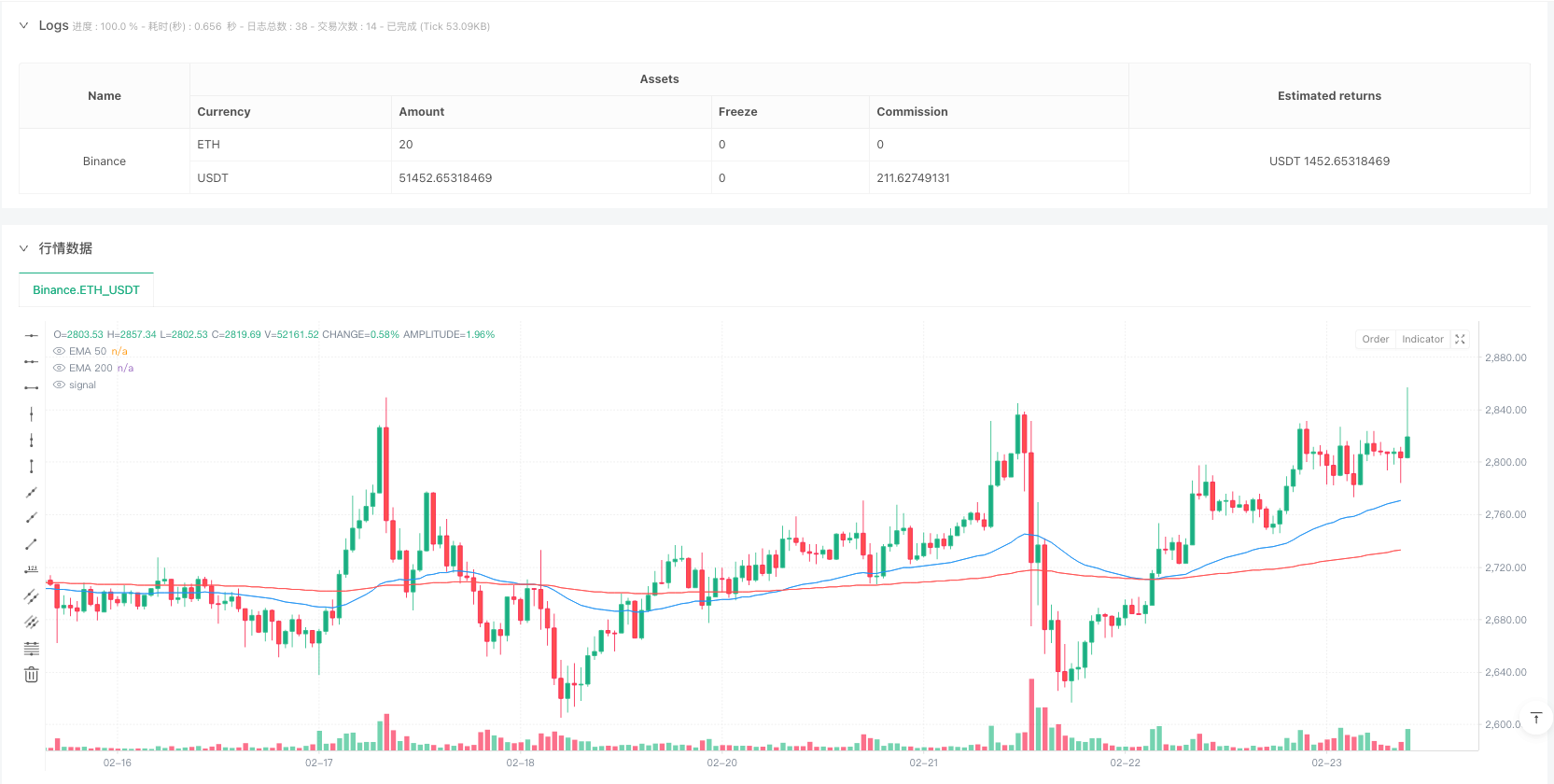
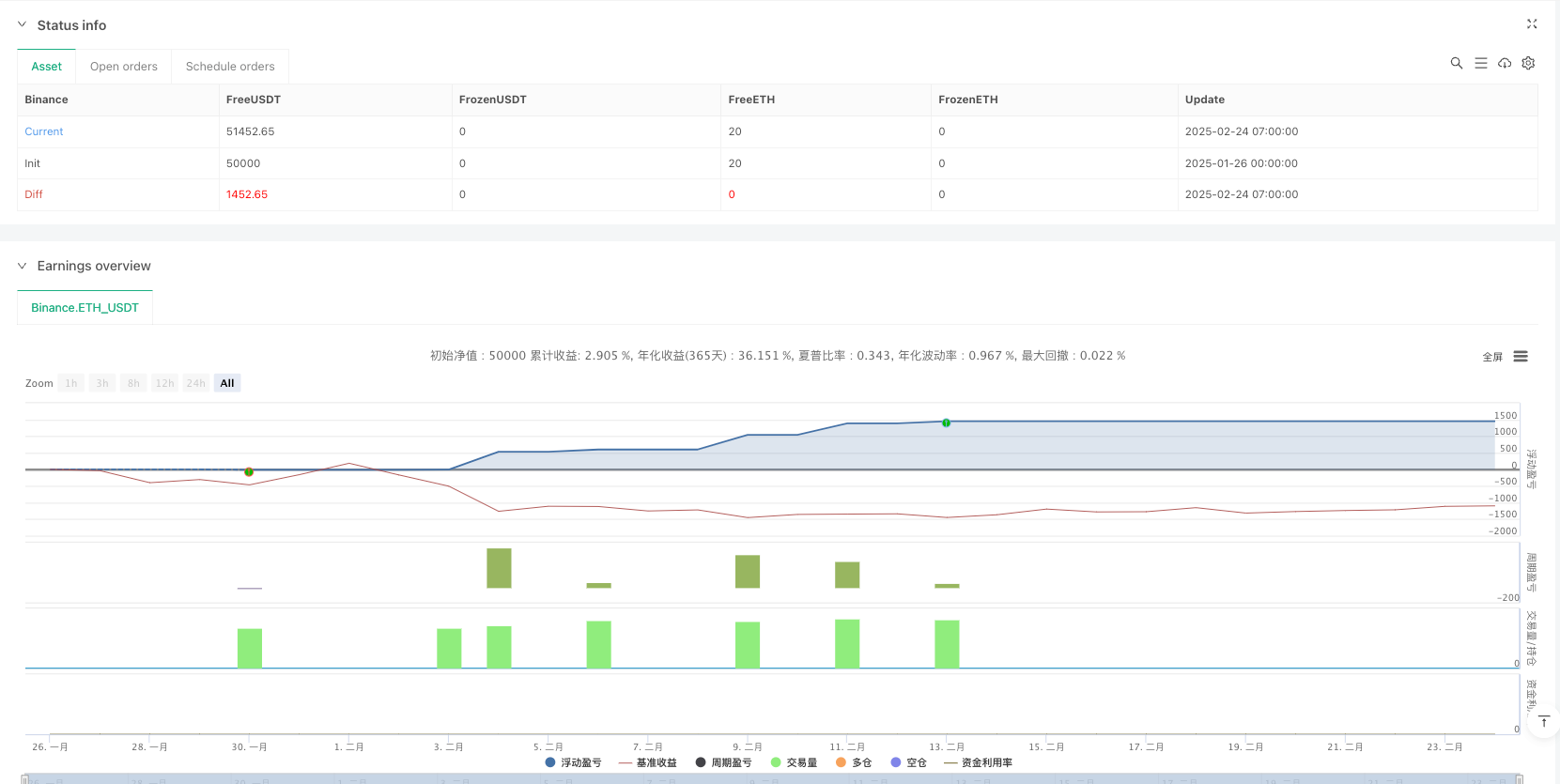
[trans]
概述
该量化交易策略是一种基于趋势突破的交易系统,结合了多重过滤条件和严格的风险管理机制。策略核心设计使用价格与均线交叉作为主要入场信号,同时引入ATR波动率指标优化入场时机,并通过EMA50与EMA200均线组合构建趋势过滤机制,确保只在强趋势环境中开仓。该策略还设置了固定止损和获利目标,并具备根据市场波动动态调整止损位置的能力。根据回测数据显示,该策略在15分钟时间框架下表现优异,胜率超过74%,利润因子达到2.4,展示出稳健的盈利能力和风险控制水平。
策略原理
该策略基于多维度信号系统运作,核心入场条件如下:
-
突破信号生成:通过价格与高点/低点SMA均线加减ATR值的交叉来识别潜在的趋势突破机会。多头入场依赖价格向上突破(ta.crossover)高点SMA均线加上ATR调整值,空头入场则依赖价格向下突破(ta.crossunder)低点SMA均线减去ATR调整值。
-
趋势过滤机制:策略采用EMA50与EMA200均线组合构建趋势环境判断系统。多头要求价格位于EMA50之上且EMA50位于EMA200之上,确认上升趋势;空头则要求价格位于EMA50之下且EMA50位于EMA200之下,确认下降趋势。
-
时间过滤器:策略限制交易时间在纽约时间2AM至2PM之间进行,专注于市场活跃度和波动性较高的时段。
-
交易冷却机制:每次交易后设置15根K线的冷却期,防止过度交易并减少市场噪音带来的假信号影响。
-
风险管理系统:
- 固定止损:设置50个点的固定止损,并通过ATR值进行动态调整
- 固定获利:设置100个点的固定获利目标
- 盈亏平衡机制:当交易盈利达到50个点时,将止损移至成本位附近(加上2个最小波动单位缓冲)
策略通过pipSize(最小波动单位)将点数转换为实际价格变动,确保在不同品种上都能正确应用风险管理规则。
策略优势
-
多重过滤系统:结合价格突破、趋势确认、时间过滤和交易冷却机制,显著减少假信号,提高交易质量。策略只在符合多重条件的情况下才会开仓,大幅提升了信号的可靠性。
-
自适应风险控制:通过结合固定止损/获利目标与ATR动态调整,使策略能够适应不同市场波动环境。ATR乘数(1.2)在高波动期间自动扩大保护范围,在低波动期间则缩小,实现智能化风险管理。
-
盈亏平衡机制:当交易获利达到特定水平(50点)时自动将止损移至成本位附近,保护已有利润并允许趋势继续发展,优化了风险回报比。
-
过度交易保护:设置交易冷却期(15根K线)有效防止在相似市场条件下连续开仓,降低交易频率和交易成本,避免在震荡市场中频繁止损。
-
高质量的交易时间控制:限制交易在纽约时间2AM至2PM期间,专注于流动性和波动性较为理想的市场时段,避开低流动性和异常波动时段。
-
突出的回测表现:策略在15分钟时间框架下展现74%以上的胜率和2.4的利润因子,表明其具有稳健的盈利能力和良好的风险回报特性。
策略风险
-
止损跳空风险:在市场大幅跳空情况下,固定止损位可能无法得到完美执行,实际损失可能超过预期。解决方法是考虑增加止损缓冲区或引入基于波动率的动态止损系统。
-
趋势识别延迟:使用EMA50和EMA200作为趋势过滤器可能导致在趋势早期阶段错过入场机会,或在趋势结束后仍保持头寸。可以通过引入更灵敏的趋势指标或多时间框架分析来优化。
-
参数敏感性:策略性能高度依赖于length(10)、cooldownBars(15)等关键参数设置。市场条件变化可能导致最优参数失效,需要定期重新优化或引入自适应参数调整机制。
-
固定获利目标限制:100点的固定获利目标可能在强趋势市场中过早结束交易,限制了盈利潜力。考虑实施部分获利或移动止损策略以优化强趋势行情中的表现。
-
时间过滤器限制:纽约时间2AM至2PM的交易窗口可能错过其他时段的交易机会,特别是对于全球24小时交易的市场。可以考虑针对不同时区或市场特性调整交易时间窗口。
-
ATR调整的稳定性:ATR值的突然变化可能导致入场条件和止损位置的不稳定。建议使用更长期的ATR计算或平滑处理ATR值,减少短期波动对策略的影响。
策略优化方向
-
动态获利目标系统:将固定获利目标(100点)替换为基于波动率的动态目标,可以根据市场条件自动调整获利目标大小。具体实现可以使用多倍ATR值作为目标距离,在高波动环境中设置更大的目标,低波动环境中设置更保守的目标。
-
趋势强度分级系统:优化现有的趋势过滤机制,引入趋势强度评分系统,根据不同的趋势强度调整头寸规模或风险参数。可以结合均线角度、价格与均线距离等因素构建综合评分,实现更精细的交易决策。
-
多时间框架确认:增加更高时间框架的趋势确认机制,确保交易方向与更大趋势保持一致。例如,在15分钟图表交易前,先确认1小时或4小时图表的趋势方向,提高信号质量。
-
部分获利机制:实现多级获利策略,允许在达到特定盈利水平时部分平仓,既锁定部分利润又保留继续获利的可能性。可以设计为当盈利达到50点时平仓50%,剩余部分使用跟踪止损继续持有。
-
自适应冷却期:将固定的15根K线冷却期改为基于市场波动性的动态冷却期。在高波动市场可以缩短冷却期以捕捉更多机会,低波动市场则延长冷却期避免过度交易。
-
增强的回测验证:扩展回测范围,在不同市场和时间周期上验证策略稳健性,特别关注不同市场条件下的表现。实施步进式优化和蒙特卡洛模拟,评估参数敏感性和策略鲁棒性。
总结
多维度自适应趋势追踪与风险管理策略是一个设计精良的量化交易系统,通过整合价格突破信号、趋势过滤、时间控制和多层风险管理机制,实现了高胜率和优秀的利润因子。策略特别注重风险控制,使用固定止损与ATR动态调整相结合的方式保护资金,同时利用盈亏平衡机制锁定部分利润。该策略适合中短期趋势交易,特别在15分钟时间框架上表现卓越。
尽管存在参数优化和获利管理方面的改进空间,该策略已经展示出系统化交易的核心优势:纪律性强、风险可控且具有可重复的交易逻辑。通过实施建议的优化措施,特别是动态获利目标和多时间框架确认系统,策略有望在不同市场环境中保持稳定表现并进一步提升整体盈利能力。 ||
Overview
This quantitative trading strategy is a trend-following system that combines multiple filtering conditions with strict risk management mechanisms. The core design uses price crosses with moving averages as the primary entry signals, while incorporating the ATR volatility indicator to optimize entry timing. It employs a trend filtering mechanism constructed with EMA50 and EMA200 combinations to ensure positions are only opened in strong trend environments. The strategy also sets fixed stop-loss and take-profit targets, with the ability to dynamically adjust stop-loss positions based on market volatility. According to backtesting data, this strategy performs excellently on the 15-minute timeframe with a win rate exceeding 74% and a profit factor of 2.4, demonstrating robust profitability and risk control levels.
Strategy Principles
This strategy operates on a multi-dimensional signal system with the following core entry conditions:
-
Breakout Signal Generation: Identifies potential trend breakout opportunities through price crosses with SMA of highs/lows plus/minus ATR values. Long entries rely on price breaking above (ta.crossover) the SMA of highs plus an ATR adjustment value, while short entries depend on price breaking below (ta.crossunder) the SMA of lows minus an ATR adjustment value.
-
Trend Filtering Mechanism: The strategy employs a combination of EMA50 and EMA200 to establish a trend environment judgment system. For longs, it requires price to be above EMA50 and EMA50 to be above EMA200, confirming an uptrend; for shorts, it requires price below EMA50 and EMA50 below EMA200, confirming a downtrend.
-
Time Filter: The strategy restricts trading to between 2AM and 2PM New York time, focusing on periods of higher market activity and volatility.
-
Trading Cooldown Mechanism: Sets a 15-bar cooldown period after each trade, preventing overtrading and reducing the impact of false signals from market noise.
-
Risk Management System:
- Fixed Stop Loss: Sets a 50-point fixed stop loss with dynamic adjustment via ATR value
- Fixed Take Profit: Sets a 100-point fixed profit target
- Break-Even Mechanism: When a trade reaches 50 points in profit, the stop loss is moved to near the entry price (plus 2 minimum tick units as buffer)
The strategy converts points to actual price movements using pipSize (minimum tick size), ensuring risk management rules are correctly applied across different instruments.
Strategy Advantages
-
Multiple Filtering System: Combines price breakouts, trend confirmation, time filtering, and trade cooldown mechanisms to significantly reduce false signals and improve trade quality. The strategy only opens positions when multiple conditions are met, greatly enhancing signal reliability.
-
Adaptive Risk Control: By combining fixed stop-loss/profit targets with ATR dynamic adjustments, the strategy can adapt to different market volatility environments. The ATR multiplier (1.2) automatically expands protection range during high volatility periods and contracts during low volatility, achieving intelligent risk management.
-
Break-Even Mechanism: Automatically moves the stop loss to near the entry price when profit reaches a specific level (50 points), protecting existing profits while allowing trends to continue developing, optimizing the risk-reward ratio.
-
Overtrading Protection: The trading cooldown period (15 bars) effectively prevents consecutive entries under similar market conditions, reducing trading frequency and costs, and avoiding frequent stop-outs in ranging markets.
-
High-Quality Trading Time Control: Restricts trading to between 2AM and 2PM New York time, focusing on market sessions with ideal liquidity and volatility, avoiding low liquidity and abnormal volatility periods.
-
Outstanding Backtesting Performance: The strategy demonstrates over 74% win rate and a profit factor of 2.4 on the 15-minute timeframe, indicating robust profitability and good risk-reward characteristics.
Strategy Risks
-
Gap Risk for Stop Losses: In situations with large market gaps, fixed stop loss positions may not execute perfectly, and actual losses could exceed expectations. The solution is to consider adding stop loss buffers or introducing a volatility-based dynamic stop loss system.
-
Trend Identification Delay: Using EMA50 and EMA200 as trend filters may cause missed entry opportunities in the early stages of trends, or maintaining positions after trends have ended. This can be optimized by introducing more sensitive trend indicators or multi-timeframe analysis.
-
Parameter Sensitivity: Strategy performance is highly dependent on key parameter settings like length (10) and cooldownBars (15). Changing market conditions may render optimal parameters ineffective, requiring periodic re-optimization or introduction of adaptive parameter adjustment mechanisms.
-
Fixed Profit Target Limitations: The 100-point fixed profit target may end trades too early in strong trend markets, limiting profit potential. Consider implementing partial profit-taking or trailing stop strategies to optimize performance in strong trend scenarios.
-
Time Filter Limitations: The trading window of 2AM to 2PM New York time may miss trading opportunities in other sessions, especially for 24-hour global markets. Consider adjusting trading time windows for different time zones or market characteristics.
-
ATR Adjustment Stability: Sudden changes in ATR values may lead to instability in entry conditions and stop loss positions. It's recommended to use longer-term ATR calculations or smooth ATR values to reduce the impact of short-term fluctuations on the strategy.
Strategy Optimization Directions
-
Dynamic Profit Target System: Replace the fixed profit target (100 points) with a volatility-based dynamic target that automatically adjusts target size based on market conditions. This can be implemented using multiple ATR values as target distances, setting larger targets in high volatility environments and more conservative targets in low volatility environments.
-
Trend Strength Grading System: Optimize the existing trend filtering mechanism by introducing a trend strength scoring system that adjusts position sizing or risk parameters based on different trend strengths. This can be constructed by combining factors such as moving average angles and price-to-moving-average distances to build a comprehensive score, enabling more refined trading decisions.
-
Multi-Timeframe Confirmation: Add higher timeframe trend confirmation mechanisms to ensure trading direction aligns with larger trends. For example, before trading on a 15-minute chart, first confirm the trend direction on 1-hour or 4-hour charts to improve signal quality.
-
Partial Profit Mechanism: Implement a multi-level profit strategy that allows partial position closing when specific profit levels are reached, both securing partial profits and retaining the possibility of continued gains. This could be designed to close 50% of the position when profit reaches 50 points, with the remainder held using a trailing stop.
-
Adaptive Cooldown Period: Change the fixed 15-bar cooldown period to a dynamic one based on market volatility. In highly volatile markets, the cooldown period can be shortened to capture more opportunities, while in low volatility markets, it can be extended to avoid overtrading.
-
Enhanced Backtesting Validation: Expand backtesting scope to validate strategy robustness across different markets and time periods, with special attention to performance under various market conditions. Implement walk-forward optimization and Monte Carlo simulations to evaluate parameter sensitivity and strategy robustness.
Summary
The Multi-Dimensional Adaptive Trend Following and Risk Management Strategy is a well-designed quantitative trading system that achieves high win rates and excellent profit factors by integrating price breakout signals, trend filtering, time control, and multi-layered risk management mechanisms. The strategy particularly emphasizes risk control, using a combination of fixed stop-losses and ATR dynamic adjustments to protect capital, while employing break-even mechanisms to secure partial profits. This strategy is suitable for medium to short-term trend trading, performing exceptionally well on the 15-minute timeframe.
Despite room for improvement in parameters optimization and profit management, the strategy already demonstrates the core advantages of systematic trading: strong discipline, controllable risk, and repeatable trading logic. By implementing the suggested optimization measures, particularly dynamic profit targets and multi-timeframe confirmation systems, the strategy is likely to maintain stable performance across different market environments and further enhance overall profitability. [/trans]
Source (PineScript)
/*backtest
start: 2025-01-26 00:00:00
end: 2025-02-24 08:00:00
period: 1h
basePeriod: 1h
exchanges: [{"eid":"Binance","currency":"ETH_USDT"}]
*/

//@version=5
strategy("Optimized Target Trend Strategy v2", overlay=true, default_qty_type=strategy.percent_of_equity, default_qty_value=100)

// Inputs
length = input.int(10, "Trend Length")
useTrendFilter = input.bool(true, "Use Trend Filter")
cooldownBars = input.int(15, "Cooldown Between Trades") // Increased cooldown to prevent overtrading

// Fixed Risk Management
fixedSL = 50 // 60 pips/ticks stop loss
fixedTP = 100 // 100 pips/ticks take profit
breakEvenTrigger = 50 // Move stop to break even after 50 pips/ticks in profit

// ATR Calculation for Dynamic Stop Buffer
atrMultiplier = 1.2
atr_value = ta.atr(14) * atrMultiplier

// Moving Averages for Trend Filter
ema50 = ta.ema(close, 50)
ema200 = ta.ema(close, 200)
strongTrendFilter = useTrendFilter ? (close > ema50 and ema50 > ema200) : true
weakTrendFilter = useTrendFilter ? (close < ema50 and ema50 < ema200) : true

// Time Filter - Trading Only Between 2 AM to 2 PM New York Time
timeAllowed = (hour >= 2 and hour < 14)

// Cooldown Logic (Prevents Overtrading)
var float lastTradeBar = na
canTrade = na(lastTradeBar) or (bar_index - lastTradeBar) > cooldownBars

// Entry Conditions with Stronger Filtering
longCondition = ta.crossover(close, ta.sma(high, length) + atr_value) and strongTrendFilter and timeAllowed and canTrade
shortCondition = ta.crossunder(close, ta.sma(low, length) - atr_value) and weakTrendFilter and timeAllowed and canTrade

// Convert Pips to Price Movement
pipSize = syminfo.mintick
SL_Price = fixedSL * pipSize
TP_Price = fixedTP * pipSize
BE_Price = breakEvenTrigger * pipSize

if (longCondition)
    strategy.entry("Long", strategy.long)
    lastTradeBar := bar_index
    strategy.exit("Take Profit", from_entry="Long", limit=close + TP_Price, stop=close - SL_Price - atr_value)

if (shortCondition)
    strategy.entry("Short", strategy.short)
    lastTradeBar := bar_index
    strategy.exit("Take Profit", from_entry="Short", limit=close - TP_Price, stop=close + SL_Price + atr_value)

// Move Stop Loss to Break Even After 50 Pips Profit
longBreakEven = close + BE_Price
shortBreakEven = close - BE_Price

if (strategy.position_size > 0 and high >= longBreakEven)
    strategy.exit("Break Even Long", from_entry="Long", stop=close + 2 * pipSize) // Small buffer to avoid premature stop-out

if (strategy.position_size < 0 and low <= shortBreakEven)
    strategy.exit("Break Even Short", from_entry="Short", stop=close - 2 * pipSize)

// Plot Trend Filter
plot(useTrendFilter ? ema50 : na, color=color.blue, title="EMA 50")
plot(useTrendFilter ? ema200 : na, color=color.red, title="EMA 200")
Detail
https://www.fmz.com/strategy/483790
Last Modified
2025-02-26 09:54:35