
18 KiB
Name
多时间周期指数移动平均交叉策略-Multi-Timeframe-Exponential-Moving-Average-Crossover-Strategy
Author
ChaoZhang
Strategy Description
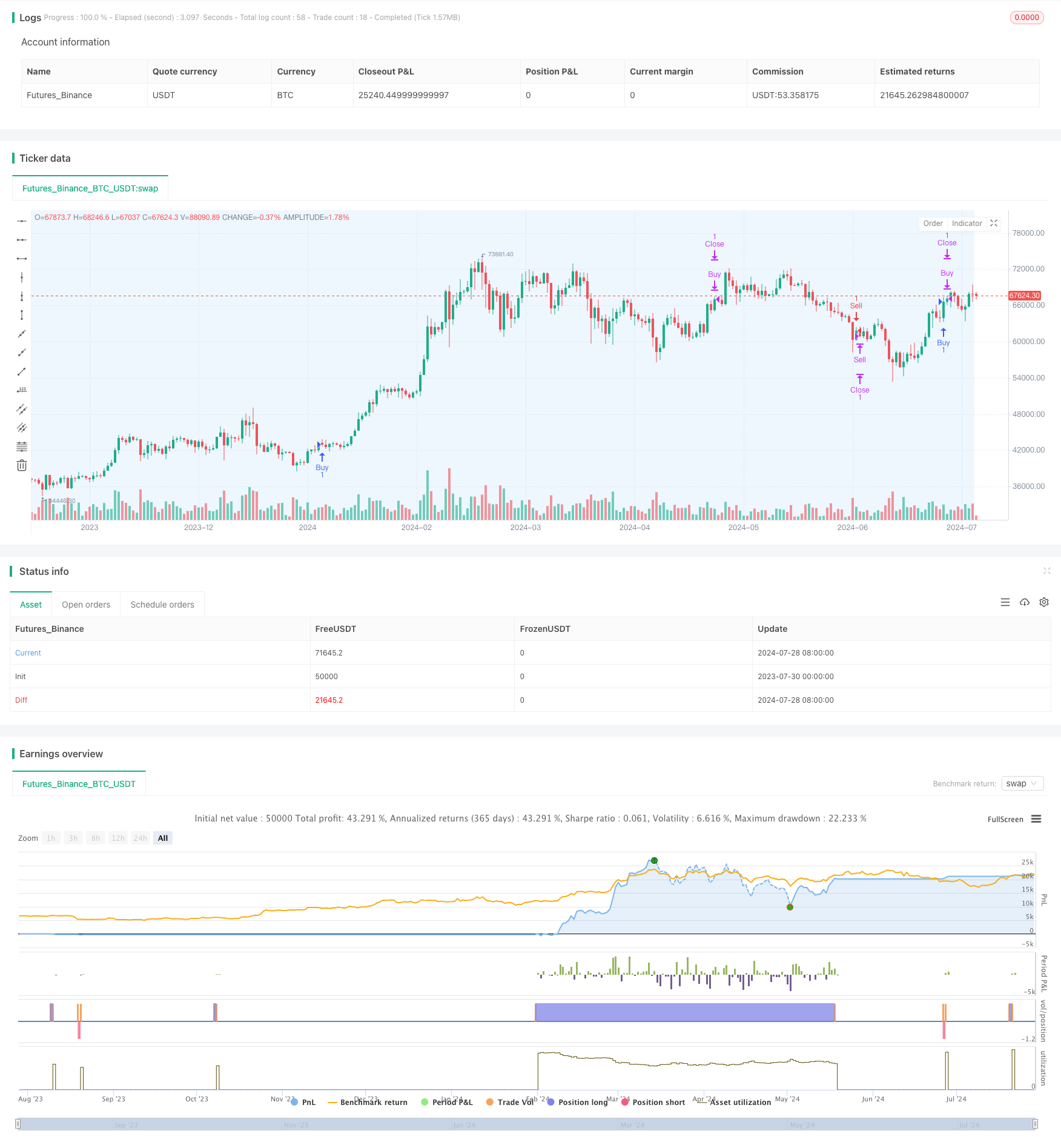
[trans]
概述
这个多时间周期指数移动平均交叉策略是一个基于EMA交叉信号的自动化交易系统。它利用不同时间周期的EMA来生成交易信号,并结合了止损和获利了结机制来管理风险。该策略主要依赖于快速EMA与慢速EMA以及更高时间周期EMA之间的交叉来识别潜在的交易机会。
策略原理
该策略的核心原理是利用多个时间周期的指数移动平均线(EMA)来识别市场趋势和生成交易信号。具体来说:
-
使用9周期EMA作为快速线,50周期EMA作为慢速线,以及15分钟时间周期上的100周期EMA作为更高时间周期参考线。
-
买入信号条件:
- 快速EMA上穿慢速EMA,且快速EMA位于更高时间周期EMA之上;或
- 快速EMA上穿更高时间周期EMA。
-
卖出信号条件:
- 快速EMA下穿慢速EMA,且快速EMA位于更高时间周期EMA之下;或
- 快速EMA下穿更高时间周期EMA。
-
交易管理:
- 设置固定的止损(SL)和获利目标(TP)。
- 当价格达到第一个获利目标(TP1)时,平仓25%的头寸并将止损移动到保本位置。
- 剩余头寸继续运行至第二个获利目标(TP2)或止损。
-
交易时间控制:
- 可设置特定的交易时间段和交易日。
策略优势
-
多时间周期分析:结合不同时间周期的EMA,有助于减少假信号并提高交易质量。
-
趋势跟踪:通过EMA交叉和位置关系,能够有效捕捉市场趋势。
-
风险管理:采用固定止损和分步获利策略,既限制了潜在损失,又允许利润继续增长。
-
灵活性:可根据不同市场和交易风格调整EMA参数、止损和获利水平。
-
自动化:策略可以通过TradingView平台和PineConnector实现全自动化交易。
-
时间管理:可以设定特定的交易时间和交易日,避免在不利的市场环境下交易。
策略风险
-
滞后性:EMA本质上是滞后指标,可能在剧烈波动的市场中反应不及时。
-
假信号:在横盘市场中,EMA交叉可能产生频繁的假信号,导致过度交易。
-
固定止损:使用固定点数的止损可能不适合所有市场条件,有时可能过大或过小。
-
依赖历史数据:策略的有效性高度依赖于回测期间的市场行为,未来表现可能有所不同。
-
市场适应性:策略在某些货币对上表现良好,但在其他货币对上可能效果不佳。
策略优化方向
-
动态参数调整:考虑根据市场波动性动态调整EMA周期、止损和获利水平。
-
增加过滤条件:引入额外的技术指标或市场情绪指标来过滤交易信号,减少假信号。
-
改进止损策略:实现跟踪止损或基于ATR的动态止损,以更好地适应市场波动。
-
优化交易时间:进行更详细的时间分析,找出最佳的交易时段和日期。
-
增加交易量管理:根据市场波动性和账户风险调整头寸大小。
-
多币种相关性分析:考虑多个货币对之间的相关性,避免过度暴露于相似的市场风险。
-
机器学习整合:利用机器学习算法优化参数选择和信号生成过程。
总结
多时间周期指数移动平均交叉策略是一个结合了趋势跟踪和风险管理的自动化交易系统。通过利用不同时间周期的EMA交叉信号,该策略旨在捕捉市场趋势并在适当的时机进行交易。虽然策略在某些市场条件下表现良好,但仍存在一些固有风险和局限性。为了进一步提高策略的稳健性和适应性,可以考虑引入动态参数调整、额外的过滤条件以及更复杂的风险管理技术。总的来说,这个策略为量化交易者提供了一个良好的起点,可以根据个人需求和市场特点进行进一步的优化和定制。
||
Overview
This Multi-Timeframe Exponential Moving Average Crossover Strategy is an automated trading system based on EMA crossover signals. It utilizes EMAs from different timeframes to generate trading signals and incorporates stop-loss and take-profit mechanisms for risk management. The strategy primarily relies on crossovers between fast and slow EMAs, as well as a higher timeframe EMA, to identify potential trading opportunities.
Strategy Principles
The core principle of this strategy is to use Exponential Moving Averages (EMAs) from multiple timeframes to identify market trends and generate trading signals. Specifically:
-
It uses a 9-period EMA as the fast line, a 50-period EMA as the slow line, and a 100-period EMA on a 15-minute timeframe as the higher timeframe reference.
-
Buy signal conditions:
- Fast EMA crosses above the slow EMA, and the fast EMA is above the higher timeframe EMA; or
- Fast EMA crosses above the higher timeframe EMA.
-
Sell signal conditions:
- Fast EMA crosses below the slow EMA, and the fast EMA is below the higher timeframe EMA; or
- Fast EMA crosses below the higher timeframe EMA.
-
Trade management:
- Sets fixed stop-loss (SL) and take-profit (TP) levels.
- When price reaches the first take-profit level (TP1), it closes 25% of the position and moves the stop-loss to breakeven.
- The remaining position continues to run until the second take-profit level (TP2) or stop-loss is hit.
-
Trading time control:
- Allows setting specific trading hours and trading days.
Strategy Advantages
-
Multi-timeframe analysis: Combining EMAs from different timeframes helps reduce false signals and improve trade quality.
-
Trend following: Effectively captures market trends through EMA crossovers and relative positions.
-
Risk management: Employs fixed stop-loss and stepped take-profit strategy, limiting potential losses while allowing profits to run.
-
Flexibility: EMA parameters, stop-loss, and take-profit levels can be adjusted for different markets and trading styles.
-
Automation: The strategy can be fully automated using the TradingView platform and PineConnector.
-
Time management: Ability to set specific trading hours and days to avoid trading in unfavorable market conditions.
Strategy Risks
-
Lag: EMAs are inherently lagging indicators and may not react quickly enough in volatile markets.
-
False signals: In ranging markets, EMA crossovers may produce frequent false signals, leading to overtrading.
-
Fixed stop-loss: Using fixed-point stop-losses may not be suitable for all market conditions, sometimes being too large or too small.
-
Dependency on historical data: The strategy's effectiveness is highly dependent on market behavior during the backtesting period, which may differ in the future.
-
Market adaptability: While the strategy performs well on some currency pairs, it may not be as effective on others.
Strategy Optimization Directions
-
Dynamic parameter adjustment: Consider dynamically adjusting EMA periods, stop-loss, and take-profit levels based on market volatility.
-
Additional filtering conditions: Introduce extra technical or sentiment indicators to filter trade signals and reduce false positives.
-
Improved stop-loss strategy: Implement trailing stops or ATR-based dynamic stop-losses to better adapt to market volatility.
-
Optimize trading times: Conduct more detailed time analysis to find the best trading hours and dates.
-
Enhanced position sizing: Adjust position sizes based on market volatility and account risk.
-
Multi-currency correlation analysis: Consider correlations between multiple currency pairs to avoid overexposure to similar market risks.
-
Machine learning integration: Utilize machine learning algorithms to optimize parameter selection and signal generation processes.
Conclusion
The Multi-Timeframe Exponential Moving Average Crossover Strategy is an automated trading system that combines trend following with risk management. By leveraging EMA crossover signals from different timeframes, the strategy aims to capture market trends and execute trades at appropriate times. While the strategy performs well under certain market conditions, it still has inherent risks and limitations. To further enhance the strategy's robustness and adaptability, considerations can be made to introduce dynamic parameter adjustments, additional filtering conditions, and more sophisticated risk management techniques. Overall, this strategy provides a solid starting point for quantitative traders, which can be further optimized and customized according to individual needs and market characteristics.
[/trans]
Source (PineScript)
/*backtest
start: 2023-07-30 00:00:00
end: 2024-07-29 00:00:00
period: 1d
basePeriod: 1h
exchanges: [{"eid":"Futures_Binance","currency":"BTC_USDT"}]
*/

//@version=5
strategy("Miles Multi TF EMA Strategy v 1", overlay=true)

Fast = input.int(9, "Fast EMA")
Xslow = input.int(50, "Slow EMA")

var bool inTrade = false // Ensure inTrade is declared and initialized
var int tradeDirection = 0
var float buy_slPrice = na
var float buy_tp1Price = na
var float buy_tp2Price = na
var float sell_slPrice = na
var float sell_tp1Price = na
var float sell_tp2Price = na
var bool tp1Hit = false
var bool buytp1Hit = false
var bool selltp1Hit = false
var float entryPrice = na
var float lastSignalBar = na
fastEMA = ta.ema(close, Fast)
XslowEMA = ta.ema(close, Xslow)
var int step = 0

// Example SL and TP settings (adjust according to your strategy)
slPips = input.int(150, "Stop Loss")
tp1Pips = input.int(75, "Take Profit 1")
tp2Pips = input.int(150, "Take Profit 2")
beoff = input.int(25, "Breakeven Offset")

// Define the higher time frame
higherTimeFrame = input.timeframe("15", "Higher Timeframe EMA")

// Fetch the EMA from the higher time frame
higherTimeFrameEMA = request.security(syminfo.tickerid, higherTimeFrame, ta.ema(close, 100))

// Input for trading start and end times, allowing end time to extend beyond midnight
startHour = input.int(1, "Start Hour", minval=0, maxval=23)
endHour = input.int(25, "End Hour", minval=0, maxval=47) // Extend maxval to 47 to allow specifying times into the next day

// Adjust endHour to be within 24-hour format using modulo operation
adjustedEndHour = endHour % 24

// Function to determine if the current time is within the trading hours
isTradingTime(currentHour) =>
    if startHour < adjustedEndHour
        currentHour >= startHour and currentHour < adjustedEndHour
    else
        currentHour >= startHour or currentHour < adjustedEndHour

// Get the current hour in the exchange's timezone
currentHour = hour(time, "Australia/Sydney")

// Check if the current time is within the trading hours
trading = isTradingTime(currentHour)

// Plot background color if within trading hours
bgcolor(trading ? color.new(color.blue, 90) : na)

// Inputs for trading days
tradeOnMonday = input.bool(true, "Trade on Monday")
tradeOnTuesday = input.bool(true, "Trade on Tuesday")
tradeOnWednesday = input.bool(true, "Trade on Wednesday")
tradeOnThursday = input.bool(true, "Trade on Thursday")
tradeOnFriday = input.bool(true, "Trade on Friday")

// Current time checks
currentDayOfWeek = dayofweek(time, "Australia/Sydney")

// Check if current time is within trading hours
isTradingHour = (currentHour >= startHour and currentHour < endHour)

// Check if trading is enabled for the current day of the week
isTradingDay = (currentDayOfWeek == dayofweek.monday and tradeOnMonday) or
               (currentDayOfWeek == dayofweek.tuesday and tradeOnTuesday) or
               (currentDayOfWeek == dayofweek.wednesday and tradeOnWednesday) or
               (currentDayOfWeek == dayofweek.thursday and tradeOnThursday) or
               (currentDayOfWeek == dayofweek.friday and tradeOnFriday)

// Combined check for trading time and day
isTradingTime = isTradingHour and isTradingDay

buySignal = false
sellSignal = false

// Conditions
if (step == 0 or step == 4) and ta.crossover(fastEMA, XslowEMA) and fastEMA > higherTimeFrameEMA
    step := 1

if (step == 0 or step == 4) and ta.crossover(fastEMA, higherTimeFrameEMA)
    step := 1

if step == 3 and ta.crossover(fastEMA, XslowEMA) and fastEMA > higherTimeFrameEMA
    step := 3

if step == 2 and ta.crossover(fastEMA, XslowEMA) and fastEMA > higherTimeFrameEMA
    step := 1

if (step == 0 or step == 3) and ta.crossunder(fastEMA, XslowEMA) and fastEMA < higherTimeFrameEMA
    step := 2

if (step == 0 or step == 3) and ta.crossunder(fastEMA, higherTimeFrameEMA)
    step := 2

if step == 4 and ta.crossunder(fastEMA, XslowEMA) and fastEMA < higherTimeFrameEMA
    step := 4

if step == 1 and ta.crossunder(fastEMA, XslowEMA) and fastEMA < higherTimeFrameEMA
    step := 2

// For buy signals
if step == 1 and isTradingTime and fastEMA > ta.ema(close, Xslow) and fastEMA > higherTimeFrameEMA
    buySignal := true
    inTrade := true
    entryPrice := close
    tradeDirection := 1
    buytp1Hit := false
    lastSignalBar := bar_index
    buy_slPrice := entryPrice - slPips * syminfo.mintick
    buy_tp1Price := entryPrice + tp1Pips * syminfo.mintick // Set TP1
    buy_tp2Price := entryPrice + tp2Pips * syminfo.mintick // Set TP2
    tp1Hit := false
    step := 3
    strategy.entry("Buy", strategy.long, stop=buy_slPrice, limit=buy_tp1Price)

if step == 2 and isTradingTime and fastEMA < ta.ema(close, Xslow) and fastEMA < higherTimeFrameEMA
    sellSignal := true
    inTrade := true
    entryPrice := close
    tradeDirection := -1
    lastSignalBar := bar_index
    selltp1Hit := false
    sell_slPrice := entryPrice + slPips * syminfo.mintick
    sell_tp1Price := entryPrice - tp1Pips * syminfo.mintick // Set TP1
    sell_tp2Price := entryPrice - tp2Pips * syminfo.mintick // Set TP2
    tp1Hit := false
    step := 4
    strategy.entry("Sell", strategy.short, stop=sell_slPrice, limit=sell_tp1Price)

// Move SL to breakeven once TP1 is hit and close 25% of the trade
if (ta.valuewhen(strategy.position_size != 0, strategy.position_size, 0) > 0)
    if high >= buy_tp1Price and not tp1Hit
        tp1Hit := true
        buy_slPrice := entryPrice + beoff * syminfo.mintick
        strategy.close("Buy", qty_percent = 25, comment = "TP1 Hit")
        strategy.exit("Close", from_entry="Buy", stop=buy_slPrice, limit=buy_tp2Price)

if (ta.valuewhen(strategy.position_size != 0, strategy.position_size, 0) < 0)
    if low <= sell_tp1Price and not tp1Hit
        tp1Hit := true
        sell_slPrice := entryPrice - beoff * syminfo.mintick
        strategy.close("Sell", qty_percent = 25, comment = "TP1 Hit")
        strategy.exit("Close", from_entry="Sell", stop=sell_slPrice, limit=sell_tp2Price)

// Managing the trade after it's initiated
if inTrade and tradeDirection == 1 and sellSignal
    inTrade := false
    tradeDirection := 0
    buy_slPrice := na
    buy_tp1Price := na
    buy_tp2Price := na
    tp1Hit := false
    step := 2

if inTrade and tradeDirection == -1 and buySignal
    inTrade := false
    tradeDirection := 0
    sell_slPrice := na
    sell_slPrice := na
    sell_tp2Price := na
    tp1Hit := false
    step := 1

if inTrade and tradeDirection == 1 and step == 1
    step := 0

if inTrade and tradeDirection == -1 and step == 2
    step := 0

if inTrade and tradeDirection == 1 and (bar_index - lastSignalBar) >= 1
    if high >= buy_tp1Price and not tp1Hit
        tp1Hit := true
        buytp1Hit := true
        lastSignalBar := bar_index
        buy_slPrice := entryPrice + beoff * syminfo.mintick
        step := 3

    if low <= buy_slPrice and not tp1Hit and (bar_index - lastSignalBar) >= 1
        strategy.close("Buy", qty_percent = 100, comment = "SL Hit")
        inTrade := false
        tradeDirection := 0
        buy_slPrice := na
        buy_tp1Price := na
        buy_tp2Price := na
        tp1Hit := false
        buytp1Hit := false
        step := 0

if inTrade and tradeDirection == 1 and tp1Hit and (bar_index - lastSignalBar) >= 1
    if low <= buy_slPrice
        inTrade := false
        tradeDirection := 0
        buy_slPrice := na
        buy_tp1Price := na
        buy_tp2Price := na
        tp1Hit := false
        buytp1Hit := false
        step := 0

    if high >= buy_tp2Price and (bar_index - lastSignalBar) >= 1
        inTrade := false
        tradeDirection := 0
        buy_slPrice := na
        buy_tp1Price := na
        buy_tp2Price := na
        tp1Hit := false
        buytp1Hit := false
        step := 0

if inTrade and tradeDirection == -1 and (bar_index - lastSignalBar) >= 1
    if low <= sell_tp1Price and not tp1Hit
        tp1Hit := true
        lastSignalBar := bar_index
        selltp1Hit := true
        sell_slPrice := entryPrice - beoff * syminfo.mintick
        step := 4

    if high >= sell_slPrice and not tp1Hit and (bar_index - lastSignalBar) >= 1
        strategy.close("Sell", qty_percent = 100, comment = "SL Hit")
        inTrade := false
        tradeDirection := 0
        sell_slPrice := na
        sell_tp1Price := na
        sell_tp2Price := na
        tp1Hit := false
        selltp1Hit := false
        step := 0

if inTrade and tradeDirection == -1 and tp1Hit  and (bar_index - lastSignalBar) >= 1
    if high >= sell_slPrice
        inTrade := false
        tradeDirection := 0
        sell_slPrice := na
        sell_tp1Price := na
        sell_tp2Price := na
        tp1Hit := false
        selltp1Hit := false
        step := 0
    if low <= sell_tp2Price
        inTrade := false
        tradeDirection := 0
        sell_slPrice := na
        sell_tp1Price := na
        sell_tp2Price := na
        tp1Hit := false
        selltp1Hit := false
        step := 0
Detail
https://www.fmz.com/strategy/458141
Last Modified
2024-07-30 12:02:23