
7.6 KiB
Name
基于高斯通道和随机RSI的趋势反转量化交易策略-Trend-Reversal-Quantitative-Trading-Strategy-Based-on-Gaussian-Channel-and-Stochastic-RSI
Author
ianzeng123
Strategy Description
[trans]
概述
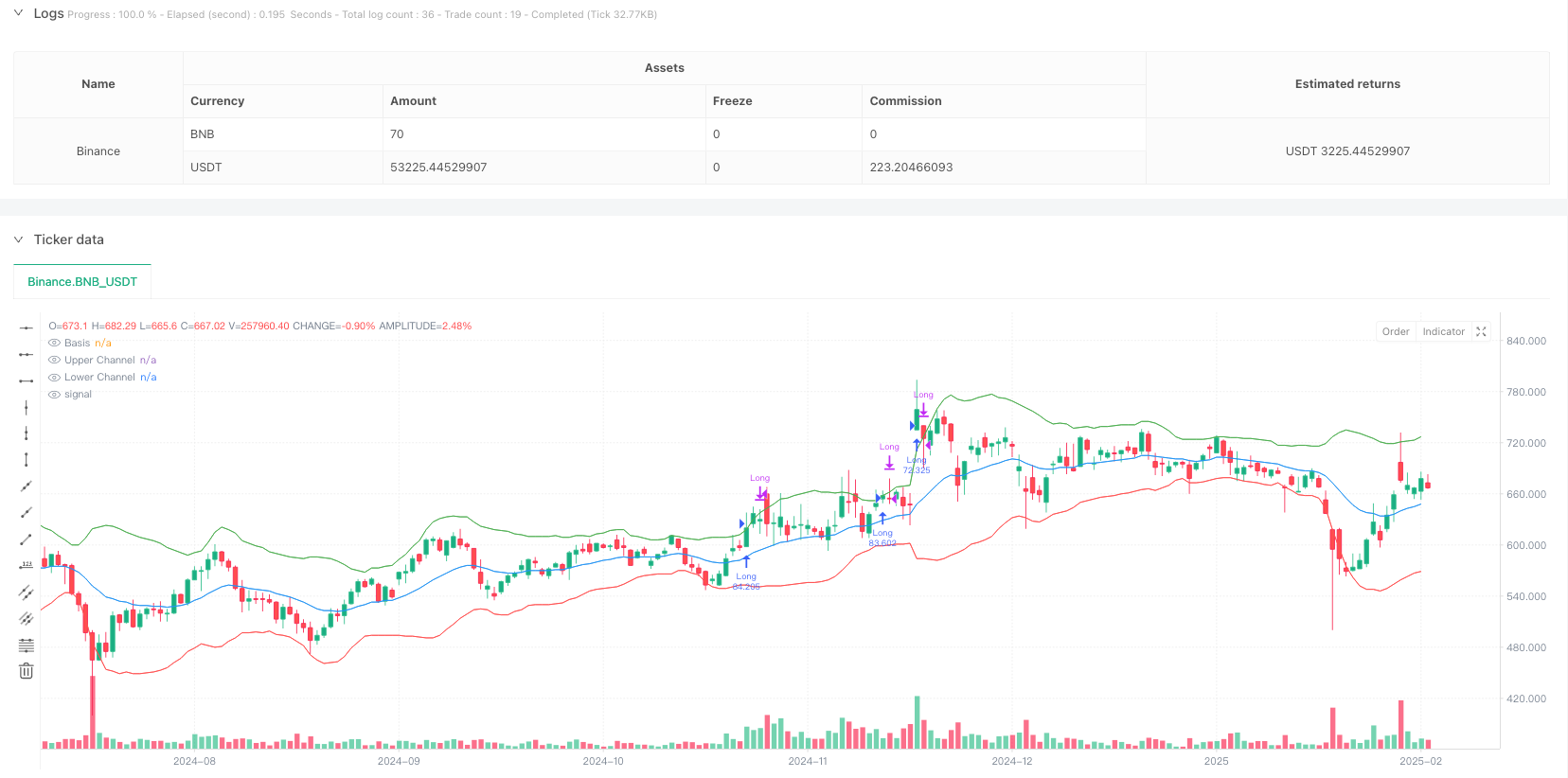
该策略是一个结合了高斯通道(Gaussian Channel)和随机相对强弱指标(Stochastic RSI)的量化交易系统。策略通过监测价格与高斯通道的交叉以及随机RSI的走势来捕捉市场的趋势反转机会。高斯通道由移动平均线和标准差构建,能够动态地反映市场波动范围,而随机RSI则提供了动量方面的确认信号。
策略原理
策略的核心逻辑包含以下几个关键部分:
- 高斯通道的构建:使用20周期的指数移动平均(EMA)作为通道中轴线,通道上下边界则是中轴线加减2倍标准差得到。
- 随机RSI的计算:首先计算14周期的RSI,然后对RSI值应用14周期的随机公式,最后对结果进行3周期的平滑处理得到K线和D线。
- 交易信号生成:当价格突破高斯通道上轨且随机RSI的K线上穿D线时,产生做多信号;当价格跌破高斯通道上轨时,平仓出场。
策略优势
- 信号可靠性高:结合了趋势和动量两个维度的指标,能够有效降低虚假信号。
- 风险控制完善:利用高斯通道的动态特性,能够根据市场波动自动调整交易区间。
- 适应性强:通过参数化设计,策略可以适应不同的市场环境和交易品种。
- 执行效率高:策略逻辑清晰简单,计算量小,适合实时交易。
策略风险
- 滞后性风险:移动平均和标准差的计算具有一定滞后性,可能导致入场时机延迟。
- 假突破风险:在震荡市场中,可能出现频繁的假突破信号。
- 参数敏感性:策略效果对参数设置较为敏感,不同市场环境可能需要调整参数。
- 市场环境依赖:在趋势不明显的横盘市场中,策略表现可能不佳。
策略优化方向
- 信号过滤优化:可以添加成交量、波动率等辅助指标来过滤交易信号。
- 动态参数调整:引入自适应机制,根据市场状态动态调整通道参数和随机RSI参数。
- 止损机制完善:增加追踪止损或基于波动率的动态止损机制。
- 仓位管理优化:根据信号强度和市场波动率动态调整持仓比例。
总结
该策略通过结合技术分析中的趋势跟踪和动量指标,构建了一个逻辑完整、风险可控的量化交易系统。虽然存在一些固有的风险,但通过持续优化和完善,策略有望在不同市场环境下保持稳定的表现。策略的模块化设计也为后续的优化和扩展提供了良好的基础。 ||
Overview
This strategy is a quantitative trading system that combines the Gaussian Channel and Stochastic RSI indicators. It captures market trend reversal opportunities by monitoring price crossovers with the Gaussian Channel and Stochastic RSI movements. The Gaussian Channel, constructed using moving averages and standard deviations, dynamically reflects market volatility ranges, while the Stochastic RSI provides momentum confirmation signals.
Strategy Principles
The core logic of the strategy includes the following key components:
- Gaussian Channel Construction: Uses a 20-period EMA as the channel centerline, with upper and lower boundaries calculated by adding and subtracting 2 times the standard deviation.
- Stochastic RSI Calculation: First calculates 14-period RSI, then applies a 14-period stochastic formula to the RSI values, finally smoothing the results with a 3-period average to get K and D lines.
- Trade Signal Generation: Generates long signals when price breaks above the upper Gaussian Channel and Stochastic RSI's K line crosses above the D line; exits when price falls below the upper channel.
Strategy Advantages
- High Signal Reliability: Combines trend and momentum indicators to effectively reduce false signals.
- Comprehensive Risk Control: Uses the dynamic nature of the Gaussian Channel to automatically adjust trading ranges based on market volatility.
- Strong Adaptability: Through parameterized design, the strategy can adapt to different market environments and trading instruments.
- High Execution Efficiency: Clear and simple strategy logic with low computational requirements, suitable for real-time trading.
Strategy Risks
- Lag Risk: Moving averages and standard deviation calculations have inherent lag, potentially causing delayed entry timing.
- False Breakout Risk: Frequent false breakout signals may occur in ranging markets.
- Parameter Sensitivity: Strategy performance is sensitive to parameter settings, which may need adjustment in different market environments.
- Market Environment Dependency: Strategy may underperform in sideways markets with unclear trends.
Strategy Optimization Directions
- Signal Filtering Optimization: Add volume, volatility, and other auxiliary indicators to filter trading signals.
- Dynamic Parameter Adjustment: Introduce adaptive mechanisms to dynamically adjust channel and Stochastic RSI parameters based on market conditions.
- Stop Loss Enhancement: Add trailing stops or volatility-based dynamic stop loss mechanisms.
- Position Management Optimization: Dynamically adjust position sizes based on signal strength and market volatility.
Summary
This strategy constructs a logically complete and risk-controlled quantitative trading system by combining trend following and momentum indicators from technical analysis. While there are some inherent risks, through continuous optimization and improvement, the strategy shows promise for maintaining stable performance across different market environments. The modular design also provides a solid foundation for future optimization and expansion.[/trans]
Source (PineScript)
/*backtest
start: 2024-02-21 00:00:00
end: 2025-02-18 08:00:00
period: 1d
basePeriod: 1d
exchanges: [{"eid":"Binance","currency":"BNB_USDT"}]
*/

//@version=5
strategy("SAJJAD JAMSHIDI Channel with Stochastic RSI Strategy", overlay=true, commission_type=strategy.commission.percent, commission_value=0.1, slippage=0, default_qty_type=strategy.percent_of_equity, default_qty_value=100, process_orders_on_close=true)

// Gaussian Channel Inputs
lengthGC = input.int(20, "Gaussian Channel Length", minval=1)
multiplier = input.float(2.0, "Standard Deviation Multiplier", minval=0.1)

// Calculate Gaussian Channel
basis = ta.ema(close, lengthGC)
deviation = multiplier * ta.stdev(close, lengthGC)
upperChannel = basis + deviation
lowerChannel = basis - deviation

// Plot Gaussian Channel
plot(basis, "Basis", color=color.blue)
plot(upperChannel, "Upper Channel", color=color.green)
plot(lowerChannel, "Lower Channel", color=color.red)

// Stochastic RSI Inputs
rsiLength = input.int(14, "RSI Length", minval=1)
stochLength = input.int(14, "Stochastic Length", minval=1)
smoothK = input.int(3, "Smooth K", minval=1)
smoothD = input.int(3, "Smooth D", minval=1)

// Calculate RSI
rsi = ta.rsi(close, rsiLength)

// Calculate Stochastic RSI
lowestRSI = ta.lowest(rsi, stochLength)
highestRSI = ta.highest(rsi, stochLength)
stochRSI = (rsi - lowestRSI) / (highestRSI - lowestRSI) * 100
k = ta.sma(stochRSI, smoothK)
d = ta.sma(k, smoothD)

// Trading Conditions
stochUp = k > d
priceAboveUpper = ta.crossover(close, upperChannel)
priceBelowUpper = ta.crossunder(close, upperChannel)


strategy.entry("Long", strategy.long, when=priceAboveUpper and stochUp)
strategy.close("Long", when=priceBelowUpper)
Detail
https://www.fmz.com/strategy/482888
Last Modified
2025-02-20 16:41:36