
11 KiB
Name
基于双均线交叉策略The-Dual-Moving-Average-Crossover-Strategy
Author
ChaoZhang
Strategy Description
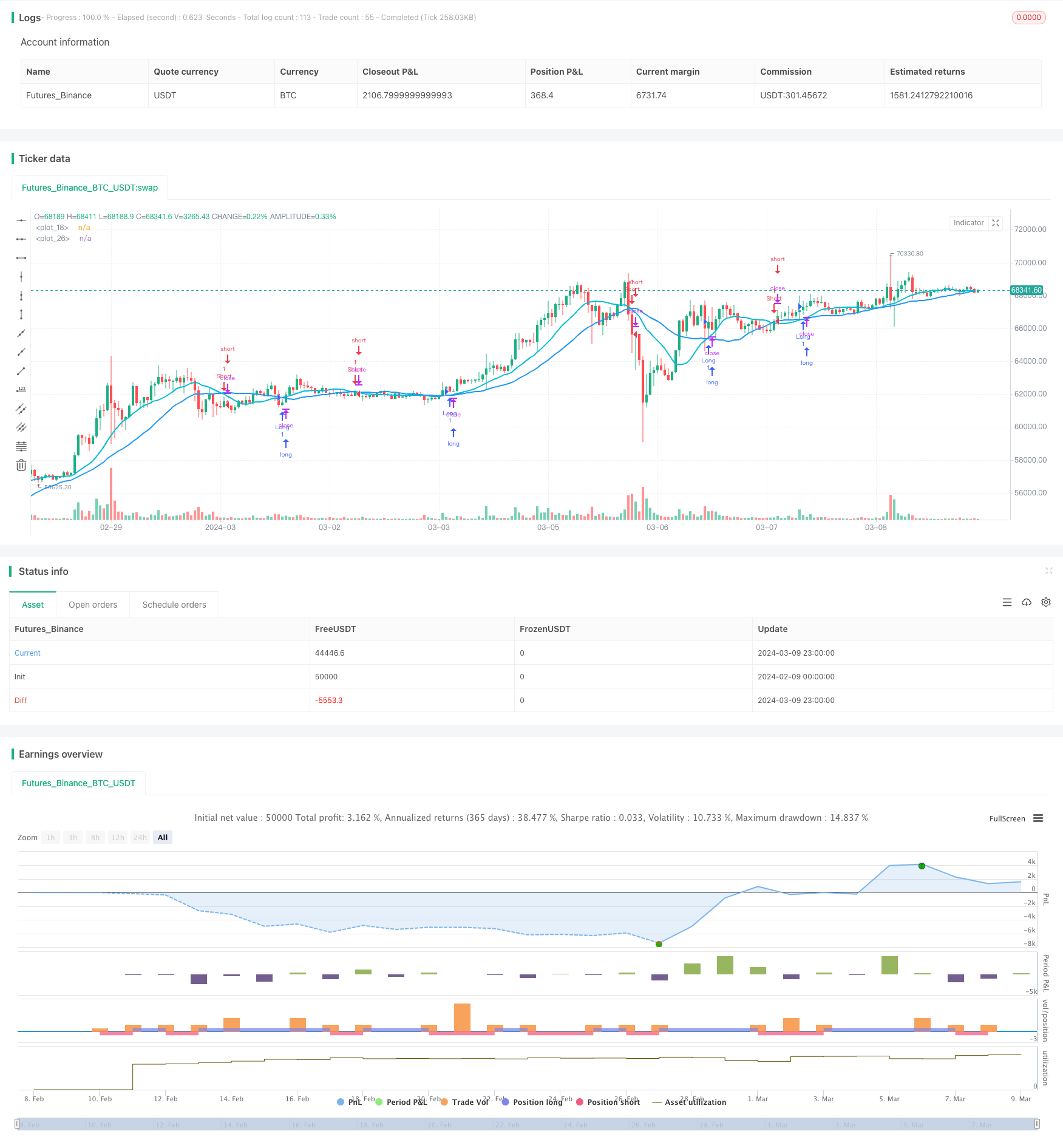 [trans]
策略概述
双均线交叉策略是一种经典的趋势跟踪策略。该策略使用两条不同周期的移动平均线来捕捉市场趋势,当快速均线上穿慢速均线时产生做多信号,当快速均线下穿慢速均线时产生做空信号。这个策略的核心思想是快速均线对价格变化更敏感,能更快反应市场趋势的变化,而慢速均线反应市场的长期趋势。通过两条均线的交叉,可以判断出市场趋势的转变,从而进行交易。
策略原理
该策略代码中使用了两条移动平均线,一条是快速均线(默认14期),一条是慢速均线(默认28期)。移动平均线类型可以选择简单移动平均线(SMA)、指数移动平均线(EMA)、加权移动平均线(WMA)和相对移动平均线(RMA)。
策略的主要逻辑如下:
- 计算快速均线和慢速均线的值
- 如果快速均线上穿慢速均线,则产生做多信号,开仓做多
- 如果快速均线下穿慢速均线,且允许做空(allowShorting=true),则产生做空信号,开仓做空
- 如果快速均线下穿慢速均线,且不允许做空(allowShorting=false),则平掉多头仓位
通过这样的逻辑,策略可以跟踪市场的主要趋势,在上涨趋势中持有多头仓位,在下跌趋势中持有空头仓位或者空仓等待。均线周期和类型可以根据不同市场和交易品种进行调整优化。
策略优势
- 逻辑简单清晰,容易理解和实现
- 适用于趋势性市场,可以有效捕捉市场的中长期趋势
- 参数可调,适用于不同的市场和交易品种
- 可以根据市场特点和个人偏好,灵活选择是否允许做空
- 移动平均线是经典的技术分析指标,被广泛使用和验证
策略风险
- 在震荡市中,频繁的均线交叉可能导致频繁交易,增加交易成本
- 快速均线选择太短,或慢速均线选择太长,可能导致信号滞后,错过最佳交易时机
- 策略在市场趋势转变时,可能出现连续亏损的情况
- 固定的均线周期参数,可能不适应市场的动态变化
针对这些风险,可以采取以下措施:
- 根据市场特点,优化均线周期参数,选择合适的快慢均线长度
- 在震荡市中,可以考虑增加过滤条件,如ATR过滤,或均线交叉角度过滤等
- 合理设置止损止盈,控制单笔交易风险
- 定期回测评估,根据市场变化调整策略参数
策略优化
- 引入更多技术指标,如MACD、RSI等,构建多因子策略,提高信号准确性
- 优化仓位管理,如考虑ATR或波动率等因素,动态调整仓位大小
- 针对震荡市,可以考虑引入趋势判断指标,如ADX等,避免频繁交易
- 使用机器学习或优化算法,自动寻找最优参数组合
这些优化可以提高策略的适应性和稳定性,更好地适应不同市场状况。但同时也要注意,过度优化可能导致策略过拟合,在实盘中表现不佳。需要在样本外数据中进一步验证。
总结
双均线交叉策略是一个经典的趋势跟踪策略,通过两条不同周期移动平均线的交叉,产生交易信号。它逻辑简单,容易实现,适用于趋势性市场。但在震荡市中,可能出现频繁交易和连续亏损的情况。因此,在使用该策略时,需要根据市场特点,优化均线周期参数,并合理设置止损止盈。此外,还可以通过引入更多技术指标、优化仓位管理、趋势判断等方式,来提高策略的适应性和稳定性。但过度优化可能导致过拟合,需要谨慎对待。总的来说,双均线交叉策略是一个值得学习和研究的经典策略,通过不断优化和改进,可以成为一个有效的交易工具。
||
Strategy Overview
The Dual Moving Average Crossover Strategy is a classic trend-following strategy. This strategy uses two moving averages with different periods to capture market trends. When the fast moving average crosses above the slow moving average, it generates a long signal. When the fast moving average crosses below the slow moving average, it generates a short signal. The core idea of this strategy is that the fast moving average is more sensitive to price changes and can react more quickly to changes in market trends, while the slow moving average reflects the long-term trend of the market. By analyzing the crossover of the two moving averages, we can determine the turning point of the market trend and make trades accordingly.
Strategy Principle
In this strategy code, two moving averages are used: a fast moving average (default 14 periods) and a slow moving average (default 28 periods). The type of moving average can be selected from Simple Moving Average (SMA), Exponential Moving Average (EMA), Weighted Moving Average (WMA), and Relative Moving Average (RMA).
The main logic of the strategy is as follows:
- Calculate the values of the fast moving average and the slow moving average
- If the fast moving average crosses above the slow moving average, it generates a long signal and opens a long position
- If the fast moving average crosses below the slow moving average and shorting is allowed (allowShorting=true), it generates a short signal and opens a short position
- If the fast moving average crosses below the slow moving average and shorting is not allowed (allowShorting=false), it closes the long position
Through this logic, the strategy can track the main trend of the market, holding long positions in an uptrend and short positions or no positions in a downtrend. The moving average period and type can be adjusted and optimized according to different markets and trading instruments.
Strategy Advantages
- Simple and clear logic, easy to understand and implement
- Suitable for trending markets, can effectively capture medium and long-term market trends
- Adjustable parameters, suitable for different markets and trading instruments
- Can flexibly choose whether to allow shorting based on market characteristics and personal preferences
- Moving averages are classic technical analysis indicators that are widely used and validated
Strategy Risks
- In range-bound markets, frequent moving average crossovers may lead to frequent trading and increase transaction costs
- If the fast moving average is chosen too short or the slow moving average is chosen too long, it may cause signal lag and miss the best trading opportunities
- When the market trend reverses, the strategy may experience consecutive losses
- Fixed moving average period parameters may not adapt to dynamic changes in the market
To address these risks, the following measures can be taken:
- Optimize moving average period parameters based on market characteristics and choose appropriate lengths for fast and slow moving averages
- In range-bound markets, consider adding filtering conditions such as ATR filtering or moving average crossover angle filtering
- Set reasonable stop-loss and take-profit levels to control single trade risk
- Conduct regular backtesting and evaluation, and adjust strategy parameters according to market changes
Strategy Optimization
- Introduce more technical indicators such as MACD and RSI to build a multi-factor strategy and improve signal accuracy
- Optimize position management, such as considering factors like ATR or volatility to dynamically adjust position sizes
- For range-bound markets, consider introducing trend determination indicators such as ADX to avoid frequent trading
- Use machine learning or optimization algorithms to automatically find the optimal parameter combination
These optimizations can improve the adaptability and stability of the strategy to better adapt to different market conditions. However, it should also be noted that over-optimization may lead to overfitting of the strategy and poor performance in live trading. Further validation on out-of-sample data is needed.
Summary
The Dual Moving Average Crossover Strategy is a classic trend-following strategy that generates trading signals through the crossover of two moving averages with different periods. It has simple logic, is easy to implement, and is suitable for trending markets. However, in range-bound markets, it may experience frequent trading and consecutive losses. Therefore, when using this strategy, it is necessary to optimize the moving average period parameters based on market characteristics and set reasonable stop-loss and take-profit levels. In addition, the adaptability and stability of the strategy can be improved by introducing more technical indicators, optimizing position management, trend determination, etc. However, over-optimization may lead to overfitting and should be treated with caution. Overall, the Dual Moving Average Crossover Strategy is a classic strategy worth learning and researching. Through continuous optimization and improvement, it can become an effective trading tool. [/trans]
Strategy Arguments
| Argument | Default | Description |
|---|---|---|
| v_input_bool_1 | true | Allow Shorting |
| v_input_int_1 | 14 | Fast MA Length |
| v_input_int_2 | 28 | Slow MA Length |
| v_input_string_1 | Simple | Fast MA Type |
| v_input_string_2 | Simple | Fast MA Type |
Source (PineScript)
/*backtest
start: 2024-02-09 00:00:00
end: 2024-03-10 00:00:00
period: 1h
basePeriod: 15m
exchanges: [{"eid":"Futures_Binance","currency":"BTC_USDT"}]
*/

// This Pine Script™ code is subject to the terms of the Mozilla Public License 2.0 at https://mozilla.org/MPL/2.0/
// © z4011

//@version=5
strategy("#2idagos", overlay=true, margin_long=100, margin_short=100)
allowShorting = input.bool(true, "Allow Shorting")
fastMALength = input.int(14, "Fast MA Length")
slowMALength = input.int(28, "Slow MA Length")
fastMAType = input.string("Simple", "Fast MA Type", ["Simple", "Exponential", "Weighted", "Relative"])
slowMAType = input.string("Simple", "Fast MA Type", ["Simple", "Exponential", "Weighted", "Relative"])

float fastMA = switch fastMAType
    "Simple" => ta.sma(close, fastMALength)
    "Exponential" => ta.ema(close, fastMALength)
    "Weighted" => ta.wma(close, fastMALength)
    "Relative" => ta.rma(close, fastMALength)

plot(fastMA, color = color.aqua, linewidth = 2)

float slowMA = switch slowMAType
    "Simple" => ta.sma(close, slowMALength)
    "Exponential" => ta.ema(close, slowMALength)
    "Weighted" => ta.wma(close, slowMALength)
    "Relative" => ta.rma(close, slowMALength)

plot(slowMA, color = color.blue, linewidth = 2)


longCondition = ta.crossover(fastMA, slowMA)
if (longCondition)
    strategy.entry("Long", strategy.long)

shortCondition = ta.crossunder(fastMA, slowMA) and allowShorting
if (shortCondition)
    strategy.entry("Short", strategy.short)

closeCondition = ta.crossunder(fastMA, slowMA) and not allowShorting
if (closeCondition)
    strategy.close("Long", "Close")
Detail
https://www.fmz.com/strategy/444363
Last Modified
2024-03-11 12:06:22