
17 KiB
Name
双指数移动平均交叉策略优化器-Dual-Exponential-Moving-Average-Crossover-Strategy-Optimizer
Author
ianzeng123
Strategy Description
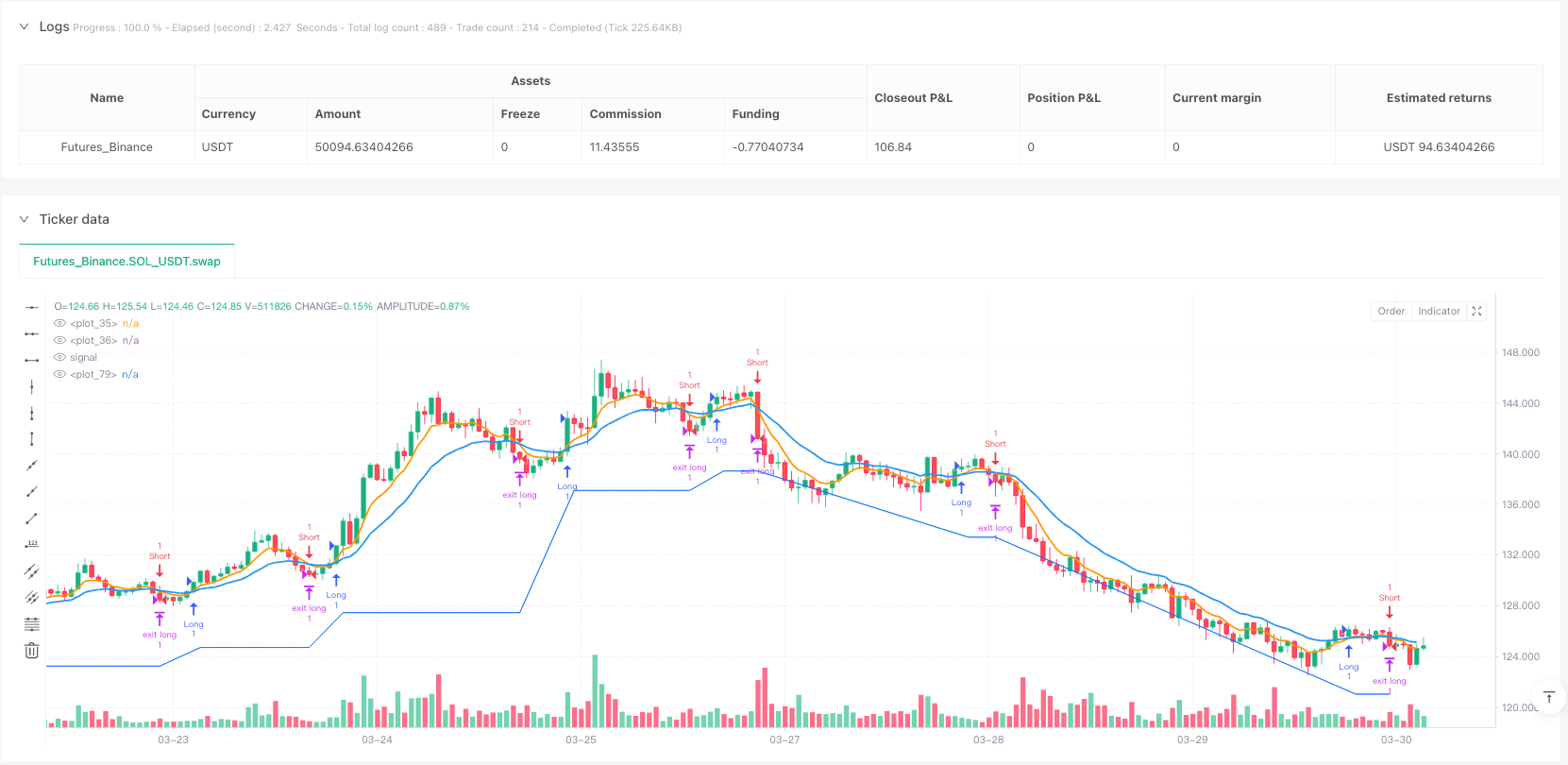
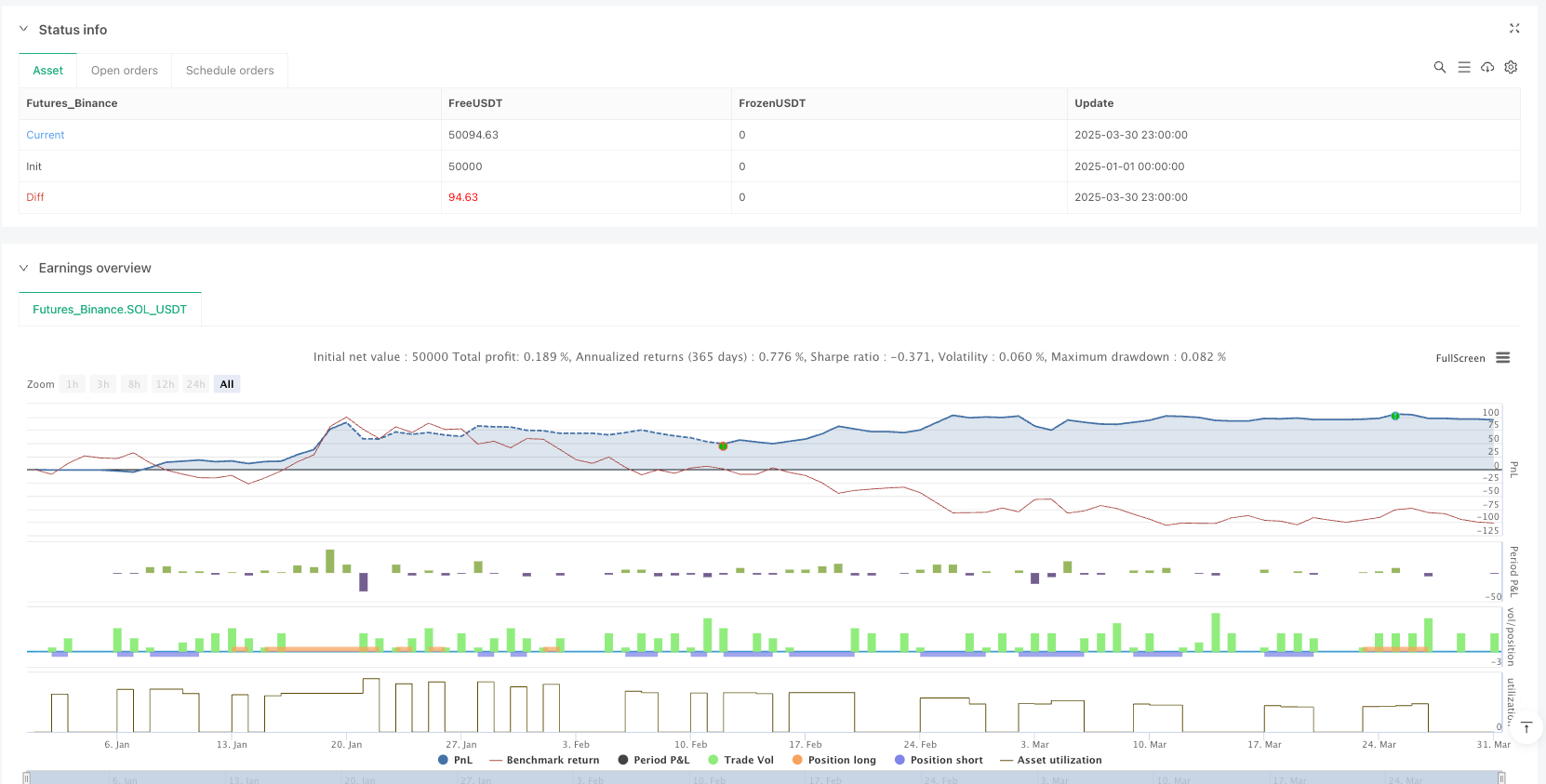
[trans]
概述
双指数移动平均交叉策略优化器是一种基于两条不同周期指数移动平均线交叉信号进行交易的量化策略。该策略利用快速EMA与慢速EMA之间的交叉关系判断市场趋势方向,并在满足特定条件时执行多空双向交易。策略的核心在于通过参数化的EMA设置,使用户能够根据不同市场环境灵活调整策略参数,同时配合止盈功能实现收益最大化。策略还支持完整的回测日期选择功能,有助于进行更精确的历史表现评估。
策略原理
该策略的核心原理基于技术分析中经典的均线交叉理论,主要包括以下几个关键组成部分:
-
双EMA交叉信号:策略使用两条不同周期的指数移动平均线(EMA),分别是默认参数为6的快速EMA和默认参数为16的慢速EMA。当快速EMA从下方穿越慢速EMA时,产生做多信号;当快速EMA从上方穿越慢速EMA时,产生做空信号。
-
方向过滤:策略允许用户通过输入参数选择交易方向(多头、空头或双向),增加策略灵活性。系统通过
longOK和shortOK变量控制是否执行相应方向的交易。 -
K线形态确认:策略引入了额外的价格确认机制,要求在做多信号出现时,当前K线收盘价需高于开盘价(阳线);在做空信号出现时,当前K线收盘价需低于开盘价(阴线)。这一设计有效过滤了部分假信号。
-
止盈机制:策略分别设置了多头和空头的止盈百分比(默认均为4%),在价格达到预设的盈利目标时自动平仓,锁定利润。
-
交叉反向平仓:当持有多头仓位时出现空头信号,或持有空头仓位时出现多头信号,策略会触发平仓操作,有效控制亏损扩大。
策略优势
深入分析该策略代码,可以总结出以下几点优势:
-
参数灵活性:策略允许用户自定义快速和慢速EMA的周期,交易方向以及止盈百分比,使策略能够适应不同市场环境和个人风险偏好。
-
双重确认机制:策略不仅依赖EMA交叉信号,还结合了K线形态(阳线/阴线)作为额外确认,提高了信号的可靠性,减少了假突破带来的损失。
-
全方位交易:支持多空双向交易,能够在不同市场趋势中捕捉机会,不仅限于单一方向的市场行情。
-
止盈优化:通过预设的止盈比例,策略能够在价格达到预期目标时自动锁定利润,避免因市场反转导致已有收益回吐。
-
反向信号平仓:当市场趋势可能反转时(出现反向交叉信号),策略会及时平仓,有效控制风险。
-
计算效率:策略使用内置的
ta.ema、ta.crossover和ta.crossunder函数计算信号,计算效率高,便于实时执行。 -
可视化支持:策略在图表上绘制了快速和慢速EMA线,以及止盈水平,便于用户直观理解策略执行情况。
策略风险
尽管该策略设计合理,但仍存在以下几点潜在风险:
-
均线滞后性:EMA本质上是滞后指标,在快速变动的市场中可能产生延迟信号,导致入场和出场时机不佳。
-
震荡市场风险:在区间震荡行情中,EMA交叉信号频繁出现但缺乏持续性,可能导致频繁交易和连续亏损。
-
缺乏止损机制:当前策略仅设置了止盈,没有明确的止损机制,在极端市场条件下可能面临较大损失。
-
K线确认限制:要求K线形态确认可能导致错过一些有效信号,特别是在快速趋势转变时。
-
固定止盈比例风险:预设的固定止盈比例可能不适合所有市场环境,在强趋势市场中可能过早获利了结,错失更大收益。
-
缺乏波动性适应机制:策略没有根据市场波动性动态调整参数的功能,在高波动性或低波动性环境中可能表现不佳。
策略优化方向
针对上述风险,可以从以下几个方向对策略进行优化:
-
引入自适应参数:可以基于ATR(真实波动幅度)或历史波动率动态调整EMA参数,使策略能够更好地适应不同市场波动环境。这样做的原因是固定参数在不同波动率市场中表现差异较大。
-
增加止损机制:建议引入基于ATR或固定百分比的止损机制,在价格严重不利时自动平仓,有效控制单次交易损失。
-
添加趋势过滤器:可以增加更长周期的趋势判断指标(如50日EMA),只在主趋势方向执行交易,避免在震荡市场中频繁交易。
-
优化入场时机:可以结合RSI、MACD等其他技术指标作为辅助确认,提高信号质量。
-
动态止盈:可以实现基于市场波动性的动态止盈,或采用移动止盈(跟踪止损)机制,在保护利润的同时允许利润增长。
-
添加交易量过滤:在信号生成时考虑交易量因素,只在交易量支持的情况下执行交易,提高信号可靠性。
-
时间过滤:增加交易时间窗口设置,避免在市场波动性较低或不规律的时段交易。
-
资金管理优化:引入动态仓位管理机制,根据信号强度、市场波动性和历史胜率调整每次交易的资金比例。
总结
双指数移动平均交叉策略优化器是一个设计合理的量化交易系统,通过快速和慢速EMA的交叉关系,结合K线形态确认和止盈机制,实现了多空双向交易功能。策略的优势在于参数灵活性、双重确认机制和全方位交易能力,但也存在均线滞后性、震荡市场风险和缺乏止损机制等问题。
通过引入自适应参数、增加止损机制、添加趋势过滤器和优化资金管理等方向的改进,可以显著提升策略的稳定性和收益能力。特别是将动态参数调整与风险管理机制相结合,可以使策略在不同市场环境中保持相对稳定的表现。
对于交易者而言,在实际应用此策略时,建议结合市场宏观分析,选择趋势明确的市场环境,同时进行充分的历史回测和参数优化,以找到适合特定交易品种的最佳参数组合。此外,持续监控策略表现,根据市场变化及时调整参数,也是保持策略长期有效性的关键。 ||
Overview
The Dual Exponential Moving Average Crossover Strategy Optimizer is a quantitative trading strategy based on crossover signals between two exponential moving averages with different periods. This strategy uses the crossover relationship between a fast EMA and a slow EMA to determine market trend direction and executes both long and short trades when specific conditions are met. The core of the strategy lies in parameterized EMA settings, allowing users to flexibly adjust strategy parameters according to different market environments, while also maximizing returns with profit target functionality. The strategy also supports a complete backtest date selection function, contributing to more accurate historical performance evaluation.
Strategy Principles
The core principle of this strategy is based on the classic moving average crossover theory in technical analysis, mainly including the following key components:
-
Dual EMA Crossover Signals: The strategy uses two exponential moving averages (EMAs) with different periods, specifically a fast EMA with a default parameter of 6 and a slow EMA with a default parameter of 16. When the fast EMA crosses above the slow EMA, a long signal is generated; when the fast EMA crosses below the slow EMA, a short signal is generated.
-
Direction Filtering: The strategy allows users to choose trading direction (long, short, or both) through input parameters, increasing strategy flexibility. The system controls whether to execute corresponding directional trades through the
longOKandshortOKvariables. -
Candlestick Pattern Confirmation: The strategy introduces an additional price confirmation mechanism, requiring that when a long signal appears, the current candle's closing price must be higher than the opening price (bullish candle); when a short signal appears, the current candle's closing price must be lower than the opening price (bearish candle). This design effectively filters out some false signals.
-
Profit Target Mechanism: The strategy sets profit percentage targets for both long and short positions (default is 4% for both), automatically closing positions when prices reach the preset profit targets, locking in profits.
-
Crossover Reversal Exit: When a short signal occurs while holding a long position, or a long signal occurs while holding a short position, the strategy triggers an exit operation, effectively controlling loss expansion.
Strategy Advantages
Deep analysis of the strategy code reveals the following advantages:
-
Parameter Flexibility: The strategy allows users to customize fast and slow EMA periods, trading direction, and profit target percentages, enabling the strategy to adapt to different market environments and personal risk preferences.
-
Dual Confirmation Mechanism: The strategy not only relies on EMA crossover signals but also combines candlestick patterns (bullish/bearish) as additional confirmation, improving signal reliability and reducing losses from false breakouts.
-
Comprehensive Trading: Supports both long and short trading, capable of capturing opportunities in different market trends, not limited to single-direction market conditions.
-
Profit Optimization: Through preset profit targets, the strategy can automatically lock in profits when prices reach expected targets, avoiding profit giveback due to market reversals.
-
Reversal Signal Exit: When the market trend may reverse (indicated by opposite crossover signals), the strategy exits positions promptly, effectively controlling risk.
-
Calculation Efficiency: The strategy uses built-in
ta.ema,ta.crossover, andta.crossunderfunctions to calculate signals, providing high computational efficiency for real-time execution. -
Visualization Support: The strategy plots fast and slow EMA lines, as well as profit target levels on the chart, allowing users to intuitively understand strategy execution.
Strategy Risks
Despite the reasonable design, the strategy still has the following potential risks:
-
Moving Average Lag: EMAs are inherently lagging indicators, which may produce delayed signals in rapidly changing markets, leading to suboptimal entry and exit timing.
-
Range-Bound Market Risk: In range-bound markets, EMA crossover signals appear frequently but lack sustainability, potentially leading to frequent trading and consecutive losses.
-
Lack of Stop-Loss Mechanism: The current strategy only sets profit targets without a clear stop-loss mechanism, which may face significant losses under extreme market conditions.
-
Candlestick Confirmation Limitation: Requiring candlestick pattern confirmation may cause missing some valid signals, especially during rapid trend changes.
-
Fixed Profit Target Risk: Preset fixed profit percentages may not be suitable for all market environments; in strong trending markets, they might result in early profit-taking, missing larger gains.
-
Lack of Volatility Adaptation Mechanism: The strategy does not have functionality to dynamically adjust parameters based on market volatility, potentially performing poorly in high or low volatility environments.
Strategy Optimization Directions
Addressing the above risks, the strategy can be optimized in the following directions:
-
Introduce Adaptive Parameters: Parameters can be dynamically adjusted based on ATR (Average True Range) or historical volatility, enabling the strategy to better adapt to different market volatility environments. This is beneficial because fixed parameters perform differently across markets with varying volatility.
-
Add Stop-Loss Mechanism: It is advisable to introduce a stop-loss mechanism based on ATR or fixed percentage, automatically exiting positions when prices move significantly against the trade, effectively controlling per-trade losses.
-
Add Trend Filter: A longer-period trend determination indicator (such as 50-day EMA) can be added to execute trades only in the direction of the main trend, avoiding frequent trading in range-bound markets.
-
Optimize Entry Timing: Other technical indicators like RSI, MACD can be incorporated as auxiliary confirmation to improve signal quality.
-
Dynamic Profit Targets: Implement dynamic profit targets based on market volatility, or adopt trailing stop mechanisms, allowing profits to grow while protecting gains.
-
Add Volume Filter: Consider volume factors when generating signals, executing trades only when supported by volume, improving signal reliability.
-
Time Filter: Add trading time window settings to avoid trading during periods of low or irregular market volatility.
-
Money Management Optimization: Introduce dynamic position sizing mechanisms, adjusting the proportion of funds for each trade based on signal strength, market volatility, and historical win rate.
Summary
The Dual Exponential Moving Average Crossover Strategy Optimizer is a well-designed quantitative trading system that achieves bidirectional trading functionality through the crossover relationship between fast and slow EMAs, combined with candlestick pattern confirmation and profit target mechanisms. The strategy's strengths lie in parameter flexibility, dual confirmation mechanisms, and comprehensive trading capabilities, but it also faces issues such as moving average lag, range-bound market risk, and lack of stop-loss mechanisms.
Through improvements in adaptive parameters, adding stop-loss mechanisms, incorporating trend filters, and optimizing money management, the strategy's stability and profitability can be significantly enhanced. Particularly, combining dynamic parameter adjustment with risk management mechanisms can maintain relatively stable performance across different market environments.
For traders applying this strategy in practice, it is recommended to combine macro market analysis, select market environments with clear trends, and conduct thorough historical backtesting and parameter optimization to find the optimal parameter combinations for specific trading instruments. Additionally, continuously monitoring strategy performance and timely adjusting parameters according to market changes are key to maintaining the strategy's long-term effectiveness.[/trans]
Source (PineScript)
/*backtest
start: 2025-01-01 00:00:00
end: 2025-03-31 00:00:00
period: 1h
basePeriod: 1h
exchanges: [{"eid":"Futures_Binance","currency":"SOL_USDT"}]
*/

// This source code is subject to the terms of the Mozilla Public License 2.0 at https://mozilla.org/MPL/2.0/
// This strategy has been created for illustration purposes only and should not be relied upon as a basis for buying, selling, or holding any asset or security.
// © kirilov

//@version=6
strategy(
     "gosho bot Strategy",
     overlay=true,
     calc_on_every_tick=true,
     currency=currency.USD
     )

// INPUT:

// Options to enter fast and slow Exponential Moving Average (EMA) values
emaFast = input.int(title="Fast EMA",  defval=6, minval=1, maxval=9999)
emaSlow = input.int(title="Slow EMA",  defval=16, minval=1, maxval=9999)

// Option to select trade directions
tradeDirection = input.string(title="Trade Direction", defval="Both", options=["Long", "Short", "Both"])


// CALCULATIONS:

// Use the built-in function to calculate two EMA lines
fastEMA = ta.ema(close, emaFast)
slowEMA = ta.ema(close, emaSlow)


// PLOT:

// Draw the EMA lines on the chart
plot(series=fastEMA, color=color.orange, linewidth=2)
plot(series=slowEMA, color=color.blue, linewidth=2)
percentageDiff = (fastEMA - slowEMA) / slowEMA * 100


// Translate input into trading conditions
longOK  = (tradeDirection == "Long") or (tradeDirection == "Both")
shortOK = (tradeDirection == "Short") or (tradeDirection == "Both")

// Decide if we should go long or short using the built-in functions
longCondition = ta.crossover(fastEMA, slowEMA)
shortCondition = ta.crossunder(fastEMA, slowEMA)


profit_long = input.float(4, "Profit_long %", minval=0.0, step=0.1) * 0.01
profit_short = input.float(4, "Profit_short %", minval=0.0, step=0.1) * 0.01
short_stop_profit = strategy.position_avg_price * (1 - profit_short)
long_stop_profit = strategy.position_avg_price * (1 + profit_long)


// ORDERS:

// Submit entry (or reverse) orders
if (longCondition and close > open )
    strategy.entry(" Long ", strategy.long)
if (shortCondition and close < open )
    strategy.entry(" Short ", strategy.short)

// Submit exit orders in the cases where we trade only long or only short
if (strategy.position_size > 0 and shortCondition   )
    strategy.exit(id="exit long", stop=close)
if (strategy.position_size < 0 and longCondition         )
    strategy.exit(id="exit short", stop=close)


plot(short_stop_profit)
Detail
https://www.fmz.com/strategy/489050
Last Modified
2025-04-01 16:09:05