
7.2 KiB
Name
双均线趋势动量交易策略-Dual-EMA-Trend-Momentum-Trading-Strategy
Author
ChaoZhang
Strategy Description
[trans]
概述
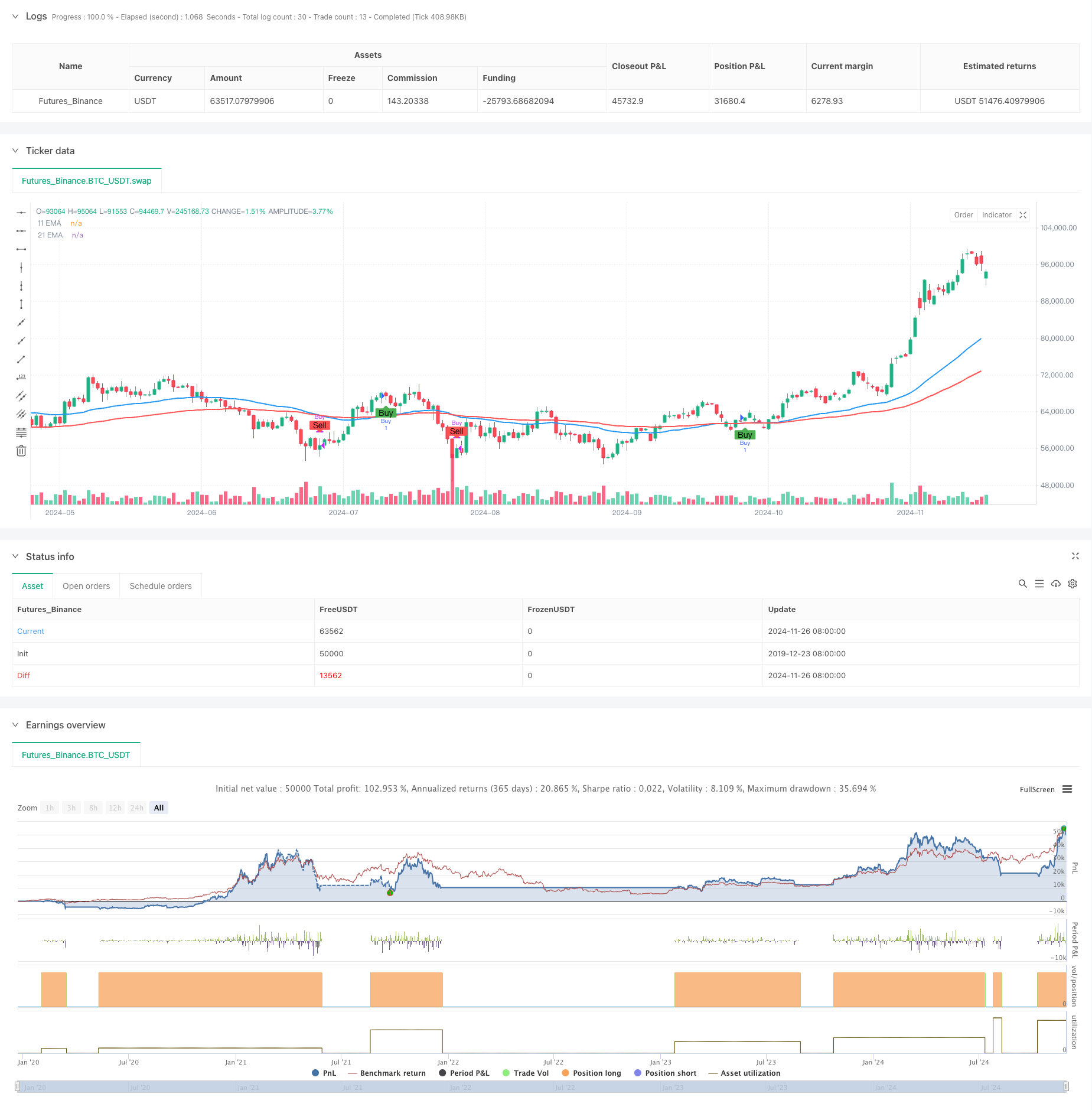
这是一个基于双均线交叉和趋势跟踪的量化交易策略。该策略主要运用47周期和95周期的指数移动平均线(EMA)来捕捉市场趋势,通过均线交叉信号进行交易。策略在15分钟时间周期上运行,综合了技术分析和动量交易的核心理念,旨在实现稳健的交易收益。
策略原理
策略核心是利用短期EMA(47周期)和长期EMA(95周期)的交叉来识别趋势变化。当短期EMA向上穿越长期EMA时,系统产生做多信号;当短期EMA向下穿越长期EMA时,系统平仓。这种设计基于价格动量和趋势延续性原理,通过均线交叉来确认趋势转换点,从而把握市场主要走势。
策略优势
- 信号明确:双均线交叉提供了清晰的入场和出场信号,降低了主观判断带来的不确定性。
- 趋势跟踪:策略能够有效捕捉中短期趋势,在趋势持续期间获得收益。
- 自动化程度高:策略逻辑简单清晰,易于程序化实现和回测验证。
- 适应性强:通过调整均线周期,策略可以适应不同市场环境和交易品种。
- 风险可控:系统化的交易规则有助于控制情绪波动,维持交易纪律。
策略风险
- 震荡市不适用:在横盘震荡市场中,频繁的假突破可能导致连续亏损。
- 滞后性:均线指标本身具有滞后性,可能错过最佳入场时机或在趋势转折时出现较大回撤。
- 参数依赖:均线周期的选择对策略表现影响较大,不同市场可能需要不同的参数设置。
- 资金管理:缺乏完善的止损机制可能在剧烈波动时遭受较大损失。
策略优化方向
- 引入波动率指标:可以添加ATR指标来动态调整止损位置,提高风险控制能力。
- 增加趋势过滤:结合RSI或MACD等指标,筛选更可靠的交易信号。
- 优化参数选择:可以通过机器学习方法,为不同市场环境自动选择最优均线周期。
- 完善资金管理:增加仓位管理和风险控制模块,设置每笔交易的最大损失比例。
- 添加市场环境判断:引入市场结构分析,在震荡市降低交易频率或暂停交易。
总结
这是一个结构清晰、逻辑严谨的趋势跟踪策略。通过双均线交叉捕捉市场趋势,具有较好的可操作性和扩展性。虽然存在一定的局限性,但通过持续优化和完善,有望发展成为一个稳定可靠的交易系统。重点是要根据不同市场特征灵活调整参数,并建立完善的风险控制机制。 ||
Overview
This is a quantitative trading strategy based on dual EMA crossover and trend following. The strategy primarily utilizes 47-period and 95-period Exponential Moving Averages (EMA) to capture market trends, executing trades based on EMA crossover signals. Operating on a 15-minute timeframe, it combines technical analysis and momentum trading principles to achieve consistent trading returns.
Strategy Principles
The core mechanism relies on identifying trend changes through crossovers between short-term EMA (47-period) and long-term EMA (95-period). Buy signals are generated when the short-term EMA crosses above the long-term EMA, while positions are closed when the short-term EMA crosses below. This design is based on price momentum and trend continuation principles, using EMA crossovers to confirm trend transition points.
Strategy Advantages
- Clear Signals: Dual EMA crossovers provide explicit entry and exit signals, reducing uncertainty from subjective judgment.
- Trend Following: The strategy effectively captures medium to short-term trends, generating profits during trend continuation.
- High Automation: Simple and clear strategy logic enables easy programming implementation and backtesting.
- Strong Adaptability: Strategy can be adapted to different market environments by adjusting EMA periods.
- Controlled Risk: Systematic trading rules help control emotional fluctuations and maintain trading discipline.
Strategy Risks
- Poor Performance in Ranging Markets: Frequent false breakouts in sideways markets may lead to consecutive losses.
- Lag Effect: EMA indicators have inherent lag, potentially missing optimal entry points or experiencing larger drawdowns during trend reversals.
- Parameter Dependency: Strategy performance heavily relies on EMA period selection, requiring different parameters for different markets.
- Capital Management: Lack of comprehensive stop-loss mechanisms may result in significant losses during volatile periods.
Optimization Directions
- Incorporate Volatility Indicators: Add ATR indicator for dynamic stop-loss adjustment to enhance risk control.
- Add Trend Filters: Combine RSI or MACD indicators to screen for more reliable trading signals.
- Optimize Parameter Selection: Implement machine learning methods for automatic selection of optimal EMA periods in different market environments.
- Improve Capital Management: Enhance position sizing and risk control modules, set maximum loss percentage per trade.
- Include Market Environment Analysis: Introduce market structure analysis to reduce trading frequency or pause trading during ranging markets.
Conclusion
This is a well-structured and logically rigorous trend-following strategy. It captures market trends through dual EMA crossovers, offering good operability and scalability. While certain limitations exist, continuous optimization and improvement can develop it into a stable and reliable trading system. The key is to flexibly adjust parameters based on different market characteristics and establish comprehensive risk control mechanisms.[/trans]
Source (PineScript)
/*backtest
start: 2019-12-23 08:00:00
end: 2024-11-27 08:00:00
period: 1d
basePeriod: 1d
exchanges: [{"eid":"Futures_Binance","currency":"BTC_USDT"}]
*/

//@version=5
strategy("EMA Crossover Strategy", overlay=true)

// Define the EMA periods
shortEmaPeriod = 47
longEmaPeriod = 95

// Calculate EMAs
ema11 = ta.ema(close, shortEmaPeriod)
ema21 = ta.ema(close, longEmaPeriod)

// Plot EMAs on the chart
plot(ema11, title="11 EMA", color=color.blue, linewidth=2)
plot(ema21, title="21 EMA", color=color.red, linewidth=2)

// Generate trading signals
longSignal = ta.crossover(ema11, ema21)
shortSignal = ta.crossunder(ema11, ema21)

// Execute trades based on signals
if (longSignal)
    strategy.entry("Buy", strategy.long)

if (shortSignal)
    strategy.close("Buy")

// Optional: Plot buy and sell signals on the chart
plotshape(series=longSignal, location=location.belowbar, color=color.green, style=shape.labelup, text="Buy")
plotshape(series=shortSignal, location=location.abovebar, color=color.red, style=shape.labeldown, text="Sell")

// Plot buy/sell signals on the main chart
plotshape(series=longSignal, location=location.belowbar, color=color.green, style=shape.labelup, text="Buy")
plotshape(series=shortSignal, location=location.abovebar, color=color.red, style=shape.labeldown, text="Sell")
Detail
https://www.fmz.com/strategy/473383
Last Modified
2024-11-29 16:08:51