
11 KiB
Name
动态仓位跟踪止损SMA交叉回撤策略-Dynamic-Position-Size-and-Trailing-Stop-SMA-Rebound-Strategy
Author
ianzeng123
Strategy Description
[trans]
概述
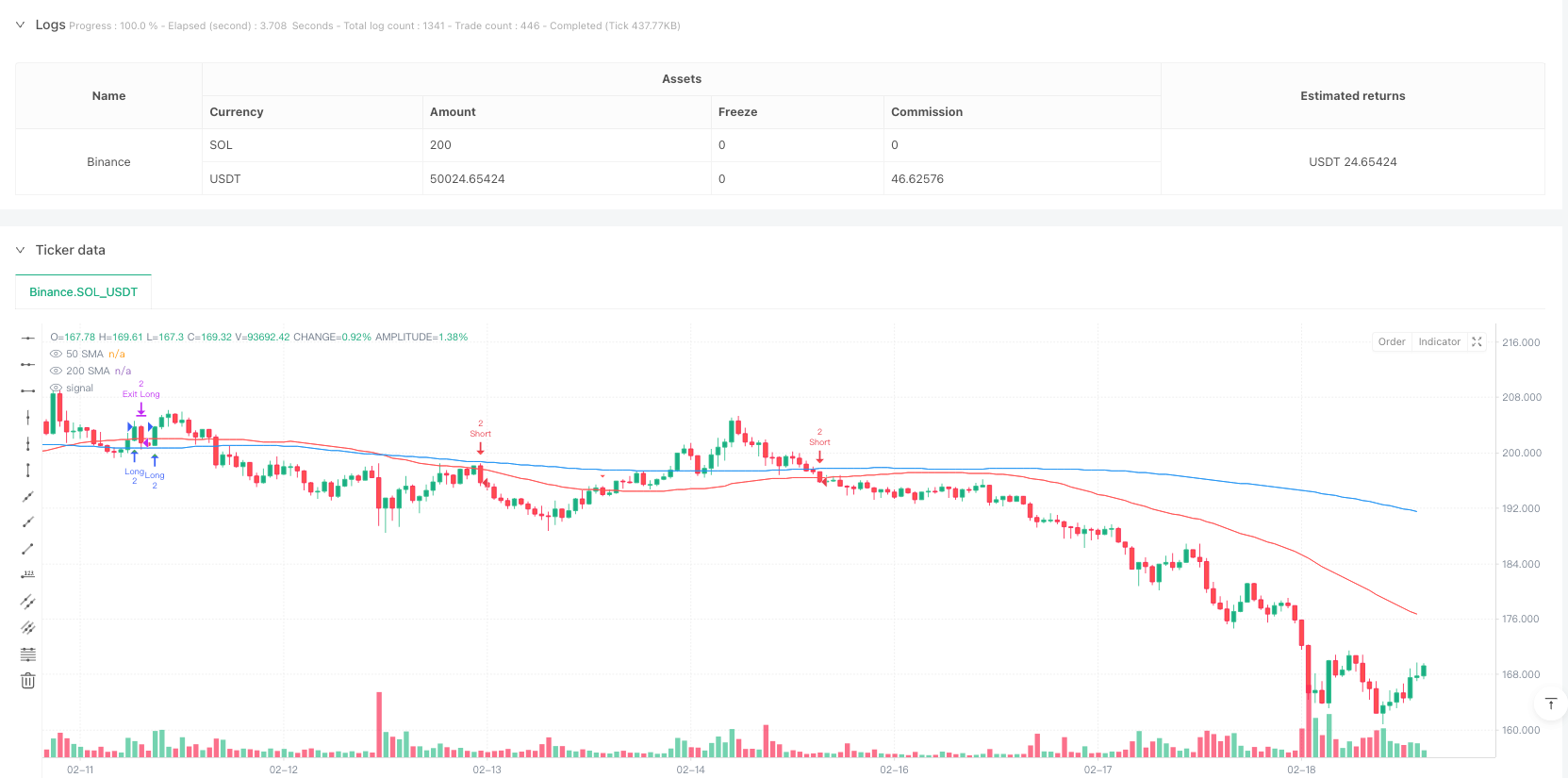
本策略是一个基于均线交叉和动态仓位管理的自动化交易系统。它利用50日和200日简单移动平均线(SMA)作为主要指标,结合动态仓位调整和跟踪止损机制,在市场趋势中寻找交易机会。策略的核心是通过价格与均线的关系判断市场方向,同时运用资金管理和风险控制确保交易的稳定性。
策略原理
策略运作基于以下核心原理:
- 入场信号基于价格与50日均线的交叉,同时参考50日均线与200日均线的相对位置判断大趋势
- 当价格从均线下方向上突破时,触发做多信号;反之触发做空信号
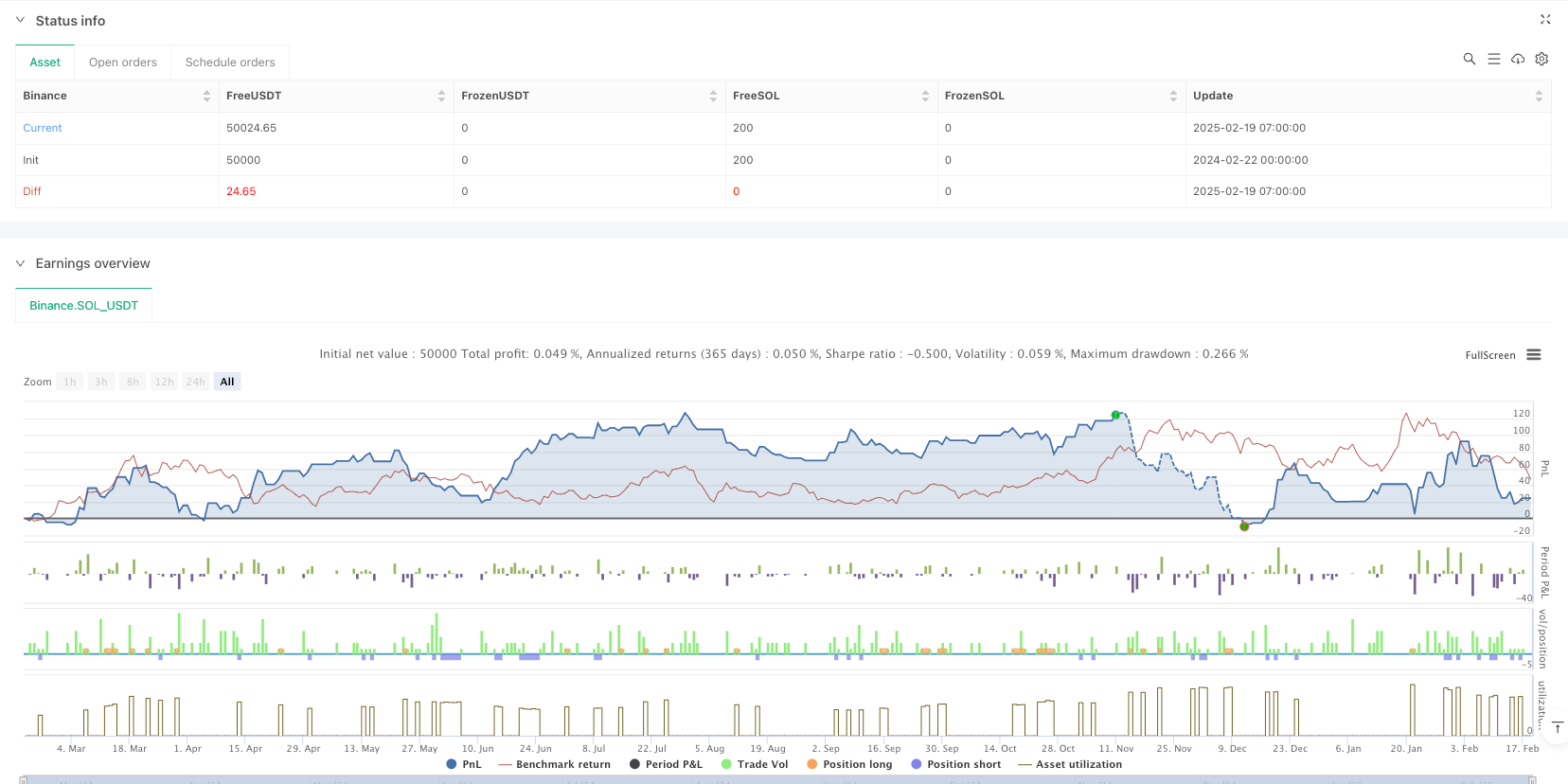
- 仓位管理采用动态调整机制,当账户盈利超过4000时增加持仓数量
- 止损采用跟踪止损机制,随着盈利增加动态调整止损位置
- 风险收益比设定为1:2.5,确保每笔交易的收益预期大于风险
策略优势
- 交易逻辑清晰明确,结合技术指标和价格行为判断入场时机
- 采用动态仓位管理,可以在盈利时适当增加交易规模,提高资金利用效率
- 跟踪止损机制能够有效锁定利润,避免大幅回撤
- 设置了交易时间过滤,仅在主要交易时段运行,避免低流动性时期的风险
- 具有完善的风险控制机制,包括止损、获利目标和仓位管理
策略风险
- 在震荡市场中可能频繁触发假突破信号,导致连续止损
- 动态仓位管理在市场突然转向时可能带来较大损失
- 依赖均线系统可能在快速波动市场中反应滞后
- 固定的风险收益比可能错过一些潜在的大趋势机会
- 交易时间限制可能错过一些重要的市场机会
策略优化方向
- 可以引入波动率指标,在不同市场环境下动态调整参数
- 考虑添加市场情绪指标,提高入场信号的准确性
- 优化跟踪止损参数,使其更好地适应不同市场环境
- 增加多重时间周期分析,提高交易系统的稳定性
- 引入成交量分析,提高信号的可靠性
总结
该策略通过结合均线系统、动态仓位管理和跟踪止损机制,构建了一个相对完整的交易系统。策略的优势在于具有清晰的交易逻辑和完善的风险控制机制,但也存在一些需要优化的地方。通过持续改进和优化,该策略有望在实际交易中取得更好的表现。
||
Overview
This strategy is an automated trading system based on moving average crossovers and dynamic position management. It utilizes 50-day and 200-day Simple Moving Averages (SMA) as primary indicators, combined with dynamic position sizing and trailing stop mechanisms to identify trading opportunities in market trends. The core of the strategy lies in determining market direction through price-MA relationships while employing money management and risk control to ensure trading stability.
Strategy Principles
The strategy operates on the following core principles:
- Entry signals are based on price crossovers with the 50-day MA, while using the relative position of 50-day and 200-day MAs to judge the broader trend
- Long signals are triggered when price breaks above the MA from below; short signals occur in the opposite scenario
- Position management employs a dynamic adjustment mechanism, increasing position size when account profits exceed 4000
- Stop-loss uses a trailing stop mechanism, dynamically adjusting stop positions as profits increase
- Risk-reward ratio is set at 1:2.5, ensuring expected returns exceed risks for each trade
Strategy Advantages
- Clear and explicit trading logic, combining technical indicators and price action for entry timing
- Dynamic position management allows for increased trading size during profitable periods, improving capital efficiency
- Trailing stop mechanism effectively locks in profits and prevents significant drawdowns
- Includes trading session filters, operating only during major trading sessions to avoid low liquidity risks
- Comprehensive risk control mechanisms including stop-loss, profit targets, and position management
Strategy Risks
- May trigger frequent false breakout signals in ranging markets, leading to consecutive stops
- Dynamic position sizing could result in larger losses during sudden market reversals
- Reliance on moving averages may lead to delayed reactions in rapidly volatile markets
- Fixed risk-reward ratio might miss potential larger trend opportunities
- Trading time restrictions could miss important market opportunities
Strategy Optimization Directions
- Introduce volatility indicators to dynamically adjust parameters in different market conditions
- Consider adding market sentiment indicators to improve entry signal accuracy
- Optimize trailing stop parameters for better adaptation to different market environments
- Add multiple timeframe analysis to enhance system stability
- Incorporate volume analysis to improve signal reliability
Summary
The strategy builds a relatively complete trading system by combining moving average systems, dynamic position management, and trailing stop mechanisms. Its strengths lie in clear trading logic and comprehensive risk control mechanisms, though there are areas for optimization. Through continuous improvement and optimization, the strategy shows promise for better performance in actual trading.[/trans]
Source (PineScript)
/*backtest
start: 2024-02-22 00:00:00
end: 2025-02-19 08:00:00
period: 1h
basePeriod: 1h
exchanges: [{"eid":"Binance","currency":"SOL_USDT"}]
*/

//@version=5
strategy("15m - Rebound 50SMA with Dynamic Lots & Trailing Stop, RRR 2:1, Date Filter (Closed Bars Only)",
     overlay=true,
     initial_capital=50000,
     default_qty_type=strategy.fixed,
     default_qty_value=1,
     pyramiding=0,
     calc_on_order_fills=true)

// ===== INPUTS =====
sma50Period  = input.int(50, "50 SMA Period", minval=1)
sma200Period = input.int(200, "200 SMA Period", minval=1)

// ===== CALCULATE SMAs =====
sma50  = ta.sma(close, sma50Period)
sma200 = ta.sma(close, sma200Period)

// ===== PLOT SMAs =====
plot(sma50, color=color.red, title="50 SMA")
plot(sma200, color=color.blue, title="200 SMA")

// ===== DEFINE TRADING SESSIONS =====
// Trading is allowed 15 minutes after market open:
//   - New York: 09:45–16:00 (America/New_York)
//   - London:   08:15–16:00 (Europe/London)
nySession     = not na(time("15", "0945-1600", "America/New_York"))
londonSession = not na(time("15", "0815-1600", "Europe/London"))
inSession     = nySession or londonSession

// ===== DEFINE DATE RANGE =====
// Only allow orders on or after January 1, 2024.
// (We include seconds in the timestamp for proper parsing.)
startDate   = timestamp("UTC", 2024, 1, 1, 0, 0, 0)
inDateRange = time >= startDate

// ===== DEFINE ENTRY CONDITIONS =====
// ----- LONG ENTRY CONDITION -----
// A long entry is triggered when:
//   - The previous candle closed below the 50 SMA and the current candle closes above it,
//   - And the 50 SMA is above the 200 SMA.
longCondition = (close[1] < sma50[1]) and (close > sma50) and (sma50 > sma200)

// ----- SHORT ENTRY CONDITION -----
// A short entry is triggered when:
//   - The previous candle closed above the 50 SMA and the current candle closes below it,
//   - And the 50 SMA is below the 200 SMA.
shortCondition = (close[1] > sma50[1]) and (close < sma50) and (sma50 < sma200)

// ===== DEBUG PLOTS =====
plotshape(longCondition and barstate.isconfirmed, title="Long Signal", location=location.belowbar, color=color.green, style=shape.triangleup, size=size.tiny)
plotshape(shortCondition and barstate.isconfirmed, title="Short Signal", location=location.abovebar, color=color.red, style=shape.triangledown, size=size.tiny)

// ===== VARIABLES FOR STOP LOSS MANAGEMENT =====
// For long positions.
var float initialLongStop = na   // Set at entry: low of the rebound candle.
var float trailStopLong   = na   // Updated trailing stop for long.
// For short positions.
var float initialShortStop = na  // Set at entry: high of the rebound candle.
var float trailStopShort   = na  // Updated trailing stop for short.

// ===== DYNAMIC LOT SIZE =====
// If current profit (strategy.equity - 50000) exceeds 4000, lot size becomes 3; otherwise, 2.
lotSize = (strategy.equity - 50000 > 4000) ? 3 : 2

// ===== ENTRY LOGIC (EXECUTED ON CONFIRMED BARS) =====
if barstate.isconfirmed and inSession and inDateRange and longCondition and strategy.position_size <= 0
    initialLongStop := low
    trailStopLong   := initialLongStop
    if strategy.position_size < 0
        strategy.close("Short", comment="Close Short before Long")
    // Submit a market order entry (no offset).
    strategy.entry("Long", strategy.long, qty=lotSize, comment="Enter Long")

if barstate.isconfirmed and inSession and inDateRange and shortCondition and strategy.position_size >= 0
    initialShortStop := high
    trailStopShort   := initialShortStop
    if strategy.position_size > 0
        strategy.close("Long", comment="Close Long before Short")
    // Submit a market order entry (no offset).
    strategy.entry("Short", strategy.short, qty=lotSize, comment="Enter Short")

// ===== TRAILING STOP LOGIC & EXIT ORDERS (ON CLOSED BARS) =====

if barstate.isconfirmed and strategy.position_size > 0
    // For Long Positions:
    floatingProfitLong = (close - strategy.position_avg_price) / syminfo.mintick
    newTrailLong = trailStopLong  // Default: no change.
    if floatingProfitLong >= 20 and floatingProfitLong < 30
        newTrailLong := initialLongStop + 5 * syminfo.mintick
    else if floatingProfitLong >= 31 and floatingProfitLong < 40
        newTrailLong := initialLongStop + 10 * syminfo.mintick
    else if floatingProfitLong >= 41 and floatingProfitLong < 50
        newTrailLong := initialLongStop + 15 * syminfo.mintick
    // Update trailing stop only if the new value is more favorable.
    trailStopLong := math.max(trailStopLong, newTrailLong)

    longRisk = strategy.position_avg_price - trailStopLong
    tpLong   = strategy.position_avg_price + 2.5 * longRisk
    strategy.exit("Exit Long", from_entry="Long", stop=trailStopLong, limit=tpLong)

if barstate.isconfirmed and strategy.position_size < 0
    // For Short Positions:
    floatingProfitShort = (strategy.position_avg_price - close) / syminfo.mintick
    newTrailShort = trailStopShort  // Default: no change.
    if floatingProfitShort >= 20 and floatingProfitShort < 30
        newTrailShort := initialShortStop - 5 * syminfo.mintick
    else if floatingProfitShort >= 31 and floatingProfitShort < 40
        newTrailShort := initialShortStop - 10 * syminfo.mintick
    else if floatingProfitShort >= 41 and floatingProfitShort < 50
        newTrailShort := initialShortStop - 15 * syminfo.mintick
    // Update trailing stop only if the new value is more favorable.
    trailStopShort := math.min(trailStopShort, newTrailShort)

    shortRisk = trailStopShort - strategy.position_avg_price
    tpShort = strategy.position_avg_price - 2.5 * shortRisk
    strategy.exit("Exit Short", from_entry="Short", stop=trailStopShort, limit=tpShort)
Detail
https://www.fmz.com/strategy/483109
Last Modified
2025-02-21 13:51:50