
17 KiB
Name
动态仓位与入场K线止损的EMA交叉策略-Dynamic-Position-Sizing-and-Entry-Candle-Stop-Loss-EMA-Crossover-Strategy
Author
ianzeng123
Strategy Description
[trans]
概述
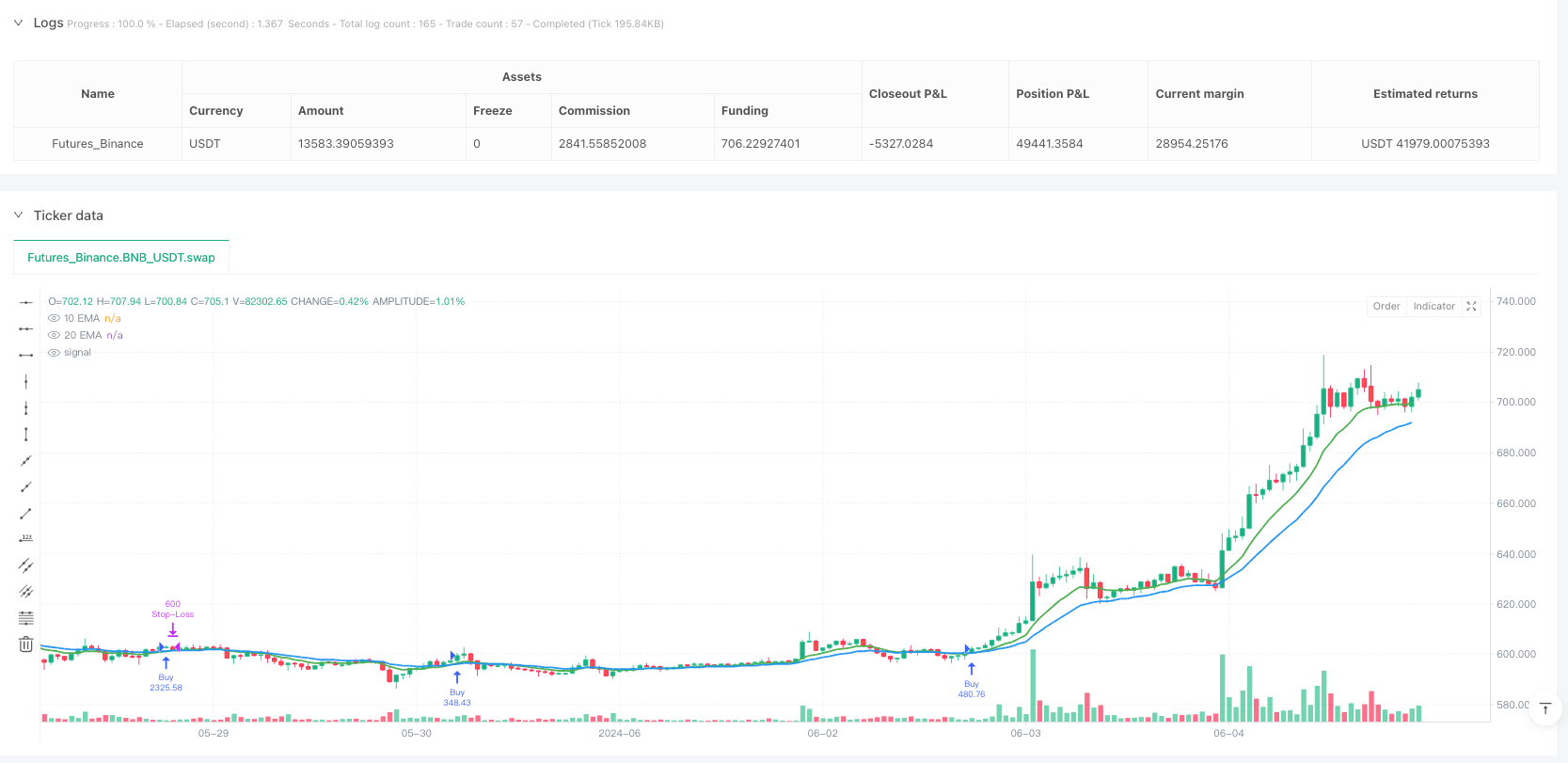
动态仓位与入场K线止损的EMA交叉策略是一种基于指数移动平均线(EMA)交叉信号的量化交易策略,该策略结合了动态仓位管理和精确的止损位设置。策略的核心思路是通过识别10周期EMA向上穿越20周期EMA(金叉)的同时,要求当前K线为阳线(收盘价高于开盘价),以此作为做多信号。策略的独特之处在于采用了基于当前价格波动的动态仓位计算方法,并将入场K线的最低点设为止损位,以实现更好的风险控制。策略还通过在图表上显示微型三角形标记来标识入场时机,提高了交易信号的可视化效果。
策略原理
该策略的运作基于以下几个核心原理:
-
EMA交叉信号:策略使用10周期和20周期的指数移动平均线,当短周期(10周期)EMA向上穿越长周期(20周期)EMA时,产生潜在的做多信号。这种交叉被称为"金叉",通常被视为上升趋势的开始。
-
阳线确认:为了增加信号的可靠性,策略要求在EMA交叉发生的同一K线上,收盘价必须高于开盘价(形成阳线)。这一条件确保市场在信号出现时展现出一定的买方力量。
-
动态仓位计算:策略采用创新的动态仓位计算方法,通过公式
1000 / (收盘价 - 最低价)来确定购买数量。这种方法会在K线波动较小时增加仓位,在波动较大时减少仓位,从而实现对波动性的自动调整。 -
入场K线止损:策略将入场K线的最低点设为止损位,这提供了一个基于市场实际波动的自然止损位置,而不是使用固定百分比或点数的止损。
-
可视化信号:在触发做多条件时,策略在K线下方添加一个微型绿色三角形标记,帮助交易者直观地识别入场信号。
策略优势
深入分析该策略的代码实现,我们可以总结出以下几点显著优势:
-
趋势确认的双重条件:通过结合EMA交叉和阳线确认,策略减少了虚假信号的可能性,只在有足够市场支持的情况下进行交易。
-
智能的动态仓位管理:基于K线高低点差异计算的动态仓位分配,能够自动适应市场波动性的变化。在波动小(潜在风险较低)的环境中增加仓位,在波动大(潜在风险较高)的环境中减少仓位,实现了智能的风险调整。
-
自适应的止损策略:使用入场K线的最低点作为止损位,提供了一个基于市场自然支撑位的止损方法,避免了固定止损可能过早被触发或过远无法有效保护资金的问题。
-
视觉清晰的交易信号:通过微型三角形标记,交易者可以直观地识别交易信号,提高了策略使用的便捷性和交易决策的效率。
-
代码结构清晰简洁:策略的实现代码简单明了,易于理解和修改,便于交易者根据自己的需求进行个性化调整。
策略风险
尽管该策略具有诸多优势,但也存在一些潜在的风险和局限性:
-
假突破风险:在震荡市场中,EMA交叉信号可能产生较多假突破,导致频繁的止损出场和资金损失。解决方法是增加额外的过滤条件,如更长周期的趋势确认或波动率指标过滤。
-
动态仓位计算的极端情况:当K线内的波动非常小时(收盘价接近最低价),计算的仓位可能会变得异常大,导致过度杠杆风险。建议设置最大仓位限制,避免在极端情况下承担过大风险。
-
止损位过近的风险:如果入场K线的最低点离入场价格很近,止损位可能过于紧密,容易被正常的市场噪音触发。可以考虑增加止损位的缓冲区或使用ATR等波动指标调整止损距离。
-
缺乏利润目标:策略定义了明确的入场和止损条件,但没有设定利润目标或其他出场条件,可能导致在趋势反转时无法及时锁定利润。建议增加基于移动止损或反向EMA交叉的出场条件。
-
参数固定不灵活:EMA周期(10和20)是固定的,可能不适合所有市场环境和时间周期。建议对这些参数进行回测优化,或考虑使用自适应参数方法。
策略优化方向
基于对策略的深入分析,以下是几个可能的优化方向:
-
增加趋势过滤器:引入更长周期的趋势指标(如50周期EMA或200周期EMA),只在大趋势方向一致时才执行交易,可以减少假突破。这样优化可以显著提高策略在强趋势市场中的表现。
-
增加波动率调整:集成ATR(Average True Range)指标来调整止损距离和动态仓位计算,使策略更好地适应不同波动环境。高波动时期可以设置更宽松的止损和更小的仓位,低波动时期则相反。
-
添加利润目标和移动止损:实现基于市场波动性的动态利润目标,并在趋势发展过程中使用移动止损来保护已获利润。例如,可以设置基于ATR倍数的利润目标,或者使用跟踪止损在价格上涨时逐步提高止损位。
-
加入成交量确认:在EMA交叉信号的基础上增加成交量确认,只有在成交量支持的情况下才执行交易,可以提高信号的可靠性。高成交量的突破通常比低成交量的突破更可靠。
-
优化动态仓位计算公式:修改仓位计算公式,增加上限和下限约束,并考虑纳入总体风险管理框架,确保单次交易的风险不超过账户总值的一定比例(如1-2%)。
-
参数自适应机制:实现EMA周期的自适应机制,根据市场条件自动调整EMA周期,使策略能够更好地适应不同的市场环境。例如,在高波动市场可以使用更长的EMA周期,在低波动市场使用更短的EMA周期。
总结
动态仓位与入场K线止损的EMA交叉策略是一种结合了趋势跟踪、动态仓位管理和精确止损的量化交易方法。通过EMA交叉和阳线确认的双重条件,策略能够识别潜在的上涨趋势;通过基于K线波动的动态仓位计算,实现了对市场风险的智能调整;通过将入场K线的最低点设为止损位,提供了一种基于市场自然支撑位的风险控制方法。
尽管该策略在趋势市场中可能表现良好,但在横盘震荡市场中可能面临假突破的风险。通过增加趋势过滤器、波动率调整、利润目标设定、成交量确认和优化仓位计算等方向的改进,可以进一步提高策略的稳健性和盈利能力。
最重要的是,任何交易策略都需要在实际应用前进行充分的历史回测和模拟交易,以验证其在不同市场环境下的表现。同时,良好的风险管理始终是成功交易的基础,即使是最优秀的策略也需要严格的资金管理和风险控制措施的支持。 ||
Overview
The Dynamic Position Sizing and Entry Candle Stop-Loss EMA Crossover Strategy is a quantitative trading approach that combines exponential moving average (EMA) crossover signals with dynamic position sizing and precise stop-loss placement. The core concept involves identifying when the 10-period EMA crosses above the 20-period EMA (golden cross) while ensuring the current candle is bullish (close higher than open). What makes this strategy unique is its dynamic position calculation method based on current price volatility and its use of the entry candle's low as a stop-loss level to achieve better risk control. The strategy also enhances trade signal visualization by displaying tiny triangle markers on the chart to identify entry points.
Strategy Principles
This strategy operates based on several core principles:
-
EMA Crossover Signal: The strategy employs 10-period and 20-period exponential moving averages. When the shorter-term (10-period) EMA crosses above the longer-term (20-period) EMA, it generates a potential long entry signal. This crossover is commonly referred to as a "golden cross" and is typically viewed as the beginning of an uptrend.
-
Bullish Candle Confirmation: To increase signal reliability, the strategy requires that the close must be above the open (forming a bullish candle) on the same bar where the EMA crossover occurs. This condition ensures that the market demonstrates some buying pressure when the signal appears.
-
Dynamic Position Sizing: The strategy employs an innovative dynamic position calculation method using the formula
1000 / (close - low)to determine the purchase quantity. This method increases position size when candle volatility is low and decreases it when volatility is high, automatically adjusting for volatility. -
Entry Candle Stop-Loss: The strategy sets the stop-loss at the low of the entry candle, providing a natural stop-loss location based on actual market volatility, rather than using a fixed percentage or point-based stop.
-
Visual Signals: When the long condition is triggered, the strategy adds a tiny green triangle marker below the candle, helping traders visually identify entry signals.
Strategy Advantages
Analyzing the code implementation of this strategy, we can summarize the following significant advantages:
-
Dual Conditions for Trend Confirmation: By combining the EMA crossover with bullish candle confirmation, the strategy reduces the likelihood of false signals, only trading when there is sufficient market support.
-
Intelligent Dynamic Position Sizing: The dynamic position allocation calculated based on candle high-low differential can automatically adapt to changes in market volatility. It increases position size in environments with low volatility (potentially lower risk) and decreases position size in environments with high volatility (potentially higher risk), achieving intelligent risk adjustment.
-
Adaptive Stop-Loss Strategy: Using the entry candle's low as a stop-loss provides a method based on natural market support levels, avoiding the problems of fixed stops being triggered too early or being too distant to effectively protect capital.
-
Visually Clear Trading Signals: Through tiny triangle markers, traders can intuitively identify trading signals, improving the convenience of strategy use and the efficiency of trading decisions.
-
Clear and Concise Code Structure: The implementation code is simple and straightforward, easy to understand and modify, making it convenient for traders to make personalized adjustments according to their needs.
Strategy Risks
Despite its many advantages, this strategy also has some potential risks and limitations:
-
False Breakout Risk: In oscillating markets, EMA crossover signals may produce numerous false breakouts, leading to frequent stop-loss exits and capital losses. The solution is to add additional filtering conditions, such as longer-term trend confirmation or volatility indicator filtering.
-
Extreme Cases in Dynamic Position Calculation: When the intra-candle volatility is very small (close price near the low), the calculated position size may become abnormally large, leading to excessive leverage risk. It is recommended to set a maximum position limit to avoid taking on too much risk in extreme cases.
-
Too-Close Stop-Loss Risk: If the entry candle's low is very close to the entry price, the stop-loss may be too tight and easily triggered by normal market noise. Consider adding a buffer zone to the stop-loss or adjusting the stop-loss distance using volatility indicators like ATR.
-
Lack of Profit Targets: The strategy defines clear entry and stop-loss conditions but does not set profit targets or other exit conditions, which may result in failure to lock in profits when trends reverse. Consider adding exit conditions based on trailing stops or reverse EMA crossovers.
-
Inflexible Fixed Parameters: The EMA periods (10 and 20) are fixed and may not be suitable for all market environments and time periods. It is recommended to perform backtesting optimization on these parameters or consider using adaptive parameter methods.
Strategy Optimization Directions
Based on in-depth analysis of the strategy, here are several possible optimization directions:
-
Add Trend Filters: Introduce longer-period trend indicators (such as 50-period EMA or 200-period EMA) and only execute trades when the major trend direction is consistent, which can reduce false breakouts. This optimization can significantly improve strategy performance in strong trend markets.
-
Incorporate Volatility Adjustment: Integrate the ATR (Average True Range) indicator to adjust stop-loss distances and dynamic position calculations, allowing the strategy to better adapt to different volatility environments. In high-volatility periods, set looser stops and smaller positions; in low-volatility periods, do the opposite.
-
Add Profit Targets and Trailing Stops: Implement dynamic profit targets based on market volatility and use trailing stops to protect profits as trends develop. For example, set profit targets based on ATR multiples, or use trailing stops to gradually raise the stop-loss level as prices rise.
-
Add Volume Confirmation: Add volume confirmation to the EMA crossover signal, only executing trades when supported by volume, which can improve signal reliability. High-volume breakouts are typically more reliable than low-volume ones.
-
Optimize Dynamic Position Sizing Formula: Modify the position calculation formula, adding upper and lower constraints, and consider incorporating it into an overall risk management framework to ensure that the risk of a single trade does not exceed a certain percentage (e.g., 1-2%) of the total account value.
-
Parameter Adaptive Mechanism: Implement an adaptive mechanism for EMA periods, automatically adjusting them according to market conditions, allowing the strategy to better adapt to different market environments. For example, use longer EMA periods in high-volatility markets and shorter EMA periods in low-volatility markets.
Summary
The Dynamic Position Sizing and Entry Candle Stop-Loss EMA Crossover Strategy is a quantitative trading method that combines trend following, dynamic position management, and precise stop-loss placement. Through the dual conditions of EMA crossover and bullish candle confirmation, the strategy can identify potential uptrends; through dynamic position calculations based on candle volatility, it achieves intelligent adjustment to market risk; through setting the entry candle's low as the stop-loss, it provides a risk control method based on natural market support levels.
While this strategy may perform well in trending markets, it may face false breakout risks in sideways, oscillating markets. By improving in areas such as adding trend filters, volatility adjustments, profit target setting, volume confirmation, and optimizing position calculation, the strategy's robustness and profitability can be further enhanced.
Most importantly, any trading strategy needs thorough historical backtesting and simulation trading before actual application to verify its performance in different market environments. At the same time, good risk management is always the foundation of successful trading. Even the best strategies need the support of strict capital management and risk control measures.[/trans]
Source (PineScript)
/*backtest
start: 2024-03-23 00:00:00
end: 2024-06-06 00:00:00
period: 1h
basePeriod: 1h
exchanges: [{"eid":"Futures_Binance","currency":"BNB_USDT"}]
*/

// This Pine Script™ code is subject to the terms of the Mozilla Public License 2.0 at https://mozilla.org/MPL/2.0/
// © nadeemred19

//@version=6
strategy("EMA Crossover with Tiny Triangle Signal & Dynamic Quantity", overlay=true)

// EMA Indicators
ema10 = ta.ema(close, 10)
ema20 = ta.ema(close, 20)

// Plot EMAs
plot(ema10, title="10 EMA", color=color.green, linewidth=2)
plot(ema20, title="20 EMA", color=color.blue, linewidth=2)

// Bullish candle condition
bullishCandle = close > open

// Variables to store entry candle low
var float entryCandleLow = na

// Entry Signal: 10 EMA crosses over 20 EMA AND candle is bullish
longCondition = ta.crossover(ema10, ema20) and bullishCandle

// Calculate dynamic stock quantity: 1000 / (close - low)
var float buyQty = na
if (longCondition)
    entryCandleLow := low
    buyQty := 1000 / (close - low)

// Plot Tiny Triangle Entry Signal
if (longCondition)
    label.new(bar_index, low, "▲", color=color.green, textcolor=color.green, size=size.tiny, style=label.style_label_down, yloc=yloc.belowbar)

// Entry and stop-loss
if (longCondition)
    strategy.entry("Buy", strategy.long, qty=buyQty)
    strategy.exit("Stop-Loss", from_entry="Buy", stop=entryCandleLow)
Detail
https://www.fmz.com/strategy/488014
Last Modified
2025-03-24 14:04:36