
16 KiB
Name
八阶蜡烛模式序列马丁格尔策略-Eight-Candle-Pattern-Sequence-Martingale-Strategy
Author
ianzeng123
Strategy Description
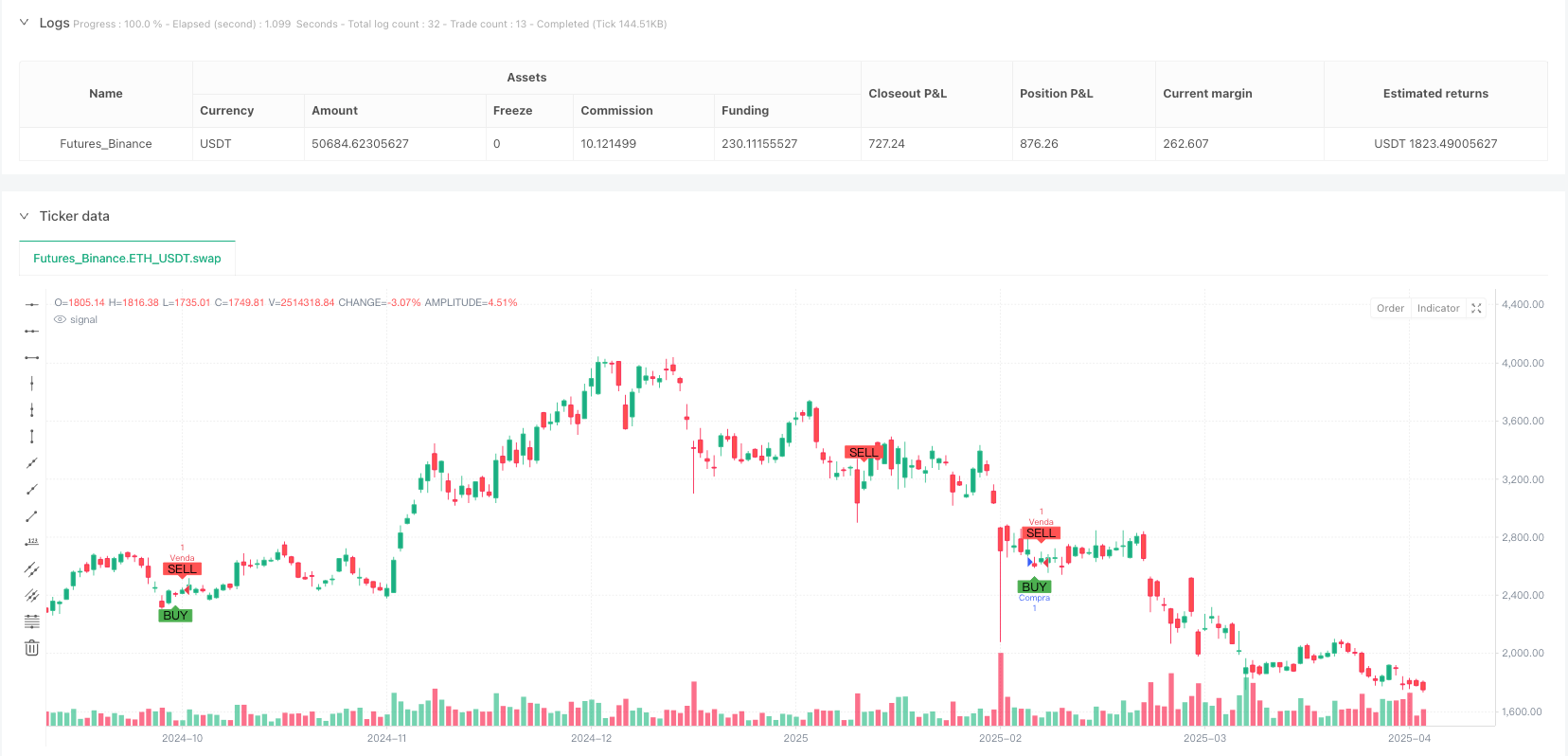
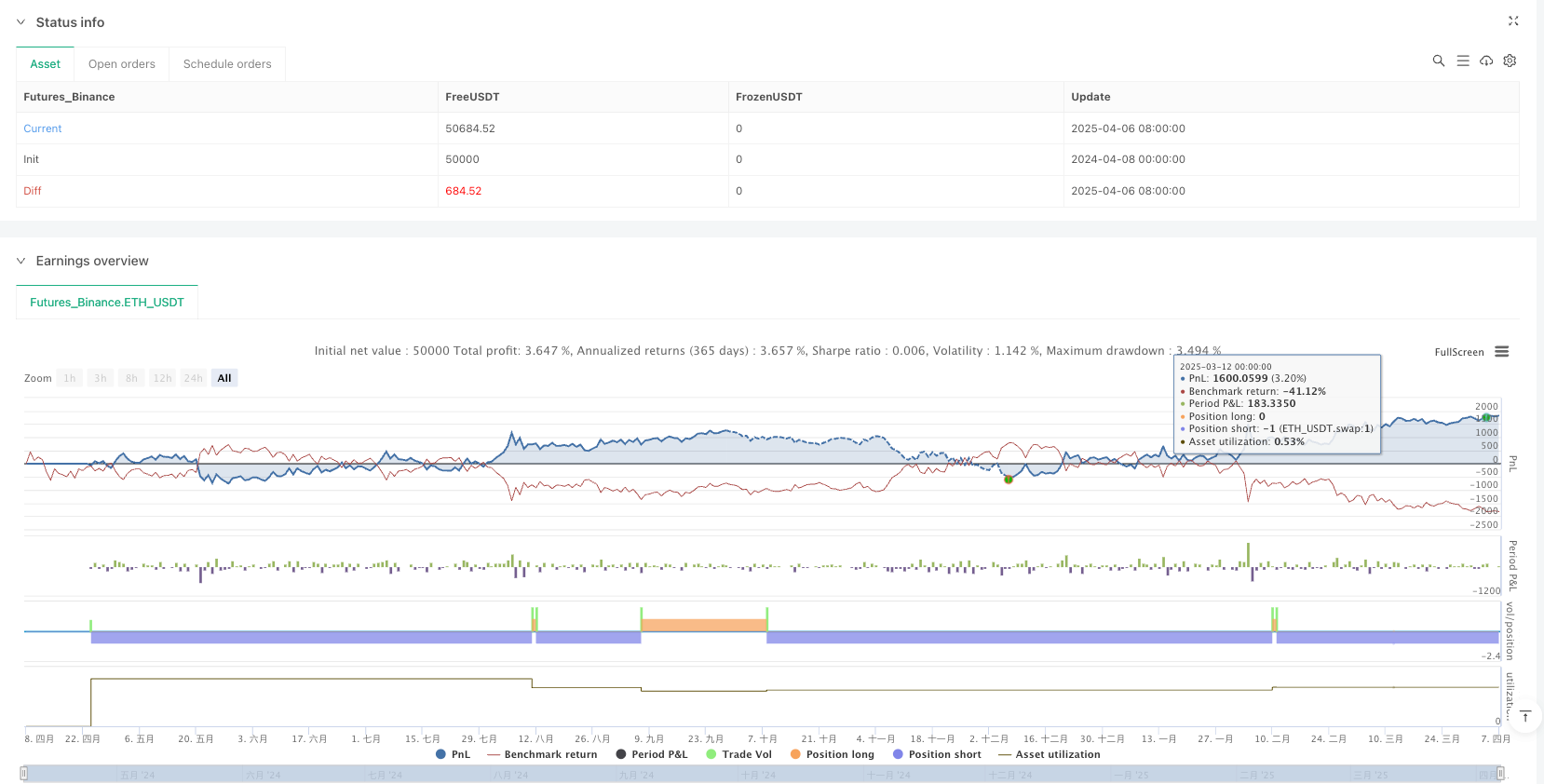
[trans]
概述
八阶蜡烛模式序列马丁格尔策略是一种结合特定蜡烛序列识别与马丁格尔资金管理系统的量化交易策略。该策略通过分析连续8根蜡烛的颜色模式来识别潜在的市场反转点,同时应用马丁格尔下注系统来管理交易规模,以期在连续亏损后通过增加仓位来弥补之前的损失。策略主要寻找两种特定的8根蜡烛序列作为入场信号,分别用于做多和做空,同时通过资金管理机制控制风险。
策略原理
策略的核心逻辑基于对特定蜡烛颜色序列的识别:
- 多头入场条件:当出现特定的8根蜡烛序列"下-下-下-下-上-下-上-下"时,策略触发做多信号。
- 空头入场条件:当出现特定的8根蜡烛序列"下-下-下-上-下-上-下-上"时,策略触发做空信号。
- 马丁格尔资金管理:
- 初始仓位由用户设置的"入场资金"参数决定
- 每次交易亏损后,下一次交易的仓位会按"乘数"参数增加(默认为2倍)
- 若交易盈利,仓位重置为初始设置值
- 设置最大资金限制,确保单笔交易不会超过可用资金
策略利用蜡烛颜色序列来捕捉市场中的特定波动模式,认为这些特定序列可能预示着市场短期内的方向反转。同时,马丁格尔系统通过在亏损后增加仓位,试图用更少的盈利交易来覆盖之前的连续亏损。
策略优势
-
模式识别的明确性:策略使用明确的8根蜡烛颜色序列作为入场条件,减少了主观判断的干扰,使交易信号更加客观和可重复。
-
资金管理的自适应性:马丁格尔系统允许策略在遭遇亏损后自动调整仓位大小,这种机制在市场震荡或短期逆势行情中可以帮助恢复之前的亏损。
-
可视化交易信号:策略提供了清晰的可视化信号标记(BUY/SELL标签)和统计表格,使交易者能够直观地了解策略的执行情况和历史表现。
-
风险控制机制:通过设置最大资金限制,策略能够防止在连续亏损情况下仓位过度扩大导致的资金耗尽问题。
-
参数灵活性:策略允许用户调整初始入场资金、马丁格尔乘数和最大资金限制,使交易者可以根据自己的风险偏好和资金状况定制策略。
策略风险
-
马丁格尔系统的内在风险:
- 连续亏损可能导致资金需求呈指数级增长
- 即使设置了最大资金限制,长期连续亏损仍可能导致大幅度的账户亏损
- 在强趋势市场中,反向操作可能导致连续亏损触发多次马丁格尔加仓
-
固定模式识别的局限性:
- 8根蜡烛的特定颜色序列在不同市场环境和时间周期下的有效性可能存在显著差异
- 没有考虑蜡烛的实体大小、影线长度等更丰富的价格信息
- 在高波动市场中,这种简单的颜色模式可能产生过多的错误信号
-
止损机制缺失:
- 代码中没有设置明确的止损机制,这可能导致亏损持续扩大
- 策略依赖于马丁格尔系统来应对亏损,而非及时止损出场
-
资金管理风险:
- 在连续亏损情况下,即使有最大资金限制,仍可能导致大比例的账户亏损
- 策略没有考虑总体资金回撤限制,缺乏对整体账户风险的控制
策略优化方向
-
增加价格结构分析:
- 除了简单的蜡烛颜色外,可以考虑蜡烛的大小、影线长度、成交量等因素
- 结合支撑阻力位、趋势线等技术指标来过滤低质量信号
- 可以添加趋势判断指标(如移动平均线)来避免在强势趋势中逆势操作
-
改进资金管理系统:
- 引入反马丁格尔系统,在亏损后减少而非增加仓位
- 根据市场波动率动态调整仓位规模,而非固定倍数增加
- 设置总账户风险限制,例如当总亏损达到一定比例时暂停交易
-
添加止损和获利机制:
- 实现固定比例或ATR倍数的止损机制,限制单笔交易亏损
- 添加移动止损功能,锁定部分利润
- 设置基于价格结构或时间的获利了结条件
-
优化入场条件:
- 对特定的8根蜡烛序列进行回测优化,找出更有效的模式组合
- 考虑加入时间过滤,避免在特定的低效市场时段交易
- 结合成交量确认信号的有效性
-
增加适应性机制:
- 根据近期策略表现动态调整参数
- 加入市场环境判断,在不同市场状态下应用不同的交易规则
- 实现多时间周期确认,提高信号质量
总结
八阶蜡烛模式序列马丁格尔策略结合了特定的蜡烛序列识别与马丁格尔资金管理系统,通过寻找特定的8根蜡烛颜色模式来捕捉潜在的市场反转机会。该策略的主要优势在于明确的入场条件和自适应的资金管理机制,但同时也面临马丁格尔系统固有的风险和简单模式识别的局限性。
为了提高策略的稳健性和盈利能力,建议重点优化资金管理系统,减少对传统马丁格尔的依赖;增加更全面的价格结构分析,提高信号质量;添加有效的止损机制,控制单笔交易风险;以及增加策略的市场适应性,使其能够在不同市场环境中保持相对稳定的表现。
最终,任何基于马丁格尔系统的策略都需要谨慎使用,交易者应充分了解其潜在风险,并通过严格的风险控制和充分的回测来确保策略在实际交易中的安全性和有效性。 ||
Overview
The Eight-Candle Pattern Sequence Martingale Strategy is a quantitative trading approach that combines specific candle sequence recognition with a Martingale money management system. The strategy identifies potential market reversal points by analyzing the color pattern of eight consecutive candles, while applying the Martingale betting system to manage trade sizes, aiming to recover previous losses by increasing position sizes after consecutive losses. The strategy primarily looks for two specific eight-candle sequences as entry signals for long and short positions, while simultaneously controlling risk through its money management mechanism.
Strategy Principles
The core logic of the strategy is based on identifying specific candle color sequences:
- Long Entry Condition: When the specific 8-candle sequence "down-down-down-down-up-down-up-down" appears, the strategy triggers a buy signal.
- Short Entry Condition: When the specific 8-candle sequence "down-down-down-up-down-up-down-up" appears, the strategy triggers a sell signal.
- Martingale Money Management:
- Initial position size is determined by the user-defined "Initial Entry" parameter
- After each losing trade, the next trade's position size increases according to the "Multiplier" parameter (default is 2x)
- If a trade is profitable, the position size resets to the initial value
- Maximum capital limit is set to ensure that a single trade doesn't exceed available funds
The strategy uses candle color sequences to capture specific oscillation patterns in the market, believing that these particular sequences may indicate short-term directional reversals. Meanwhile, the Martingale system attempts to cover previous consecutive losses by increasing position sizes, trying to recover with fewer profitable trades.
Strategy Advantages
-
Clear Pattern Recognition: The strategy uses well-defined 8-candle color sequences as entry conditions, reducing subjective judgment interference and making trading signals more objective and reproducible.
-
Adaptive Money Management: The Martingale system allows the strategy to automatically adjust position sizes after losses, which can help recover previous losses during market oscillations or short-term counter-trend movements.
-
Visualized Trading Signals: The strategy provides clear visual signal markers (BUY/SELL labels) and statistical tables, allowing traders to intuitively understand the strategy's execution and historical performance.
-
Risk Control Mechanism: By setting a maximum capital limit, the strategy can prevent excessive position expansion that could deplete funds during consecutive losses.
-
Parameter Flexibility: The strategy allows users to adjust the initial entry capital, Martingale multiplier, and maximum capital limit, enabling traders to customize the strategy according to their risk preferences and capital situation.
Strategy Risks
-
Inherent Risks of the Martingale System:
- Consecutive losses can lead to exponential growth in capital requirements
- Even with a maximum capital limit, long-term consecutive losses may still result in significant account drawdowns
- In strong trending markets, counter-trend operations may trigger multiple Martingale position increases due to consecutive losses
-
Limitations of Fixed Pattern Recognition:
- The effectiveness of specific 8-candle color sequences may vary significantly across different market environments and timeframes
- The strategy doesn't consider more comprehensive price information such as candle body size or shadow length
- In highly volatile markets, this simple color pattern may generate too many false signals
-
Lack of Stop-Loss Mechanism:
- There is no clear stop-loss mechanism in the code, which may lead to continuously expanding losses
- The strategy relies on the Martingale system to address losses rather than timely stop-loss exits
-
Money Management Risks:
- Even with maximum capital limits, consecutive losses may still cause a large proportion of account drawdowns
- The strategy doesn't consider overall capital drawdown limits, lacking control over total account risk
Strategy Optimization Directions
-
Add Price Structure Analysis:
- Consider factors such as candle size, shadow length, and volume in addition to simple candle colors
- Incorporate technical indicators like support/resistance levels and trend lines to filter low-quality signals
- Add trend determination indicators (such as moving averages) to avoid counter-trend operations in strong trending markets
-
Improve Money Management System:
- Introduce an anti-Martingale system, reducing rather than increasing position sizes after losses
- Dynamically adjust position sizes based on market volatility instead of fixed multiplier increases
- Set total account risk limits, for example, pausing trading when total losses reach a certain percentage
-
Add Stop-Loss and Profit-Taking Mechanisms:
- Implement fixed percentage or ATR multiple stop-loss mechanisms to limit single trade losses
- Add trailing stop-loss functionality to lock in partial profits
- Set profit-taking conditions based on price structure or time
-
Optimize Entry Conditions:
- Backtest and optimize the specific 8-candle sequences to find more effective pattern combinations
- Consider adding time filters to avoid trading during specific inefficient market sessions
- Incorporate volume confirmation to validate signal effectiveness
-
Increase Adaptive Mechanisms:
- Dynamically adjust parameters based on recent strategy performance
- Add market environment assessment to apply different trading rules in different market states
- Implement multiple timeframe confirmation to improve signal quality
Summary
The Eight-Candle Pattern Sequence Martingale Strategy combines specific candle sequence recognition with a Martingale money management system, seeking potential market reversal opportunities by identifying specific 8-candle color patterns. The strategy's main advantages are clear entry conditions and adaptive money management, but it also faces inherent risks of the Martingale system and limitations of simple pattern recognition.
To improve the strategy's robustness and profitability, it is recommended to focus on optimizing the money management system, reducing dependence on traditional Martingale; adding more comprehensive price structure analysis to improve signal quality; implementing effective stop-loss mechanisms to control individual trade risk; and increasing the strategy's market adaptability to maintain relatively stable performance across different market environments.
Ultimately, any strategy based on the Martingale system should be used with caution. Traders should fully understand its potential risks and ensure the strategy's safety and effectiveness in actual trading through strict risk control and thorough backtesting.[/trans]
Source (PineScript)
/*backtest
start: 2024-04-08 00:00:00
end: 2025-04-07 00:00:00
period: 1d
basePeriod: 1d
exchanges: [{"eid":"Futures_Binance","currency":"ETH_USDT"}]
*/

//@version=6
strategy("SUPRA MTS1", overlay=true)

// Martingale Parameters
initial_bet = input.float(1, title="Initial Bet")         // Initial bet amount
multiplier = input.float(2, title="Martingale Multiplier") // Multiplier in case of loss
max_capital = input.float(100, title="Maximum Capital")    // Loss limit

// Define if the candle is bullish (green) or bearish (red)
is_green = close > open
is_red = close < open

// Create buffers to store the last 8 candles
sequence_green_red =  is_red[7] and is_red[6] and is_red[5] and is_red[4] and is_green[3] and is_red[2] and is_green[1] and is_red
sequence_red_green = is_red[7] and is_red[6] and is_red[5] and is_green[4] and is_red[3] and is_green[2] and is_red[1] and is_green

// Martingale control variables
var float bet = initial_bet
var float current_capital = max_capital

// Counters for buy and sell signals
var int total_buys = 0
var int total_sells = 0

// If the last trade was a loss, double the bet (within capital limit)
new_bet = bet * multiplier
if strategy.opentrades > 0 and strategy.position_size == 0
    bet := new_bet < current_capital ? new_bet : current_capital // Ensure bet doesn't exceed capital

// If won, reset to initial bet
if strategy.opentrades == 0
    bet := initial_bet

// Entry conditions
if sequence_green_red
    strategy.entry("Buy", strategy.long, bet)
    total_buys := total_buys + 1

if sequence_red_green
    strategy.entry("Sell", strategy.short, bet)
    total_sells := total_sells + 1

// Plot signals on the chart
plotshape(sequence_green_red, location=location.belowbar, color=color.green, style=shape.labelup, title="Buy", text="BUY")
plotshape(sequence_red_green, location=location.abovebar, color=color.red, style=shape.labeldown, title="Sell", text="SELL")

// Create alert table
var table tbl = table.new(position=position.top_right, columns=2, rows=3, border_width=1)
if bar_index == 0
    table.cell(tbl, 0, 0, "Type", text_color=color.white, bgcolor=color.blue)
    table.cell(tbl, 1, 0, "Total", text_color=color.white, bgcolor=color.blue)
    table.cell(tbl, 0, 1, "Buys", text_color=color.white, bgcolor=color.green)
    table.cell(tbl, 1, 1, str.tostring(total_buys), text_color=color.white, bgcolor=color.green)
    table.cell(tbl, 0, 2, "Sells", text_color=color.white, bgcolor=color.red)
    table.cell(tbl, 1, 2, str.tostring(total_sells), text_color=color.white, bgcolor=color.red)

// Update table on every candle
if bar_index > 0
    table.cell(tbl, 1, 1, str.tostring(total_buys), text_color=color.white, bgcolor=color.green)
    table.cell(tbl, 1, 2, str.tostring(total_sells), text_color=color.white, bgcolor=color.red)
Detail
https://www.fmz.com/strategy/489742
Last Modified
2025-04-08 10:53:33