
9.9 KiB
Name
云层动量交叉策略结合均线与成交量确认-Cloud-Momentum-Crossover-Strategy-with-Moving-Averages-and-Volume-Confirmation
Author
ChaoZhang
Strategy Description
[trans]
概述
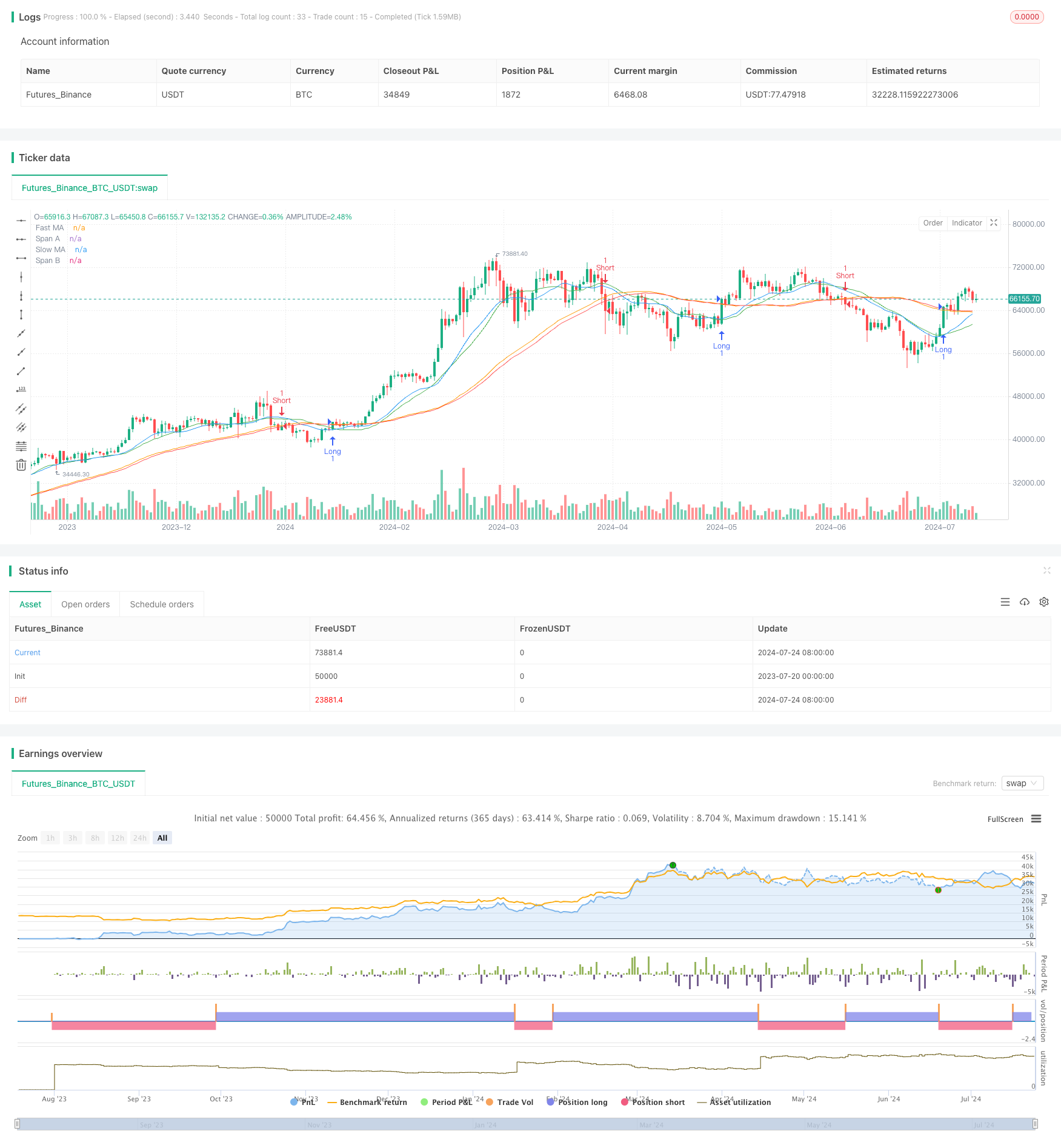
云层动量交叉策略结合均线与成交量确认是一种综合性的交易策略,结合了多个技术指标来识别潜在的交易机会。该策略主要利用一目云图、移动平均线和成交量指标来确定市场趋势和交易信号。策略的核心思想是在价格突破云层的同时,得到移动平均线和成交量的确认,从而增加交易信号的可靠性。
策略原理
-
一目云图组件:
- 转换线(Conversion Line):9周期的(最高价+最低价)/2的简单移动平均
- 基准线(Base Line):26周期的(最高价+最低价)/2的简单移动平均
- 先行带A(Leading Span A):(转换线+基准线)/2
- 先行带B(Leading Span B):52周期的(最高价+最低价)/2的简单移动平均
-
移动平均线:
- 快速移动平均线:20周期的收盘价简单移动平均
- 慢速移动平均线:50周期的收盘价简单移动平均
-
成交量确认:
- 当前成交量超过前一周期成交量的120%
-
交易信号:
- 做多条件:价格高于先行带A、快速移动平均线和慢速移动平均线,同时满足成交量确认
- 做空条件:价格低于先行带A、快速移动平均线和慢速移动平均线,同时满足成交量确认
策略优势
-
多重确认:结合了一目云图、移动平均线和成交量三个维度的确认,提高了交易信号的可靠性。
-
趋势跟踪:利用一目云图和移动平均线可以有效捕捉中长期趋势,减少假突破。
-
灵活性:通过调整各个指标的参数,可以适应不同的市场环境和交易品种。
-
成交量确认:加入成交量确认可以过滤掉一些虚假的突破信号,提高交易的成功率。
-
可视化:一目云图和移动平均线都可以直观地在图表上展示,便于交易者快速判断市场状况。
策略风险
-
滞后性:所有使用的指标都具有一定的滞后性,可能导致在快速变化的市场中错过一些交易机会。
-
假突破:尽管使用了多重确认,但在震荡市场中仍可能出现假突破信号。
-
参数敏感性:策略的表现可能对参数设置较为敏感,需要进行充分的回测和优化。
-
过度交易:在某些市场条件下,可能会产生过多的交易信号,增加交易成本。
-
市场适应性:该策略可能在趋势明显的市场中表现更好,而在震荡市场中效果可能不佳。
策略优化方向
-
动态参数调整:可以考虑根据市场波动率动态调整指标参数,以适应不同的市场环境。
-
加入止损和止盈:引入适当的止损和止盈机制,可以更好地控制风险和锁定利润。
-
时间过滤:可以加入时间过滤器,避免在市场开盘和收盘等波动较大的时间段进行交易。
-
趋势强度确认:可以引入ADX等趋势强度指标,只在趋势足够强时才进行交易。
-
多时间周期分析:结合更长的时间周期进行分析,以提高交易信号的可靠性。
-
加入其他技术指标:如RSI或MACD,进一步确认交易信号。
-
资金管理优化:根据不同的市场条件和信号强度,动态调整仓位大小。
总结
云层动量交叉策略结合均线与成交量确认是一个综合性的交易系统,通过结合一目云图、移动平均线和成交量指标,提供了一个相对可靠的交易框架。该策略的优势在于多重确认机制和趋势跟踪能力,但也面临着指标滞后和参数敏感性等挑战。通过进一步的优化,如动态参数调整、加入止损止盈机制和多时间周期分析等,可以增强策略的稳健性和适应性。交易者在使用此策略时,需要充分了解其原理和局限性,并根据具体的交易品种和市场环境进行适当的调整和优化。
||
Overview
The Cloud Momentum Crossover Strategy with Moving Averages and Volume Confirmation is a comprehensive trading approach that combines multiple technical indicators to identify potential trading opportunities. This strategy primarily utilizes Ichimoku Clouds, Moving Averages, and Volume indicators to determine market trends and generate trading signals. The core idea is to confirm price breakouts through the cloud with moving averages and volume confirmation, thereby increasing the reliability of trading signals.
Strategy Principle
-
Ichimoku Cloud Components:
- Conversion Line: 9-period Simple Moving Average (SMA) of (High + Low) / 2
- Base Line: 26-period SMA of (High + Low) / 2
- Leading Span A: (Conversion Line + Base Line) / 2
- Leading Span B: 52-period SMA of (High + Low) / 2
-
Moving Averages:
- Fast Moving Average: 20-period SMA of closing prices
- Slow Moving Average: 50-period SMA of closing prices
-
Volume Confirmation:
- Current volume exceeds 120% of the previous period's volume
-
Trading Signals:
- Long Entry: Price above Leading Span A, Fast MA, and Slow MA, with volume confirmation
- Short Entry: Price below Leading Span A, Fast MA, and Slow MA, with volume confirmation
Strategy Advantages
-
Multiple Confirmations: Combines Ichimoku Clouds, Moving Averages, and Volume for increased signal reliability.
-
Trend Following: Effectively captures medium to long-term trends using Ichimoku Clouds and Moving Averages, reducing false breakouts.
-
Flexibility: Adjustable parameters allow adaptation to various market conditions and trading instruments.
-
Volume Confirmation: Filters out potential false breakout signals, improving trade success rate.
-
Visualization: Ichimoku Clouds and Moving Averages provide clear visual representation on charts for quick market assessment.
Strategy Risks
-
Lag: All indicators used have inherent lag, potentially missing opportunities in rapidly changing markets.
-
False Breakouts: Despite multiple confirmations, false signals may still occur in choppy markets.
-
Parameter Sensitivity: Strategy performance may be sensitive to parameter settings, requiring thorough backtesting and optimization.
-
Overtrading: Certain market conditions may generate excessive trading signals, increasing transaction costs.
-
Market Adaptability: The strategy may perform better in trending markets and potentially underperform in ranging markets.
Strategy Optimization Directions
-
Dynamic Parameter Adjustment: Consider dynamically adjusting indicator parameters based on market volatility to adapt to different market environments.
-
Implement Stop-Loss and Take-Profit: Introduce appropriate stop-loss and take-profit mechanisms to better control risk and lock in profits.
-
Time Filtering: Add time filters to avoid trading during highly volatile market opening and closing periods.
-
Trend Strength Confirmation: Incorporate trend strength indicators like ADX to trade only when the trend is sufficiently strong.
-
Multi-Timeframe Analysis: Integrate analysis from longer timeframes to improve trading signal reliability.
-
Additional Technical Indicators: Consider adding RSI or MACD for further signal confirmation.
-
Position Sizing Optimization: Dynamically adjust position sizes based on market conditions and signal strength.
Conclusion
The Cloud Momentum Crossover Strategy with Moving Averages and Volume Confirmation is a comprehensive trading system that provides a relatively reliable trading framework by combining Ichimoku Clouds, Moving Averages, and Volume indicators. The strategy's strengths lie in its multiple confirmation mechanisms and trend-following capabilities, but it also faces challenges such as indicator lag and parameter sensitivity. Further optimization, including dynamic parameter adjustment, implementing stop-loss and take-profit mechanisms, and multi-timeframe analysis, can enhance the strategy's robustness and adaptability. Traders using this strategy should fully understand its principles and limitations, making appropriate adjustments and optimizations based on specific trading instruments and market environments.
[/trans]
Source (PineScript)
/*backtest
start: 2023-07-20 00:00:00
end: 2024-07-25 00:00:00
period: 1d
basePeriod: 1h
exchanges: [{"eid":"Futures_Binance","currency":"BTC_USDT"}]
*/

//@version=5
strategy("Ichimoku Clouds Strategy with Moving Averages and Volume Confirmation", overlay=true)

// Define input variables
conversion_period = input.int(9, title="Conversion Line Period")
base_period = input.int(26, title="Base Line Period")
span_b_period = input.int(52, title="Span B Period")
displacement = input.int(26, title="Displacement")
fast_ma_length = input.int(20, title="Fast MA Length")
slow_ma_length = input.int(50, title="Slow MA Length")
volume_threshold_percent = input.float(20, title="Volume Threshold (%)")

// Calculate Ichimoku Clouds
conversion_line = ta.sma((high + low) / 2, conversion_period)
base_line = ta.sma((high + low) / 2, base_period)
span_a = (conversion_line + base_line) / 2
span_b = ta.sma((high + low) / 2, span_b_period)

// Plot Ichimoku Clouds
plot(span_a, color=color.blue, title="Span A")
plot(span_b, color=color.red, title="Span B")

// Calculate moving averages
fast_ma = ta.sma(close, fast_ma_length)
slow_ma = ta.sma(close, slow_ma_length)

// Plot moving averages
plot(fast_ma, color=color.green, title="Fast MA")
plot(slow_ma, color=color.orange, title="Slow MA")

// Volume condition
volume_confirmation = volume > volume[1] * (1 + volume_threshold_percent / 100)

// Entry conditions
long_condition = close > span_a and close > fast_ma and close > slow_ma and volume_confirmation
short_condition = close < span_a and close < fast_ma and close < slow_ma and volume_confirmation

if (long_condition)
    strategy.entry("Long", strategy.long)
if (short_condition)
    strategy.entry("Short", strategy.short)
Detail
https://www.fmz.com/strategy/457812
Last Modified
2024-07-26 17:38:28