179 lines
9.9 KiB
Markdown
179 lines
9.9 KiB
Markdown

|
|
||
|
|
> Name
|
||
|
|
|
||
|
|
基于5日指数移动平均线的趋势追踪策略优化模型-5-Day-EMA-Based-Trend-Following-Strategy-Optimization-Model
|
||
|
|
|
||
|
|
> Author
|
||
|
|
|
||
|
|
ChaoZhang
|
||
|
|
|
||
|
|
> Strategy Description
|
||
|
|
|
||
|
|
|
||
|
|
|
||
|
|
[trans]
|
||
|
|
#### 概述
|
||
|
|
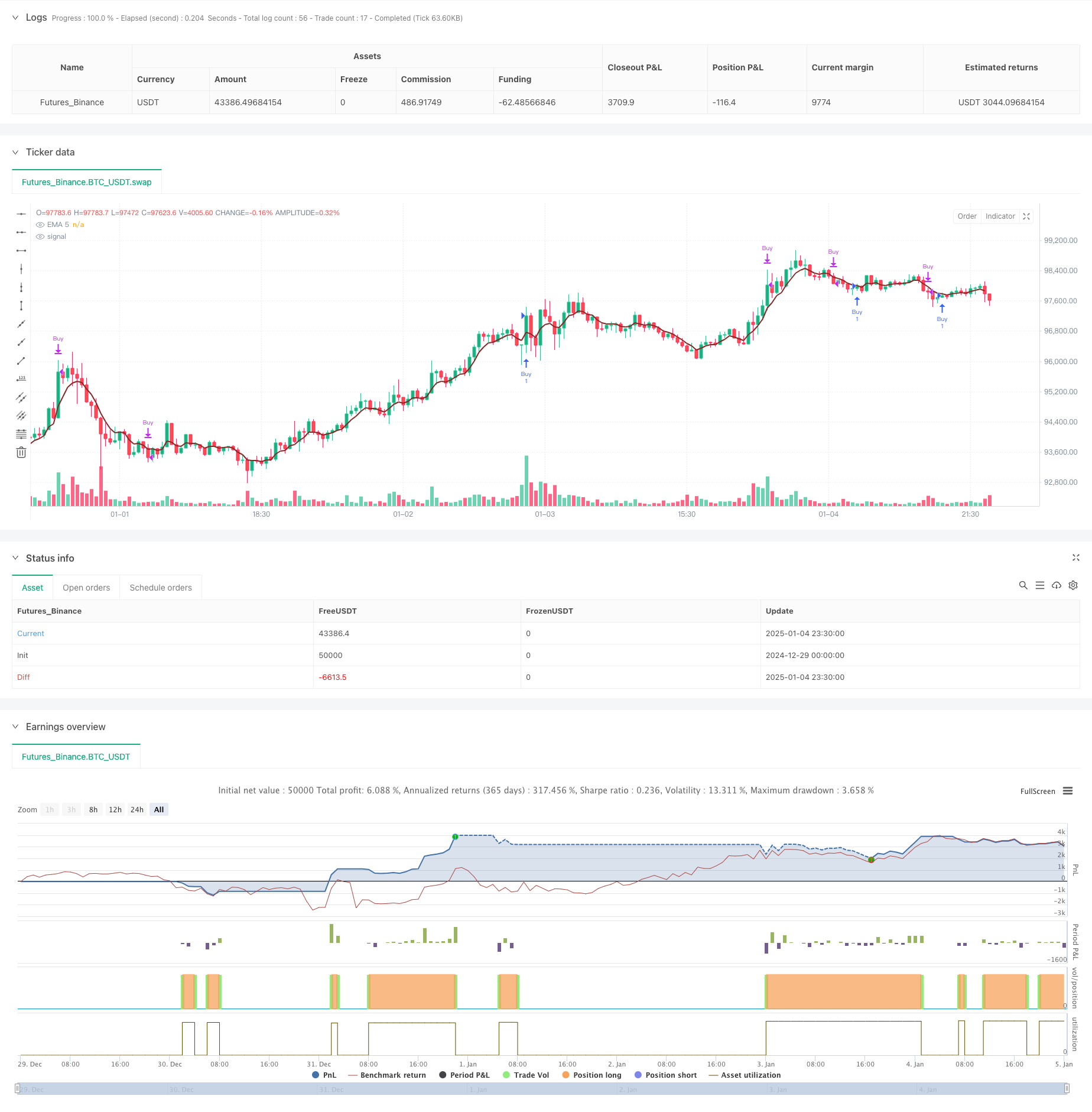
该策略是一个基于5日指数移动平均线(EMA)的趋势追踪交易系统,通过对价格与EMA的位置关系进行分析,结合止损和获利目标的动态调整,实现对市场趋势的把握。策略采用百分比仓位管理方式,并考虑了交易成本因素,具有较强的实用性和灵活性。
|
||
|
|
|
||
|
|
#### 策略原理
|
||
|
|
策略的核心逻辑基于价格与5日EMA的交互关系来判断入场时机。具体来说,当前一个周期的最高价低于EMA,且当前周期出现突破时,系统会发出做多信号。同时,策略还包含了可选的附加条件,即要求收盘价高于前一周期,以增加信号的可靠性。对于风险控制,策略提供了两种止损方式:基于前期低点的动态止损,以及基于固定点数的止损。获利目标则基于风险收益比来动态设定,保证了交易的收益潜力。
|
||
|
|
|
||
|
|
#### 策略优势
|
||
|
|
1. 趋势把握能力强:通过EMA与价格的配合,能够有效捕捉趋势的起始阶段。
|
||
|
|
2. 风险控制完善:提供灵活的止损选项,既可以使用固定点数止损,也可以使用动态止损。
|
||
|
|
3. 收益目标合理:基于风险收益比设定获利目标,确保每笔交易都具有足够的盈利空间。
|
||
|
|
4. 交易成本考虑充分:在策略中加入了交易成本的计算,更符合实际交易环境。
|
||
|
|
5. 参数灵活可调:关键参数如止损距离、风险收益比等都可以根据不同市场条件进行调整。
|
||
|
|
|
||
|
|
#### 策略风险
|
||
|
|
1. 假突破风险:在震荡市场中可能会出现假突破信号,导致止损出场。
|
||
|
|
2. 滑点影响:在波动剧烈的市场中,实际成交价格可能与信号价格有较大偏差。
|
||
|
|
3. EMA滞后性:作为移动平均指标,EMA具有一定的滞后性,可能导致入场时机略有延迟。
|
||
|
|
4. 资金管理风险:固定百分比仓位管理在连续亏损时可能导致资金回撤过大。
|
||
|
|
|
||
|
|
#### 策略优化方向
|
||
|
|
1. 多周期确认:可以添加更长周期的趋势确认,如增加20日EMA作为趋势方向过滤器。
|
||
|
|
2. 波动率适应:引入ATR指标来动态调整止损和获利目标,使策略更好地适应不同的市场波动环境。
|
||
|
|
3. 仓位优化:可以根据市场波动率和信号强度来动态调整仓位大小,提高资金使用效率。
|
||
|
|
4. 时间过滤:添加时间过滤条件,避免在市场开盘和收盘等波动较大的时段进行交易。
|
||
|
|
5. 市场环境识别:增加市场环境判断机制,在不同的市场状态下采用不同的参数设置。
|
||
|
|
|
||
|
|
#### 总结
|
||
|
|
这是一个设计合理、逻辑清晰的趋势追踪策略,通过EMA指标和价格行为的结合,能够有效捕捉市场趋势。策略在风险控制和收益管理方面都有较为完善的机制,同时提供了多个可优化的方向,具有较强的实用价值和改进空间。后续可以通过添加多周期分析、调整止损机制等方式来进一步提升策略的稳定性和盈利能力。 ||
|
||
|
|
|
||
|
|
#### Overview
|
||
|
|
This strategy is a trend-following trading system based on the 5-day Exponential Moving Average (EMA), which analyzes the relationship between price and EMA to capture market trends. The strategy incorporates dynamic adjustment of stop-loss and profit targets, uses percentage-based position management, and considers transaction costs, making it highly practical and flexible.
|
||
|
|
|
||
|
|
#### Strategy Principle
|
||
|
|
The core logic is based on the interaction between price and 5-day EMA to determine entry points. Specifically, a long signal is generated when the previous period's high is below the EMA and the current period shows a breakthrough. The strategy also includes an optional additional condition requiring the closing price to be higher than the previous period to increase signal reliability. For risk control, the strategy offers two types of stop-loss methods: dynamic stop-loss based on previous lows and fixed-point stop-loss. Profit targets are dynamically set based on the risk-reward ratio to ensure trading profit potential.
|
||
|
|
|
||
|
|
#### Strategy Advantages
|
||
|
|
1. Strong trend capture capability: Effectively captures trend initiation phases through the combination of EMA and price action.
|
||
|
|
2. Comprehensive risk control: Provides flexible stop-loss options, including both fixed-point and dynamic stop-loss methods.
|
||
|
|
3. Reasonable profit targets: Sets profit objectives based on risk-reward ratio, ensuring sufficient profit potential for each trade.
|
||
|
|
4. Thorough consideration of transaction costs: Incorporates trading cost calculations, better reflecting real trading conditions.
|
||
|
|
5. Flexible parameters: Key parameters such as stop-loss distance and risk-reward ratio can be adjusted according to different market conditions.
|
||
|
|
|
||
|
|
#### Strategy Risks
|
||
|
|
1. False breakout risk: May generate false breakout signals in choppy markets, leading to stop-loss exits.
|
||
|
|
2. Slippage impact: Actual execution prices may significantly deviate from signal prices in volatile markets.
|
||
|
|
3. EMA lag: As a moving average indicator, EMA has inherent lag, potentially causing delayed entries.
|
||
|
|
4. Money management risk: Fixed percentage position sizing may lead to excessive drawdowns during consecutive losses.
|
||
|
|
|
||
|
|
#### Strategy Optimization Directions
|
||
|
|
1. Multi-timeframe confirmation: Add longer-period trend confirmation, such as incorporating 20-day EMA as a trend direction filter.
|
||
|
|
2. Volatility adaptation: Introduce ATR indicator to dynamically adjust stop-loss and profit targets for better adaptation to different market volatility environments.
|
||
|
|
3. Position optimization: Dynamically adjust position sizes based on market volatility and signal strength to improve capital efficiency.
|
||
|
|
4. Time filtering: Add time-based filters to avoid trading during highly volatile market opening and closing periods.
|
||
|
|
5. Market environment recognition: Implement market condition identification mechanisms to use different parameter settings in different market states.
|
||
|
|
|
||
|
|
#### Summary
|
||
|
|
This is a well-designed trend-following strategy with clear logic, effectively capturing market trends through the combination of EMA indicator and price action. The strategy has comprehensive mechanisms for risk control and profit management while offering multiple optimization directions, demonstrating strong practical value and room for improvement. Future enhancements can focus on adding multi-timeframe analysis and adjusting stop-loss mechanisms to further improve strategy stability and profitability.[/trans]
|
||
|
|
|
||
|
|
|
||
|
|
|
||
|
|
> Source (PineScript)
|
||
|
|
|
||
|
|
``` pinescript
|
||
|
|
/*backtest
|
||
|
|
start: 2024-12-29 00:00:00
|
||
|
|
end: 2025-01-05 00:00:00
|
||
|
|
period: 30m
|
||
|
|
basePeriod: 30m
|
||
|
|
exchanges: [{"eid":"Futures_Binance","currency":"BTC_USDT"}]
|
||
|
|
*/
|
||
|
|
|
||
|
|
//@version=5
|
||
|
|
strategy("Demo GPT - PowerOfStocks 5EMA", overlay=true)
|
||
|
|
|
||
|
|
// Inputs
|
||
|
|
enableSL = input.bool(false, title="Enable Extra SL")
|
||
|
|
usl = input.int(defval=5, title="SL Distance in Points", minval=1, maxval=100)
|
||
|
|
riskRewardRatio = input.int(defval=3, title="Risk to Reward Ratio", minval=3, maxval=25)
|
||
|
|
showSell = input.bool(true, title="Show Sell Signals")
|
||
|
|
showBuy = input.bool(true, title="Show Buy Signals")
|
||
|
|
buySellExtraCond = input.bool(false, title="Buy/Sell with Extra Condition")
|
||
|
|
startDate = input(timestamp("2018-01-01 00:00"), title="Start Date")
|
||
|
|
endDate = input(timestamp("2069-12-31 23:59"), title="End Date")
|
||
|
|
|
||
|
|
// EMA Calculation
|
||
|
|
ema5 = ta.ema(close, 5)
|
||
|
|
|
||
|
|
// Plot EMA
|
||
|
|
plot(ema5, "EMA 5", color=color.new(#882626, 0), linewidth=2)
|
||
|
|
|
||
|
|
// Variables for Buy
|
||
|
|
var bool longTriggered = na
|
||
|
|
var float longStopLoss = na
|
||
|
|
var float longTarget = na
|
||
|
|
|
||
|
|
// Variables for Sell (used for signal visualization but no actual short trades)
|
||
|
|
var bool shortTriggered = na
|
||
|
|
var float shortStopLoss = na
|
||
|
|
var float shortTarget = na
|
||
|
|
|
||
|
|
// Long Entry Logic
|
||
|
|
if true
|
||
|
|
if (showBuy)
|
||
|
|
longCondition = high[1] < ema5[1] and high[1] < high and (not buySellExtraCond or close > close[1])
|
||
|
|
if (longCondition and not longTriggered)
|
||
|
|
entryPrice = high[1]
|
||
|
|
stopLoss = enableSL ? low[1] - usl * syminfo.mintick : low[1]
|
||
|
|
target = enableSL ? entryPrice + (entryPrice - stopLoss) * riskRewardRatio : high[1] + (high[1] - low[1]) * riskRewardRatio
|
||
|
|
|
||
|
|
// Execute Buy Order
|
||
|
|
strategy.entry("Buy", strategy.long, stop=entryPrice)
|
||
|
|
|
||
|
|
longTriggered := true
|
||
|
|
longStopLoss := stopLoss
|
||
|
|
longTarget := target
|
||
|
|
|
||
|
|
label.new(bar_index, entryPrice, text="Buy@ " + str.tostring(entryPrice), style=label.style_label_up, color=color.green, textcolor=color.white)
|
||
|
|
|
||
|
|
// Short Signal Logic (Visual Only)
|
||
|
|
if (true)
|
||
|
|
if (showSell)
|
||
|
|
shortCondition = low[1] > ema5[1] and low[1] > low and (not buySellExtraCond or close < close[1])
|
||
|
|
if (shortCondition and not shortTriggered)
|
||
|
|
entryPrice = low[1]
|
||
|
|
stopLoss = enableSL ? high[1] + usl * syminfo.mintick : high[1]
|
||
|
|
target = enableSL ? entryPrice - (stopLoss - entryPrice) * riskRewardRatio : low[1] - (high[1] - low[1]) * riskRewardRatio
|
||
|
|
|
||
|
|
// Visual Signals Only
|
||
|
|
label.new(bar_index, entryPrice, text="Sell@ " + str.tostring(entryPrice), style=label.style_label_down, color=color.red, textcolor=color.white)
|
||
|
|
|
||
|
|
shortTriggered := true
|
||
|
|
shortStopLoss := stopLoss
|
||
|
|
shortTarget := target
|
||
|
|
|
||
|
|
// Exit Logic for Buy
|
||
|
|
if longTriggered
|
||
|
|
// Stop-loss Hit
|
||
|
|
if low <= longStopLoss
|
||
|
|
strategy.close("Buy", comment="SL Hit")
|
||
|
|
longTriggered := false
|
||
|
|
|
||
|
|
// Target Hit
|
||
|
|
if high >= longTarget
|
||
|
|
strategy.close("Buy", comment="Target Hit")
|
||
|
|
longTriggered := false
|
||
|
|
|
||
|
|
// Exit Logic for Short (Signals Only)
|
||
|
|
if shortTriggered
|
||
|
|
// Stop-loss Hit
|
||
|
|
if high >= shortStopLoss
|
||
|
|
shortTriggered := false
|
||
|
|
// Target Hit
|
||
|
|
if low <= shortTarget
|
||
|
|
shortTriggered := false
|
||
|
|
|
||
|
|
```
|
||
|
|
|
||
|
|
> Detail
|
||
|
|
|
||
|
|
https://www.fmz.com/strategy/477512
|
||
|
|
|
||
|
|
> Last Modified
|
||
|
|
|
||
|
|
2025-01-06 10:54:42
|